
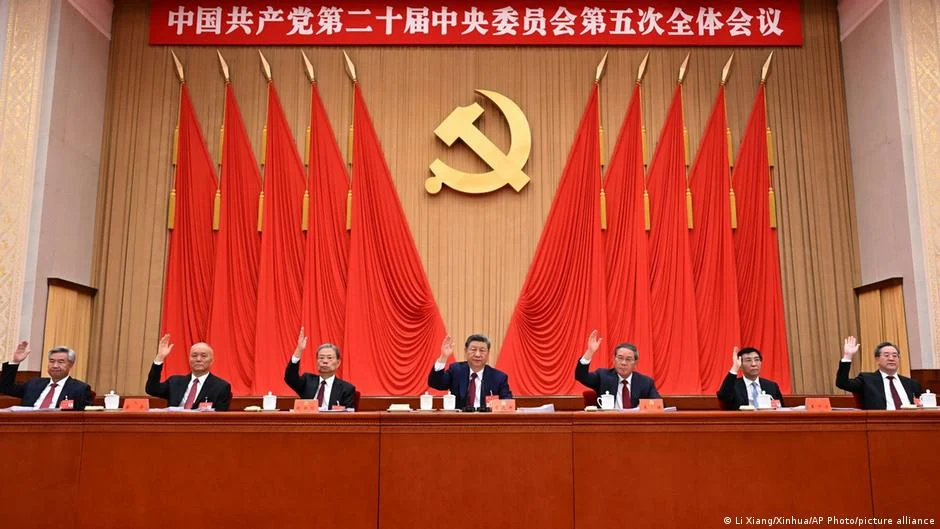
The top echelon of the Chinese Communist Party (CCP) concluded a high-stakes, four-day plenary session in Beijing this week, signaling a renewed and aggressive push for ideological conformity and iron-clad administrative discipline. As the ruling party navigates a complex web of internal economic pressures and a precarious international environment, General Secretary Xi Jinping has reaffirmed his mandate to root out dissent, eliminate "two-faced" officials, and consolidate his authority across all levels of the state apparatus.
The resolution issued following the closed-door meetings emphasizes the necessity of "comprehensive and strict Party leadership." By framing the current political climate as a test of "political courage," the CCP leadership has effectively signaled that individual initiative—while officially encouraged for the purpose of policy implementation—must never deviate from the central agenda dictated by Beijing.
A Chronology of Consolidation: From 2012 to the Present
To understand the current obsession with discipline, one must look at the evolution of Xi Jinping’s governance since he assumed power in 2012.
- 2012–2017 (The Foundation): Upon taking office, Xi launched a massive anti-corruption campaign, colloquially known as "taming the tigers and flies." This period saw the purging of high-ranking officials, including Zhou Yongkang and Bo Xilai, which effectively neutralized competing power bases within the CCP.
- 2018 (Institutionalizing Power): In a historic constitutional shift, the National People’s Congress voted to abolish presidential term limits. This maneuver cleared the path for Xi to remain in power indefinitely, fundamentally altering the collective leadership model that had characterized Chinese politics since the post-Mao era.
- 2022 (The Third Term): During the 20th Party Congress, Xi secured a precedent-breaking third term as General Secretary, signaling that his vision of "socialism with Chinese characteristics for a new era" would be the guiding light for the next decade.
- 2024–2025 (The Era of "Strict Governance"): The current focus has shifted from simple anti-corruption to "political loyalty." Recent directives have specifically targeted cadres who pay lip service to the central government while failing to act or, worse, pursuing independent agendas.
The Anatomy of Internal Pressure
The CCP’s internal documents, including recent speeches published in Qiushi, characterize "two-faced" officials as the greatest threat to national stability. These individuals are described as those who demonstrate performative loyalty while harboring "individualistic" goals that conflict with the collective interests of the Party.
Kerry Brown, head of the Lau China Institute at King’s College London, suggests that this is a defensive mechanism. "If the CCP isn’t disciplined and united, the party believes that it will go the same way as everywhere else in the world at the moment and become disunited and unstable," Brown observed. For the current leadership, the perceived chaos in Western democracies—marked by political polarization and legislative gridlock—serves as a cautionary tale. The CCP’s internal mantra remains that the "China model" is superior precisely because it avoids the friction of pluralism.
Economic Context and the Burden of Implementation
China’s current economic climate adds a layer of urgency to these political maneuvers. With growth rates cooling significantly compared to the high-octane expansions of the early 2000s, the CCP faces the dual challenge of reviving the property sector, addressing local government debt, and managing high youth unemployment.
Data from the National Bureau of Statistics (NBS) underscores the difficulty of this transition. Consumer confidence remains historically low, and the private sector—the traditional engine of China’s growth—has expressed concerns regarding the regulatory unpredictability of the last three years.
By demanding "proactivity" from officials, Xi is attempting to force local governments to solve regional economic problems without increasing the central government’s fiscal burden. However, this creates a structural paradox. If officials are punished for even minor deviations from the central line, they become hyper-cautious, often opting for inaction over risk-taking. As Chong Ja Ian, a political scientist at the National University of Singapore, notes, "The ‘proactivity’ demanded by Xi is limited to the implementation, not decision-making." This creates a bottleneck where local officials wait for detailed instructions from Beijing before acting, slowing the response time to localized economic crises.
The Succession Dilemma
The absence of a clear successor is perhaps the most significant point of concern for international observers. In the past, the CCP utilized a "successor-in-waiting" model, where a future leader would be appointed to the Politburo Standing Committee years before taking the reins. This ensured a degree of predictability and prevented power vacuums.
Under Xi, this tradition has been discarded. While this allows for greater short-term unity and reduces the likelihood of internal factions coalescing around an alternative figure, it carries long-term risks. History suggests that the lack of a transparent succession plan can lead to sudden, violent shifts in leadership or institutional paralysis during moments of crisis.
For now, at age 73, Xi shows no signs of stepping back. His consolidation of power within the military and the security apparatus suggests that his influence will persist well into the next decade. Observers anticipate that he will likely be confirmed for another term in the coming years, maintaining the trajectory of a centralized, party-first state.
Implications for the Global Order
The international community, particularly the United States and its allies, views these internal developments with caution. The tightening of discipline within the CCP is often mirrored by a more assertive foreign policy. When a government feels internally vulnerable, it often projects strength externally to bolster domestic legitimacy.
The emphasis on "strict leadership" also impacts international business. As multinational corporations navigate the "de-risking" strategies and stricter data compliance laws in China, they are forced to deal with a bureaucracy that is increasingly driven by political ideological compliance rather than market-driven logic. The "two-faced" label, once reserved for political rivals, is now being applied more broadly to bureaucrats who fail to enforce the state’s increasingly complex regulatory requirements.
Conclusion: A High-Stakes Balancing Act
The CCP’s recent session underscores a fundamental shift in the party’s philosophy: it no longer seeks to merely manage the state; it seeks to permeate every layer of it with absolute loyalty. While this may provide a temporary shield against instability, it creates a rigid system that may struggle to adapt to the fluid and unpredictable nature of the global economy.
As the party prepares for the future, the primary challenge remains the same one that has defined the Xi era: how to maintain total control while simultaneously fostering the dynamism required to prevent economic stagnation. By prioritizing unity above all else, the leadership has ensured that the party will face its challenges as a monolith, but it has also ensured that there is no room for error, and no clear mechanism for self-correction if that monolithic path leads to a dead end. For now, the Party maintains that this path is the only one that ensures the survival of the state in a "messy" world—a gamble that will define the trajectory of China for years to come.

