
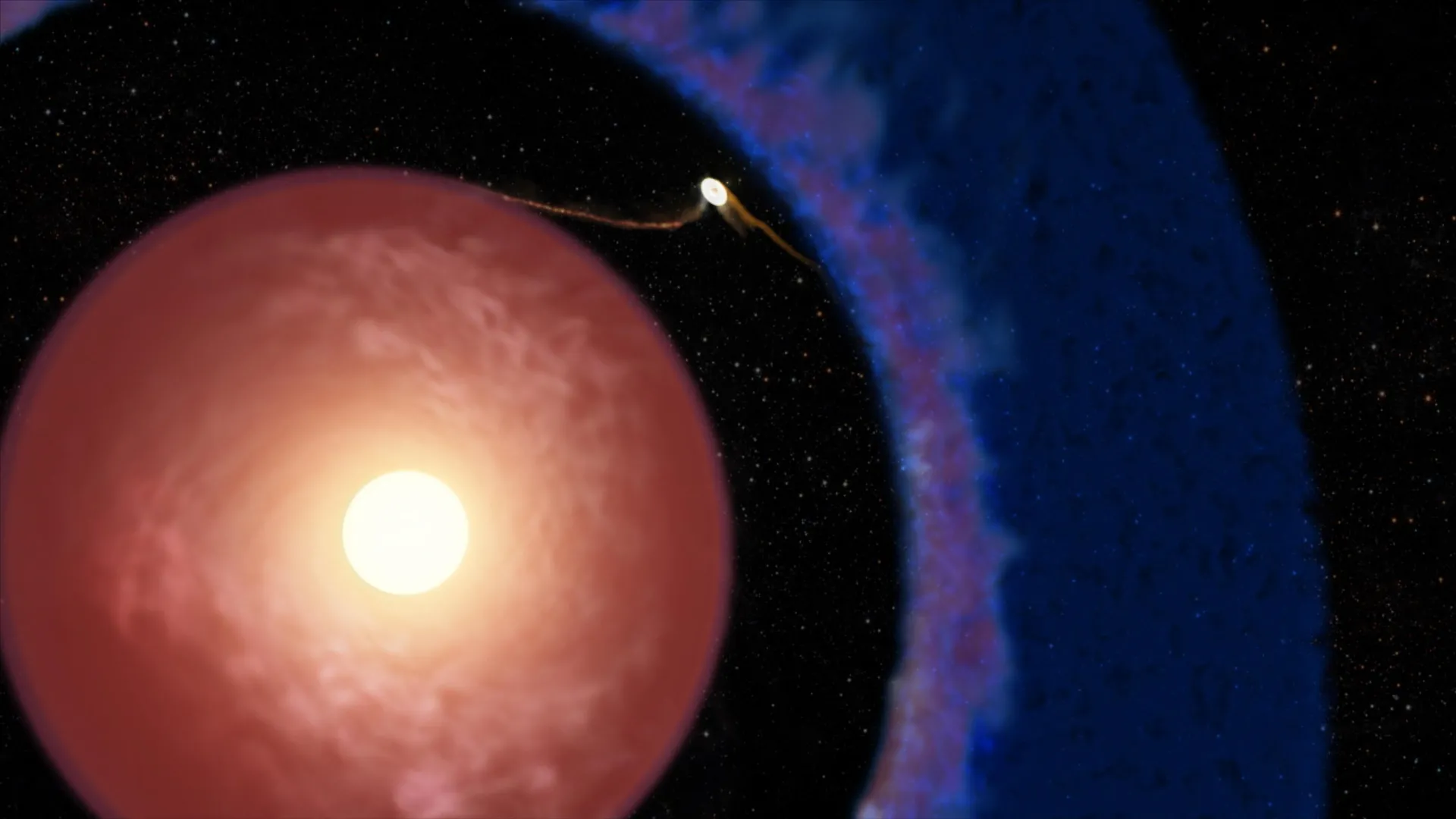
In a landmark discovery that fundamentally challenges existing theories of planetary evolution, an international team of researchers has confirmed the existence of Elias 2-24 b, the youngest exoplanet ever identified. At less than one million years old—a mere blink of an eye in astronomical terms—this infant world is still enveloped in the primordial shroud of gas and dust from which it was born. The findings, published on September 16 in The Astrophysical Journal Letters, provide an unprecedented window into the chaotic, high-energy environment of a nascent solar system, forcing a major re-evaluation of how quickly gas giants can form in the deep reaches of space.
The Anatomy of a Celestial Discovery
The discovery of Elias 2-24 b was not the result of a single, sudden observation, but rather the culmination of a decade-long scientific investigation that bridged data from multiple observatories. The object, which possesses a mass roughly equivalent to that of Jupiter, orbits its host star at a distance approximately 55 times greater than the distance between Earth and the Sun. Located 450 light-years away, the planet resides within a dense debris disk of ice, rock, and gas—a classic signpost of active planet formation.
The team, led by Andrea Bernardi, a doctoral candidate at the Universidad Diego Portales in Chile, utilized high-resolution data from the W. M. Keck Observatory in Hawaii. By employing a coronagraph—a specialized instrument that masks the blinding glare of a central star—astronomers were able to isolate the faint, infrared signature of the forming planet. This technical feat allowed researchers to distinguish the planet from the scattered light of the disk, effectively peeling back the curtain on a process that usually remains hidden behind a thick veil of dust.
A Chronology of the Investigation
The history of Elias 2-24 b is a testament to the power of archival data in modern astrophysics. The mystery began roughly ten years ago when the Atacama Large Millimeter/submillimeter Array (ALMA) in Chile first detected a distinct gap in the dusty disk surrounding the star Elias 2-24. In the scientific community, such gaps are considered "smoking guns" for the presence of a planet, as a forming world acts like a cosmic snowplow, clearing a path through the orbital debris as it gathers mass.
Following the ALMA data, researchers using the European Southern Observatory’s Very Large Telescope (VLT) identified a faint point of light within that gap. However, the discovery remained tentative for years. To confirm the object’s identity, Bernardi and his colleagues turned to the Keck Observatory Archive—a collaborative effort between NASA and the California Institute of Technology. By comparing archival observations captured in 2018 and 2020, the team successfully tracked the object’s orbital motion. Its trajectory, consistent with a body orbiting the star rather than a static background object, provided the definitive proof needed to classify it as an exoplanet.
Challenging the Standard Model of Planet Formation
The existence of Elias 2-24 b presents a profound theoretical dilemma. Standard models of planet formation, derived from decades of computer simulations and observations of our own solar system, suggest that a gas giant of Jupiter’s scale requires significant time to accumulate enough material to reach its final mass. Specifically, current models posit that forming a giant planet at a distance similar to Jupiter’s orbit (roughly five astronomical units from the Sun) requires approximately five million years.
Elias 2-24 b, however, has achieved its massive state in under one million years, and it is located much further out from its host star than our own Jupiter. Physics suggests that at such vast distances, the density of gas and dust is significantly lower, which should logically slow down the accretion process. The fact that Elias 2-24 b exists in its current state suggests that our current understanding of accretion—the process by which planets grow—is incomplete.
"Our planet-formation models already struggled to explain the previous record holders, such as the planets orbiting PDS 70 and WISPIT 2, which are all more than 5 million years old," noted Lucas Cieza, a professor at the Instituto de Estudios Astrofísicos and co-author of the study. "Elias 2-24 b demonstrates that there are significant, missing processes in our current models of how matter aggregates in the early stages of a star system’s life."
The Observational Gap in Exoplanet Science
To date, astronomers have confirmed the existence of over 6,000 exoplanets. However, the vast majority of these discoveries have been made using the "transit method." This technique relies on detecting a temporary dip in a star’s brightness as a planet passes in front of it. While highly effective, the transit method is inherently biased toward planets that are older, closer to their host stars, and lacking in obscuring debris.
As a result, scientists have been largely "blind" to the earliest stages of planetary development. Young stars are often surrounded by thick, opaque disks of dust that hide the internal architecture of the system. Finding a planet like Elias 2-24 b is a rare stroke of luck that provides a "ground truth" for theoretical physicists. It serves as a necessary reality check, forcing researchers to reconcile their mathematical models with the messy, tangible reality of a developing solar system.
The Future of Planet Hunting: The Roman Space Telescope
The confirmation of Elias 2-24 b is viewed by the scientific community as a herald of a new era. The challenges encountered by Bernardi’s team—namely the difficulty of distinguishing faint objects from the glare of a star—are set to be addressed by next-generation technology.
The Nancy Grace Roman Space Telescope, which launched in late 2024, is equipped with an advanced coronagraph specifically designed to overcome the limitations faced by current ground-based observatories. While Elias 2-24 b orbits its star at a great distance, the Roman telescope is engineered to detect planets in much tighter orbits, potentially allowing scientists to observe true "Jupiter analogs"—planets that occupy the same relative position as our own gas giant.
By pushing the boundaries of what is observable, the Roman mission aims to bridge the observational gap that has long hindered the study of early-stage planets. According to Cieza, the goal is to observe the entire lifecycle of planetary systems, from the collapse of a molecular cloud to the stabilization of mature, orbiting worlds.
Broader Implications for Galactic Evolution
The discovery of Elias 2-24 b does more than just update a textbook; it provides a direct comparison to our own history. By studying a system that is still in its infancy, astronomers are effectively looking back at the "infant" version of our own solar system as it might have appeared four and a half billion years ago.
This research underscores the dynamic nature of our galaxy. The Milky Way is a prolific factory of stars and planets, operating in a continuous cycle of birth and evolution. However, capturing these systems in the act of formation is notoriously difficult. The success of the team at the Keck Observatory highlights the necessity of collaborative science—where archival data, modern computational techniques, and multi-telescope coordination are synthesized to solve long-standing cosmic mysteries.
As astronomers move forward, the focus will shift from simply finding planets to understanding the specific mechanisms that allow them to coalesce so rapidly in the cold, sparse reaches of the outer disk. For now, Elias 2-24 b stands as a singular, essential data point—a reminder that the universe is far more efficient at building worlds than our current theories ever dared to imagine. As researchers continue to analyze the data, the lessons learned from this infant planet will undoubtedly refine our models, bringing us closer to answering the fundamental question of how our own world—and the countless others like it—came to be.

