
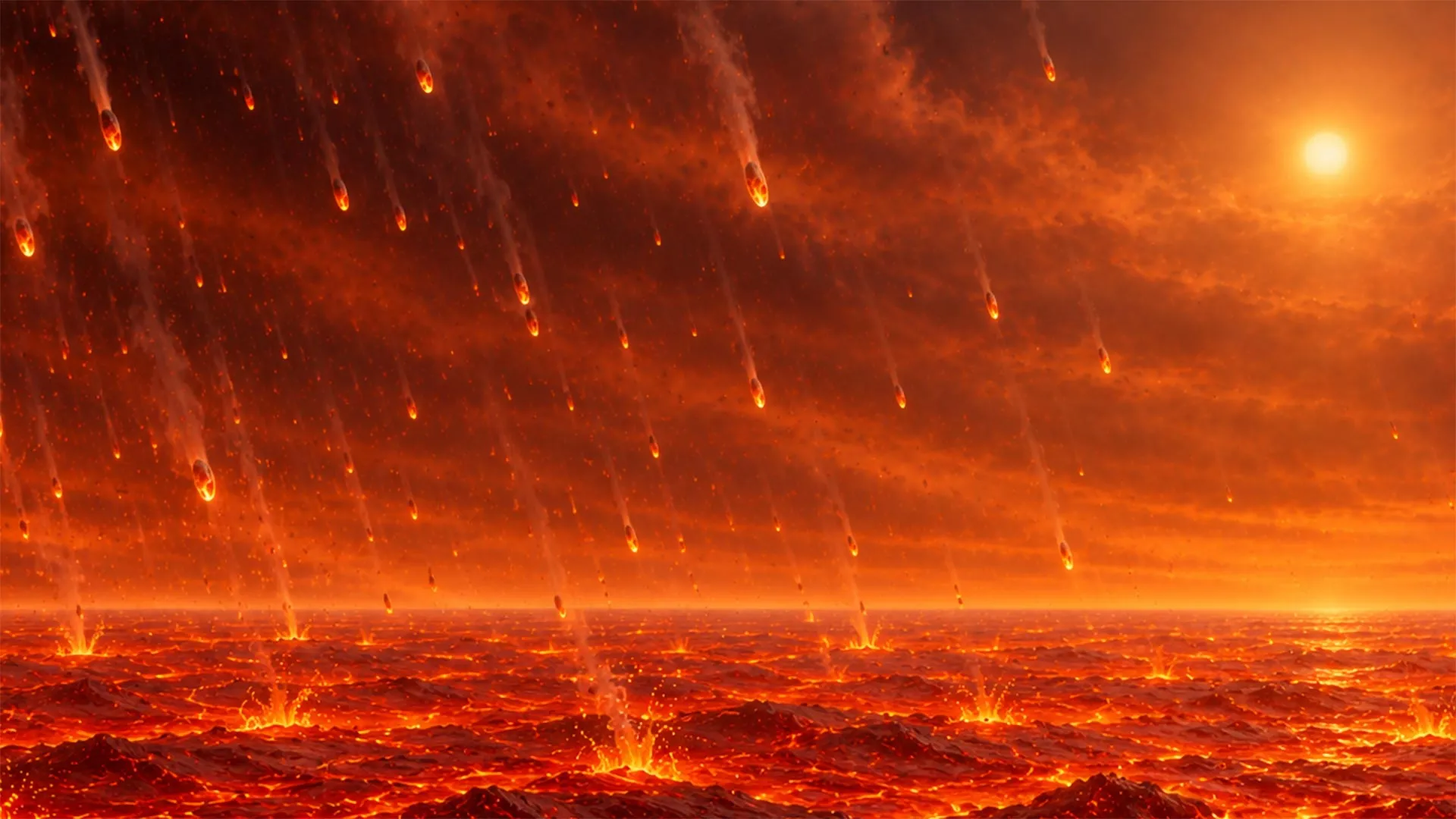
This radical shift in planetary science, detailed in a study recently published in the journal Nature Geoscience, challenges the long-standing consensus that Earth’s vast oceans were primarily "delivered" by icy celestial bodies. Instead, researchers from The University of New Mexico propose that the early Earth acted as a chemical factory, synthesizing its own water through intense, high-temperature interactions between rocky material and a primordial, hydrogen-rich atmosphere.
The Traditional Paradigm: The Delivery Hypothesis
For decades, the prevailing narrative regarding the origins of Earth’s hydrosphere has been one of external delivery. Astronomers and geochemists have theorized that the early Earth was a dry, desolate rock, lacking the volatile elements necessary to host liquid water. According to this model, during the "Late Heavy Bombardment"—a period roughly 4.1 to 3.8 billion years ago—the planet was struck by a barrage of carbonaceous chondrite meteorites and icy comets from the outer solar system.
These objects, rich in volatiles, are thought to have deposited the water that eventually formed the oceans. However, this theory has long been plagued by discrepancies in isotopic signatures. Specifically, the ratio of deuterium to hydrogen in Earth’s oceans does not always align perfectly with the signatures found in many studied comets. Furthermore, the mechanics of transporting enough water-rich material across vast distances of space to cover 71 percent of the Earth’s surface in water has remained a complex hurdle for planetary modelers.
A New Chemical Mechanism: The Pebble Accretion Model
The research team, led by graduate student Susmita Garai and guided by Professor Zachary Sharp, director of Earth and Planetary Sciences at the University of New Mexico, turned their focus to a more recent concept in planetary science: "pebble accretion." This theory posits that planets grow by sweeping up small, pebble-sized particles from the protoplanetary disk.
As these pebbles accumulated to build the proto-Earth, the planet’s gravity pulled in a thick, dense atmosphere. In the high-pressure, high-temperature environment of this nascent world—where temperatures reached between 1,200 and 1,400 degrees Celsius—the interaction between falling rocky debris and the hydrogen-rich atmosphere would have been violent and transformative.
The core of the discovery lies in a reduction reaction. Silicate rocks, which make up the bulk of planetary crusts, contain iron oxide. When these rocks passed through a hydrogen-rich atmosphere at extreme temperatures, the hydrogen effectively "stripped" the oxygen from the iron oxide. This process converted the iron oxide into metallic iron and released water vapor as a byproduct.
Experimental Validation
To prove this hypothesis, the team conducted a series of rigorous laboratory experiments designed to replicate the hellish conditions of the Hadean Eon. By exposing silicate samples to flowing hydrogen gas at temperatures exceeding 1,200 degrees Celsius, the researchers observed the chemical transformation in real-time.
The results were statistically significant. Within minutes, approximately 80 percent of the iron oxide in the silicate samples had been converted into metallic iron, with a corresponding release of water vapor. To ensure the result was specifically due to the presence of hydrogen, the team conducted control experiments using helium. In the helium environment, no such reduction occurred, confirming that the chemical reaction was indeed fueled by the interaction between the rock and the hydrogen gas.
The speed and efficiency of this reaction were unexpected. Previous models of water delivery focused on a slow, protracted accumulation over millions of years. This new mechanism, however, suggests that water production could have been rapid and prolific. Extrapolating their findings to the scale of a planetary formation event, the researchers estimated that the process could have generated hundreds of oceans’ worth of water during the Earth’s formative stages.
Chronology of Earth’s Formation
Understanding this timeline is critical to interpreting the findings. The Earth is estimated to have formed approximately 4.54 billion years ago.
- 4.54 Billion Years Ago: Initial accretion of rocky material begins.
- 4.5 Billion Years Ago: Formation of the proto-Earth; development of a hydrogen-rich atmosphere.
- 4.5 – 4.4 Billion Years Ago: The "Pebble Accretion" phase where the identified chemical reaction would have been at its most active, producing massive quantities of water vapor that later condensed into the first oceans.
- 4.4 – 3.8 Billion Years Ago: Stabilization of the crust and the potential secondary contribution of water from late-stage asteroid impacts.
By suggesting that water was produced early in this cycle, the researchers provide a mechanism that accounts for the presence of water even before the "Late Heavy Bombardment" began, potentially explaining how Earth could have hosted liquid water shortly after its formation.
Broader Implications for Exoplanetary Habitability
The implications of this study extend well beyond our own solar system. If the production of water is a fundamental byproduct of planet formation—a "built-in" feature of rocky worlds growing in hydrogen-rich environments—then the statistical likelihood of finding habitable planets elsewhere in the universe increases exponentially.
"Virtually any Earth-sized planet should have water by this newly identified mechanism," Professor Sharp noted in his discussion of the findings. This suggests that the "Goldilocks Zone"—the region around a star where liquid water can exist—might be more densely populated with actual water than previously estimated. If rocky planets do not need to rely on the "luck" of asteroid or comet impacts to gain their water, then the search for extraterrestrial life could be significantly broadened to include a wider array of planetary systems.
Critical Analysis and Future Research
While the findings are compelling, they do not entirely invalidate the role of asteroids and comets. Scientific consensus is rarely binary, and it is likely that Earth’s water inventory is a composite of multiple sources. The next phase of research will need to quantify the specific isotopic contributions of this chemical production versus those of extraterrestrial delivery.
Furthermore, the study assumes that all young rocky planets possess a hydrogen-rich atmosphere. While this is common in the early stages of planetary growth, the rate at which a planet loses its atmosphere—and thus the duration of this water-making process—varies based on the star’s radiation and the planet’s mass.
Independent experts have noted that the work of Susmita Garai and her colleagues represents a significant leap forward in the field of cosmochemistry. By shifting the focus from "delivery" to "production," the team has provided a new, robust framework for understanding the volatile evolution of terrestrial planets.
As the scientific community continues to analyze these results, the focus will likely turn to the James Webb Space Telescope and other advanced observatories. By observing the atmospheres of young, forming planets in other solar systems, astronomers may be able to detect the signature of this process in real-time, effectively watching the birth of oceans on worlds trillions of miles away.
In conclusion, the research conducted at The University of New Mexico does not just rewrite the history of our oceans; it offers a compelling argument that water is a natural, perhaps even inevitable, consequence of the planetary formation process. If the Earth created its own oceans from its own building blocks, it stands to reason that the universe is far wetter, and perhaps far more alive, than humanity has ever dared to hope.

