
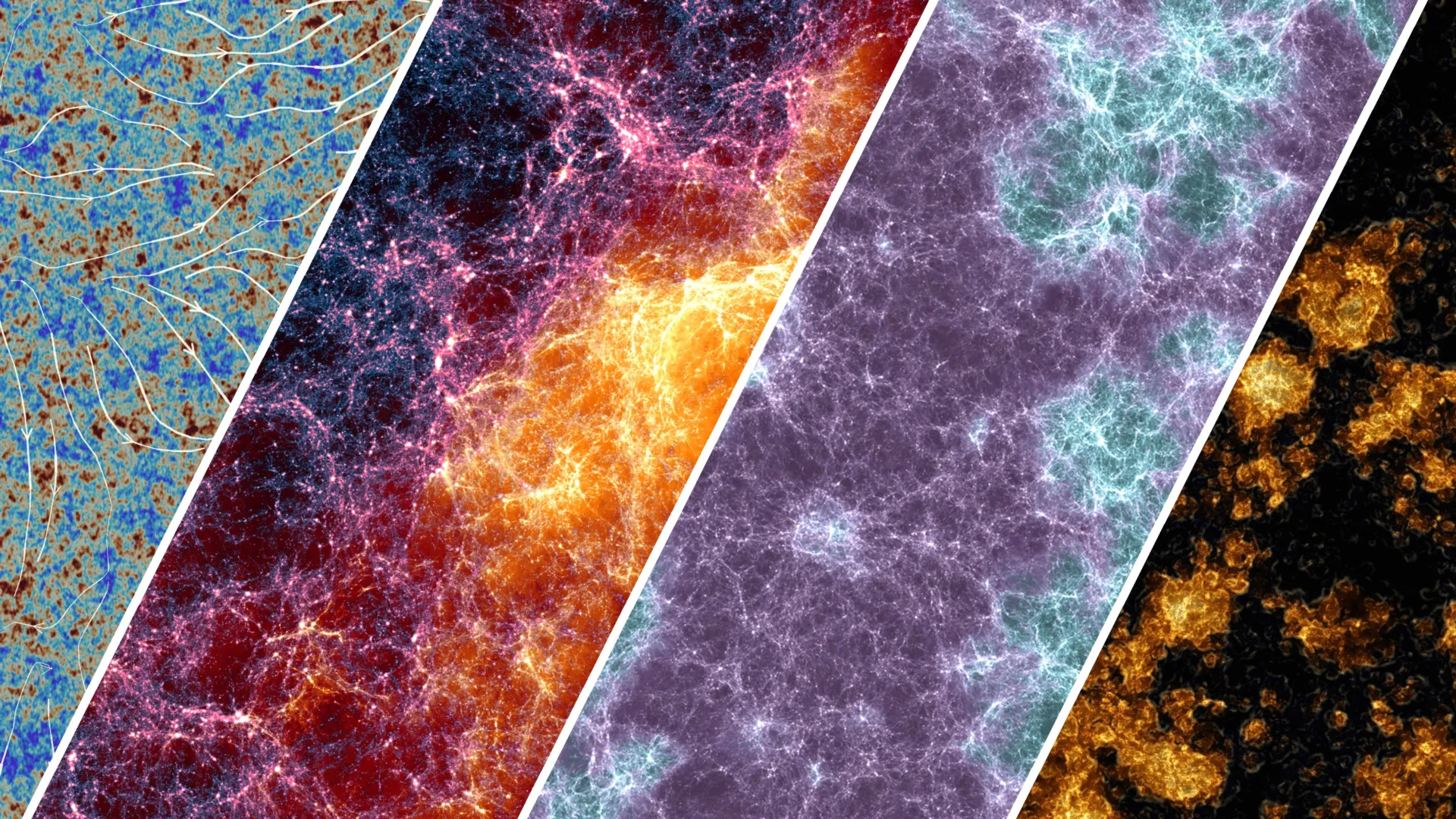
The universe was once a featureless, opaque expanse of neutral hydrogen, a silent void that persisted for millions of years following the Big Bang. Now, an unprecedented computer simulation has provided scientists with a high-definition window into this "Cosmic Dark Age," marking a significant leap in our understanding of how the first stars and galaxies ignited to transform the cosmos. Developed by a multi-institutional coalition of researchers from MIT, Harvard University, and international partners, the simulation—aptly named Lumina—recreates the evolution of the early universe across a staggering volume of 1.6 billion light-years, capturing the complex physics that governed the transition from primordial darkness to the luminous, structured universe observed today.
The research, recently published in the Monthly Notices of the Royal Astronomical Society (MNRAS), represents a culmination of years of computational refinement and astrophysical modeling. By simulating the evolution of the universe from approximately 45 million years after the Big Bang through its first 2 billion years, Lumina bridges the gap between theoretical cosmology and the observable data currently being harvested by cutting-edge space telescopes.
A Chronology of the Cosmic Dawn
To appreciate the scale of Lumina’s achievement, one must understand the timeline of the early universe. The story begins 13.8 billion years ago with the Big Bang, a period of intense heat and density. As the universe expanded, it cooled, allowing subatomic particles to coalesce. Approximately 380,000 years after the initial event, a milestone known as "recombination" occurred: electrons and protons combined to form neutral hydrogen atoms. This moment effectively decoupled light from matter, creating the Cosmic Microwave Background (CMB) radiation that scientists study today.
However, the universe then entered a period of profound quiescence. With no stars yet formed, the cosmos was blanketed in a fog of neutral hydrogen. This gas was opaque to certain wavelengths of light, effectively shielding the universe from the radiation that would later define the galactic era. It was not until the first stars began to ignite—likely 100 to 200 million years after the Big Bang—that this dark age began to recede.
Lumina captures this pivotal transition in granular detail. It tracks the subsequent era of "re-ionization," a two-stage process where the energetic ultraviolet (UV) radiation from the first generation of stars and the accretion of matter by supermassive black holes stripped electrons from hydrogen and helium atoms. This process cleared the cosmic "fog," rendering the universe transparent to the radiation that allows astronomers to peer into the deep past.
Computational Power at the Exascale
The technical architecture behind Lumina is as ambitious as its scientific scope. Built upon the legacy of the IllustrisTNG project—a previous benchmark in cosmological simulation—Lumina integrates advanced radiation transport models that account for the movement of photons through gas and dark matter. The simulation encompasses half a trillion individual elements, including dark matter particles and gas cells, providing a resolution approximately 30 times higher than its predecessor while operating on a volume 100 times larger.
The sheer computational burden of this model required the use of Frontier, the world’s first exascale supercomputer located at the Oak Ridge National Laboratory. According to Xuejian (Jacob) Shen, an MIT co-author, the simulation utilized the coordinated power of over 100,000 CPU cores and 15,000 GPUs. The primary engineering challenge was not merely the raw processing speed, but the orchestration of communication between these massive numbers of processors as they simultaneously calculated the gravitational interactions of dark matter, the hydrodynamics of gas, and the radiative transfer of light across billions of light-years.
Dissecting the Drivers of Re-ionization
One of the most significant findings produced by Lumina is the clear distinction between the drivers of hydrogen and helium re-ionization. Previous models often struggled to account for the energy requirements of stripping electrons from helium, which necessitates a significantly higher energy threshold than hydrogen.
Lumina’s data suggests a two-tiered model: the first stars and their subsequent galaxies were the primary agents responsible for the ionization of hydrogen, while the high-energy environments surrounding growing supermassive black holes—known as active galactic nuclei—provided the necessary radiation to ionize helium. This dual-source theory provides a more coherent explanation for the observed state of the intergalactic medium during the first two billion years of cosmic history.
"Lumina does everything from small-scale star and galaxy formation to large-scale re-ionization of hydrogen and helium, in a volume that is 100 times larger than previous best simulations," notes Mark Vogelsberger, a professor of physics at MIT and a lead author of the study. The ability to zoom from the formation of a singular, disk-shaped galaxy to the vast, web-like structure of the entire simulated volume allows researchers to witness, for the first time, how micro-scale star formation directly influences macro-scale cosmic transparency.
Implications for Future Astronomical Surveys
The utility of Lumina extends far beyond its internal beauty; it serves as a predictive tool for the next generation of observational astronomy. As projects like the James Webb Space Telescope (JWST) and upcoming ground-based observatories continue to map the high-redshift universe, they are uncovering galaxies that defy traditional expectations.
Because Lumina produces such vast populations of simulated galaxies, researchers can now perform direct "apples-to-apples" comparisons between the virtual universe and real-world surveys. If the number or distribution of galaxies observed by telescopes differs from the simulation, it signals to physicists that there may be gaps in our current understanding of dark matter, gravity, or stellar evolution.
Furthermore, the team plans to leverage the simulation to predict the signatures of gravitational waves originating from the early universe. As gravitational-wave astronomy matures, the ability to correlate these ripples in spacetime with the physical formation of the first black holes will be invaluable.
A Collaborative Scientific Endeavor
The development of Lumina is the result of a concerted effort by a global team, including researchers from MIT, Harvard University, the Max Planck Institute for Astrophysics, the University of Texas at Dallas, and York University. This collaborative spirit ensures that the model is not a siloed project but a resource for the broader astrophysical community. By making the simulation data accessible, the team has invited peers to probe the model, test their own hypotheses, and refine the parameters of the early universe.
The research received significant backing from NASA and the National Science Foundation, alongside the vital allocation of computational time from the U.S. Department of Energy. This interdisciplinary support underscores the strategic importance of computational astrophysics in modern science—where the "laboratory" is not a physical space, but a digital reconstruction of the fundamental laws of nature.
The Path Forward
As the scientific community digests the insights provided by Lumina, the focus shifts toward integration. The simulation provides a framework that reconciles the "Dark Age" with the era of observable structure. However, it also raises new questions: Why did some regions of the early universe re-ionize faster than others? What role did dark matter play in accelerating the growth of the first massive black holes?
The ability of Lumina to track matter across such vast scales suggests that the "Cosmic Dawn" was not a uniform event, but a complex, localized process defined by the chaotic dance of gas, light, and gravity. For the researchers involved, this is only the beginning. With the simulation now established, the team is already looking toward incorporating more sophisticated models of magnetic fields and cosmic rays to further increase the fidelity of their virtual universe.
In the quest to understand our origins, humanity has moved from merely staring at the stars to recreating their birth in the binary heart of a supercomputer. Lumina represents more than just a breakthrough in software; it is a profound testament to the human capacity to illuminate the darkest chapters of our cosmic history. As we continue to refine these models, we move closer to answering the most fundamental question of all: how a cold, dark, and empty universe transformed into the vibrant, star-filled cosmos we call home.

