
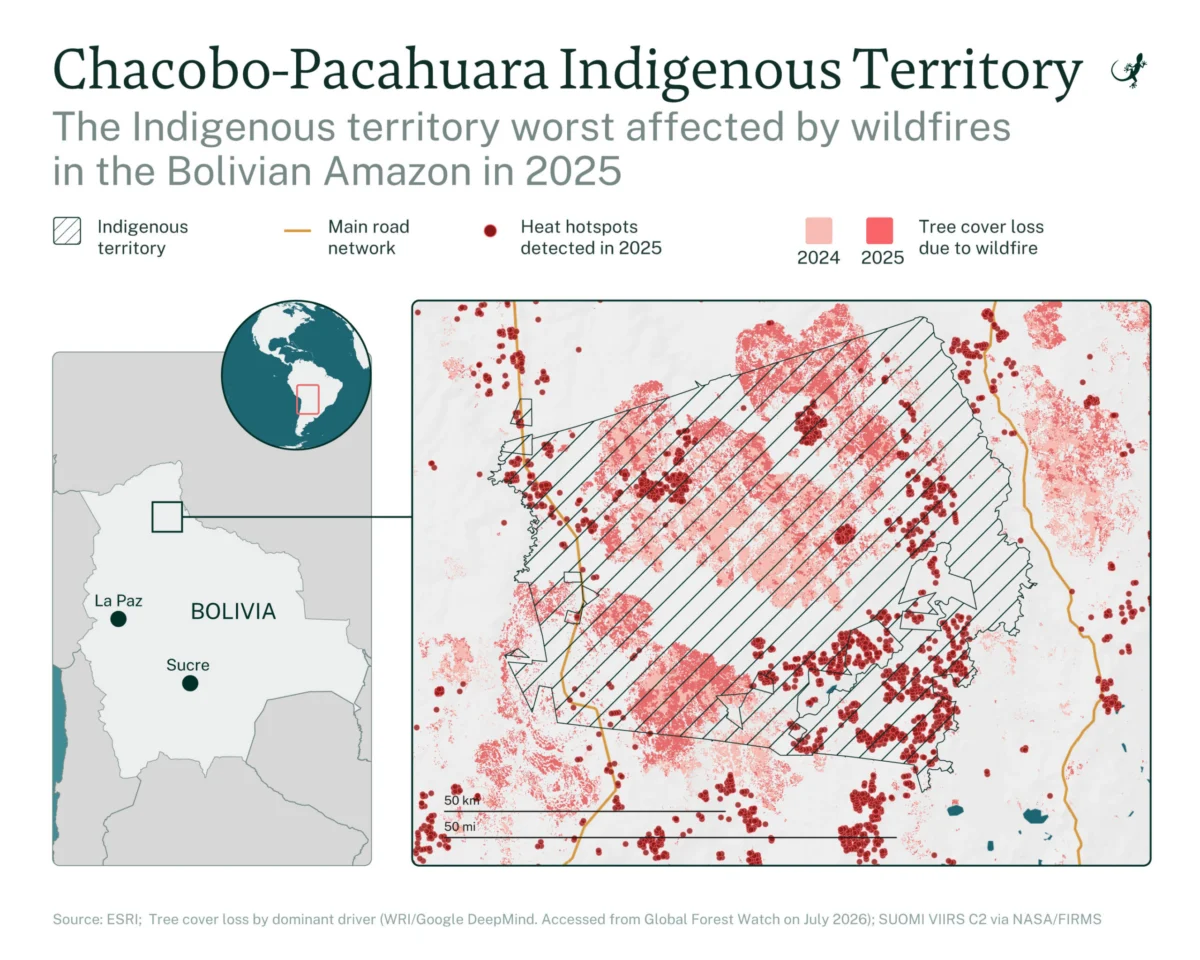
The Chacobo-Pacahuara Indigenous territory, a vital ecological and cultural bastion in the Beni department of northern Bolivia, has been devastated by a series of intensive wildfires throughout September and October 2025. This marks the third consecutive year that the region has faced abnormally high fire activity, threatening the survival of local communities and the biodiversity of the Amazonian savanna and forest transition zones. According to satellite imagery analyzed by Global Forest Watch and ground-level reports from Indigenous leaders, the blazes have consumed thousands of hectares of ancestral land, with preliminary evidence suggesting the fires originated from illegal burning practices in neighboring cattle pastures.
The scale of the destruction has reached a critical threshold, impacting not only the environment but also the very foundations of Indigenous subsistence. For the Chácobo and Pacahuara peoples, the forest is not merely a backdrop but a primary source of food, medicine, and shelter. The 2025 fire season has decimated essential crops, including cassava, bananas, corn, and rice, leaving families in a state of food insecurity. Furthermore, the loss of "forest islands"—elevated patches of dense vegetation within the savanna—has raised urgent concerns regarding the safety of Indigenous groups living in voluntary isolation, whose traditional migratory routes and hunting grounds have been reduced to ash.
A Statistical Overview of the 2025 Fire Season
The data surrounding the 2025 fire season paints a grim picture of a territory under siege. According to a detailed bulletin from the Center for Legal Studies and Social Research (CEJIS), the Chacobo-Pacahuara territory recorded 1,141 heat hotspots between January 1 and September 12, 2025. As the dry season intensified, a secondary surge was documented between September 29 and October 16, adding another 845 hotspots to the tally. These hotspots, detected via infrared satellite sensors, almost universally indicate active wildfire fronts or recently cooled burn scars.
This sharp increase in fire activity aligns with the typical peak of the Bolivian Amazon’s fire season, which usually occurs between August and October when humidity levels drop and temperatures rise. However, the intensity of the 2025 season distinguishes it from historical norms. While the region previously maintained a relatively stable and low fire profile prior to 2023, the last three years have seen an exponential rise in alerts. In 2024, CEJIS reported that an astonishing 47% of the territory was burned—totaling approximately 228,348 hectares (564,260 acres) of the territory’s total 485,260-hectare (1.2 million acres) area. The 2025 figures suggest that the cumulative damage is preventing the ecosystem from recovering, leading to a permanent shift in the landscape.
Humanitarian Crisis and the Threat to Isolated Tribes
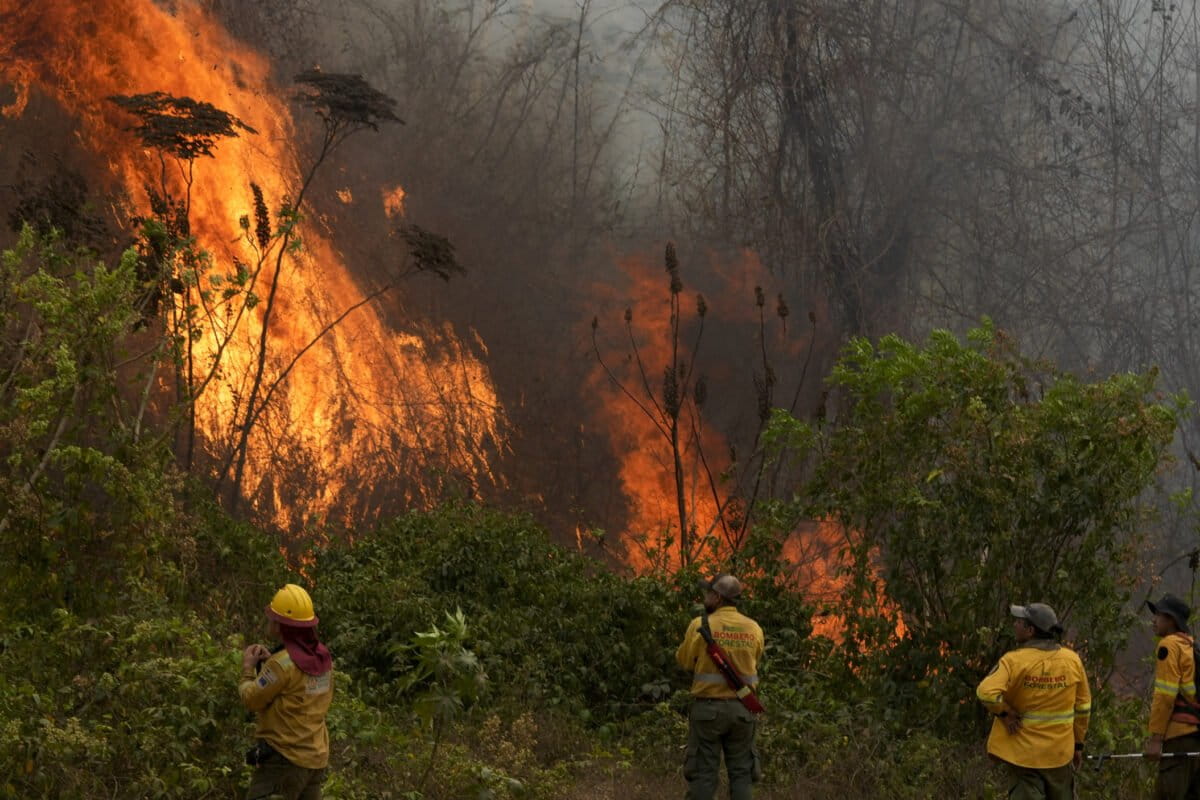
The human cost of the wildfires is most acutely felt by the Indigenous residents who have watched their homes and livelihoods disappear. Constantino Toledo Ortiz, a prominent leader of the Chácobo people, has been vocal about the "serious ordeal" facing his community. In communications with environmental monitors, Ortiz detailed the loss of homes and the total destruction of subsistence fields. The fires have not only stripped the land of its agricultural value but have also killed significant numbers of local wildlife, including monkeys, wild pigs, tapirs, and various bird species, which are central to the Indigenous diet and traditional practices.
Of even greater concern to community leaders is the fate of the Pacahuara relatives living in voluntary isolation. These groups depend entirely on the integrity of the forest for their survival. "We have Indigenous relatives who live in voluntary isolation, and we do not know what has happened to them because the forest and the forest islands where they lived burned," Ortiz stated. There is growing speculation among the Chácobo that these isolated groups may have been forced to flee across the border into Brazil to escape the smoke and flames, potentially leading to dangerous encounters with loggers or miners in unfamiliar territories.
The Pacahuara are among the most vulnerable Indigenous groups in Bolivia. Having faced near-extinction during the rubber boom and subsequent decades of encroachment, their remaining population is small and highly dependent on the specific micro-climates of the Beni department. The destruction of their habitat represents an existential threat to their cultural and physical survival.
Ecological Devastation: Beyond the Trees
The Chacobo-Pacahuara territory is a unique mosaic of tropical rainforest and Beni savanna (also known as the Llanos de Moxos). This ecosystem is characterized by its seasonal flooding and high biodiversity. The "forest islands" mentioned by local leaders are critical biodiversity hotspots that provide refuge for terrestrial animals during the flood season and serve as nesting sites for endemic birds.
When these islands burn, the damage is often irreversible in the short term. Unlike the surrounding grasses of the savanna, which are adapted to occasional fire, the trees in these forest patches are highly sensitive to heat. The 2025 fires have been particularly "hot," fueled by an accumulation of dry biomass from previous years’ burn cycles. This has resulted in high-intensity blazes that sterilize the soil and destroy the seed bank, making natural regeneration difficult. The loss of canopy cover also leads to increased soil temperatures and faster evaporation of ground moisture, creating a feedback loop that makes the territory even more susceptible to future fires.
The Drivers of Destruction: Agriculture and Cattle Ranching
The origins of these fires are rarely natural. Indigenous leaders and environmental analysts point to the expansion of the agricultural frontier as the primary catalyst. In the Beni department, large-scale cattle ranching is a major economic driver. It is a common, albeit often illegal, practice for ranchers to use fire to clear old pasture and stimulate the growth of new grass at the end of the dry season.
In 2025, as in previous years, these "controlled" burns frequently escaped their intended boundaries, driven by unpredictable winds and the extreme dryness of the landscape. Ortiz confirmed that the fires affecting the Chacobo-Pacahuara territory originated in the private cattle pastures surrounding the Indigenous land. Despite the territory’s status as a protected Indigenous area, the lack of physical barriers or effective buffer zone management allows fire to sweep across the landscape unchecked.
The political economy of Bolivia has also played a role. Over the last decade, various "fire laws" and decrees have been criticized by environmental groups for being too lenient on land clearing for agribusiness. While the government often implements temporary bans on burning during the height of the dry season, enforcement in remote regions like northern Beni remains minimal.
Institutional Silence and the Legal Framework
A significant point of frustration for the Chácobo and Pacahuara communities is the perceived negligence of state and local authorities. Despite repeated reports filed with municipal leaders in Riberalta, the departmental government of Beni, and the national Forest and Land Control and Social Authority (ABT), the Indigenous communities claim they have received virtually no emergency assistance or fire-fighting support.
The ABT is the primary body responsible for monitoring and penalizing illegal burns in Bolivia. However, the agency has been stretched thin by simultaneous fire crises in other parts of the country, such as the Chiquitania and Santa Cruz regions. For the Indigenous peoples of Beni, this lack of response is seen as a systemic failure to uphold their constitutional rights. Under Bolivian law, the state is obligated to protect Indigenous territories (TCOs) and ensure the physical and cultural integrity of its inhabitants. The continued encroachment of fire from private lands into the Chacobo-Pacahuara TCO suggests a failure to enforce land-use regulations and hold neighboring landowners accountable for the damage caused by their agricultural practices.

Broader Implications and the Path Forward
The recurring wildfires in the Chacobo-Pacahuara territory are a microcosm of a larger crisis facing the Amazon basin. As climate change alters rainfall patterns and human activity continues to fragment the forest, the resilience of these ecosystems is being pushed to the breaking point. The transition from a stable fire regime to one characterized by annual, high-intensity blazes threatens to turn the northern Bolivian Amazon into a degraded scrubland, a process known as "savannization."
For the Chácobo and Pacahuara, the immediate priority is the restoration of food security and the location of their isolated relatives. However, without a fundamental change in how land is managed in the Beni department, the 2026 season may bring more of the same. Environmental advocates are calling for:
- Stricter Enforcement: Real-time satellite monitoring must be paired with on-the-ground enforcement and significant fines for landowners whose fires cross into protected Indigenous territories.
- Emergency Assistance: Immediate humanitarian aid, including food, seeds, and building materials, is required for the affected Indigenous families.
- Transboundary Cooperation: Given the proximity to the Brazilian border and the movement of isolated groups, bilateral cooperation is essential to ensure the safety of uncontacted tribes.
- Community-Led Management: Empowering Indigenous brigades with the equipment and training necessary to create firebreaks and manage their own lands could provide a more effective first line of defense than distant government agencies.
As the smoke clears over the Beni savanna, the long-term survival of the Chacobo-Pacahuara people remains uncertain. Their struggle highlights the tension between industrial agricultural expansion and the preservation of the world’s most critical cultural and biological landscapes. Without intervention, the "forest islands" that have sustained these communities for generations may soon exist only in memory.

