
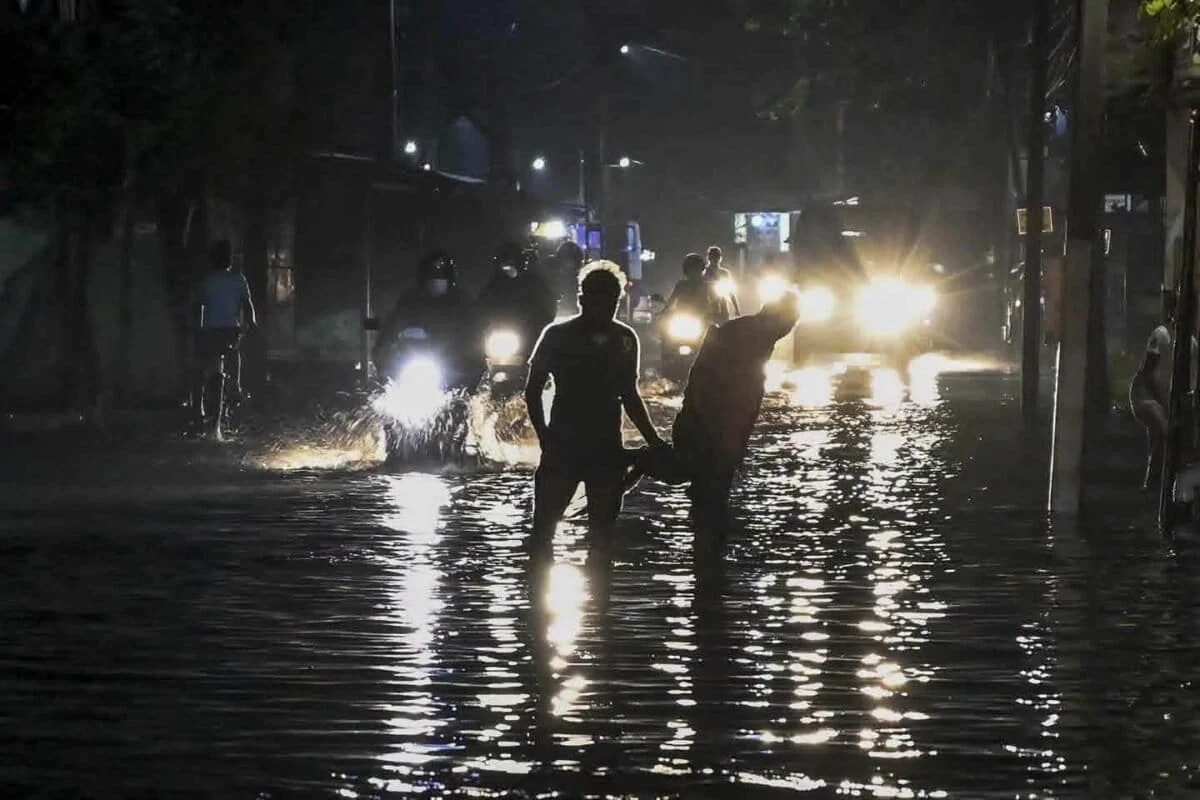
COLOMBO — On November 6, Sri Lanka’s commercial capital, Colombo, was brought to a standstill as an unprecedented 129-millimeter (5-inch) downpour struck the city within a narrow timeframe, overwhelming century-old drainage infrastructure and triggering widespread flash flooding. The event, which submerged vehicles and paralyzed public transportation, has reignited a critical debate regarding the intersection of rapid urban development, the degradation of natural flood-mitigation systems, and the urgent need for climate-resilient infrastructure.
For commuters, the impact was immediate. Siva Sivasagunthan, a local ride-hailing driver, reported that the rapid rise of water levels caught many motorists off guard. His own vehicle was partially submerged, and what should have been a 30-minute commute stretched into a two-hour ordeal. This experience was shared by thousands, as the sudden deluge turned streets into rivers, highlighting the vulnerability of the city’s economic hub to extreme weather events.
A History of High-Intensity Rainfall
While heavy rainfall is not foreign to Colombo’s tropical climate, meteorologists point to a concerning shift in precipitation patterns. Ajith Wijemanna, director of the Department of Meteorology, noted that while the city has historically faced significant rainfall, the intensity of the November 6 event was particularly alarming.

"We have seen instances over the decades where Colombo has experienced rainfall exceeding 400 mm (15.7 in)," Wijemanna explained. "In June 1992, the city saw 493.7 mm (19.4 in) within 24 hours, and in November 2010, we recorded 440.2 mm (17.3 in)."
However, the recent incident was defined by its velocity rather than just the total volume. Meteorological data indicated that the rainfall hit rates of 120 mm to 135 mm per hour in various sectors. "We believe that the main cause of flooding was the high intensity during a short period of time, such as an hour, which was similar to a gushing downpour," Wijemanna added. He further highlighted a critical gap in the country’s disaster preparedness: the lack of a Doppler weather radar system. Such technology would provide the essential lead time required to issue early warnings and mobilize emergency services before the flooding reaches critical stages.
The Failure of Aging Infrastructure
The flash flood served as a stark reminder of the limitations of Colombo’s municipal engineering. Deepika Wijethilake, deputy director of drainage design at the Colombo Municipal Council (CMC), noted that the city’s sewer and storm water systems are approximately 100 years old. Designed for a different era, these systems are calibrated to manage a maximum capacity of 30 mm of rainfall per hour.
When faced with a deluge exceeding 100 mm per hour, the system was rendered essentially obsolete. Furthermore, the modern urban landscape—characterized by an increase in paved surfaces and concrete structures—has drastically reduced the soil’s natural permeability. With less ground to absorb the water, the runoff is directed entirely into the overburdened canal and pipe network.

In the immediate aftermath, Prime Minister Harini Amarasuriya ordered a swift intervention by local authorities, including the Department of Irrigation and various divisional secretariats. Maintenance crews were deployed to clear blockages, identifying 60 primary locations where debris, silt, and waste were obstructing the flow of water. While these efforts are necessary for short-term mitigation, experts argue they do not address the systemic issues of a city designed for a lower-intensity climate.
The Real Estate Boom and the Wetland Crisis
Perhaps the most significant long-term factor exacerbating Colombo’s flood risk is the systematic encroachment upon its natural wetlands. These areas, which serve as the city’s "natural kidneys," have historically provided vital ecosystem services by absorbing excess water and slowly releasing it into the drainage network or groundwater tables.
A 2025 study by the Centre for a Smart Future (CSF) titled "Shifting Grounds" provides a scathing analysis of the environmental pressures caused by booming real estate development in suburban areas like Thalangama, Kaduwela, Malabe, and Thalawathugoda. Property developers are increasingly marketing these wetland-adjacent areas as "green living" enclaves, using the natural beauty of the landscape to justify 30-40% annual spikes in property prices.
"They are able to leverage the wetland to create demand and price premiums, but hardly ensure that their projects are nature-positive," said Anushka Wijesinha, director of the CSF. "The ecological value of the wetland is not reflected in the prices charged or the fees paid to local authorities."

Wijesinha emphasizes that the view of wetlands as merely aesthetic features is dangerously narrow. "Over 45% of the country’s GDP is generated by the Western Province. When the city floods, we face massive supply chain risks and international connectivity issues. We need to shift our perspective from aesthetics to economic resilience."
Ecological Significance and Potential Solutions
The Colombo Wetland Complex (CWC) is a designated RAMSAR-accredited site, recognizing its importance as a habitat for biodiversity and a natural flood buffer. Environmental scientist Chethika Gunasiri notes that 37% of the rainwater entering Colombo is typically managed by this complex.
"However, we are seeing these wetlands being filled and converted into terrestrial land for construction," Gunasiri warned. "Many are also being invaded by the pond apple (Annona glabra), which reduces their water-holding capacity. If we continue on this path, no amount of drainage maintenance will save the city from future floods."
Gunasiri advocates for the adoption of international models of "sponge city" design. Referencing Copenhagen’s Cloudburst Management Plan, she suggests that Colombo should look toward integrating rain gardens, small detention ponds, and bioswales into its urban infrastructure. These features act as natural filtration and retention points, allowing water to be managed at the source rather than overwhelming the central drainage pipes.

A Call for Financial and Structural Reform
Moving forward, the consensus among urban planners and environmentalists is that a multi-faceted approach is required. The CMC has stated that it is currently reviewing designs for new drainage systems capable of handling 100 mm of rainfall per hour, though such a project requires significant capital and time.
Anushka Wijesinha proposes the establishment of an "Adaptation and Resilience Fund." This blended finance mechanism would pool government resources, bilateral grants, and contributions from property developers who profit from wetland-adjacent projects. "The biggest risk we face now is fiscal—the lack of funds to pay for these investments when they are needed most," he said.
The November 6 flood has forced a moment of reckoning for Colombo. As the city continues to grow, the pressure on its natural and man-made infrastructure will only intensify. The challenge for policymakers is to reconcile the demand for urban expansion with the non-negotiable reality of climate change. Whether through the restoration of the wetland complex, the modernization of drainage systems, or the implementation of sustainable building practices, the city must transition from reactive crisis management to proactive, long-term resilience.
For now, the residents of Colombo remain in a state of heightened alert. Every dark cloud now carries the potential for disruption, a symptom of a city that has outpaced its own infrastructure and is only now beginning to calculate the true cost of losing its natural defenses. The path toward a sustainable future will require not just engineering, but a fundamental shift in how the city values its environment as the bedrock of its economic survival.

