
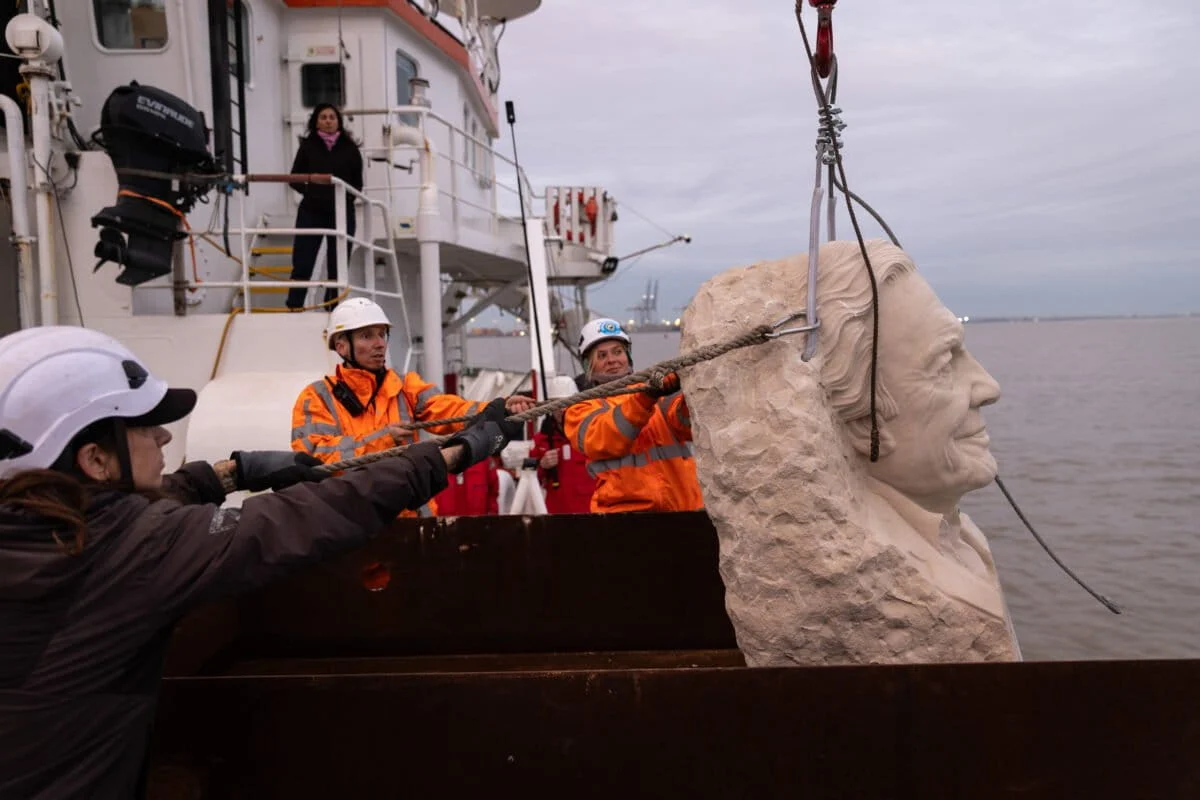
The Southern North Sea Marine Protected Area (MPA) has become the latest flashpoint in a growing geopolitical and environmental struggle over the integrity of the United Kingdom’s maritime conservation efforts. In a bold tactical maneuver designed to force the hand of regulatory bodies, Greenpeace activists recently deployed ten two-tonne boulders across the seabed of this 37,000-square-kilometer zone. By creating physical obstructions on the seafloor, the organization aims to render the area inaccessible to bottom trawling—a controversial commercial fishing practice that involves dragging weighted, heavy-duty nets across the ocean floor to scoop up marine life indiscriminately.
Among the boulders deposited was one intricately carved in the likeness of world-renowned naturalist Sir David Attenborough, a symbolic gesture intended to highlight the ecological fragility of the region. While the action has successfully drawn international attention to the disconnect between the official status of "protected" waters and the reality of ongoing industrial exploitation, it has also triggered a sharp backlash from fishing industry representatives and prompted formal investigations by British authorities.
A Chronology of Conflict: From Dogger Bank to the Southern North Sea
The deployment of these boulders is the latest in a series of direct-action campaigns initiated by Greenpeace over the past five years. This strategy, while unconventional, has a documented history of influencing administrative outcomes within the U.K. legal system.
In 2020 and 2021, Greenpeace executed similar operations in the Dogger Bank and Offshore Brighton MPAs. The rationale was identical: the areas were technically designated as protected zones, yet they remained open to bottom-towed gear. Following the initial deployment of boulders in the Dogger Bank, the U.K.’s Marine Management Organisation (MMO) launched a legal challenge against the activists. However, the legal proceedings took a surprising turn when a judge questioned whether pursuing the case was in the public interest. Ultimately, the MMO withdrew its legal action. Crucially, within months of this regulatory retreat, the British government enacted a new byelaw that officially banned all bottom-towed fishing gear in the Dogger Bank Special Area of Conservation.
Greenpeace views this precedent as a blueprint for policy change, arguing that the government’s failure to act on its own conservation mandates necessitates civil disobedience. However, the current situation in the Southern North Sea presents a more complex regulatory environment, as the U.K. continues to navigate post-Brexit maritime policies and the delicate balance between domestic food security and international conservation commitments.
The Ecological Cost of Bottom Trawling
To understand the intensity of this dispute, one must examine the mechanics of bottom trawling. Often described by marine scientists as the "clear-cutting" of the ocean, the process involves heavy steel doors and weighted chains that are dragged across the benthic zone. The environmental consequences are profound and often permanent.
According to data from the International Council for the Exploration of the Sea (ICES), bottom-trawled areas suffer significant loss of structural complexity. The nets pulverize coral reefs, seagrass meadows, and sponge beds that provide essential habitats for juvenile fish. Furthermore, the practice leads to massive amounts of bycatch—non-target species such as sharks, rays, dolphins, and porpoises that are trapped in the nets and frequently die before they can be released.
Elena Polisano, head of oceans at Greenpeace U.K., has characterized the Southern North Sea MPA as a "paper park." In her assessment, the term is not merely a political critique but an accurate description of the current regulatory framework. By allowing industrial trawling within the boundaries of a protected area, the government is essentially nullifying the conservation objectives that the MPA was established to achieve. As the U.K. strives to meet the global goal of protecting 30% of its land and sea by 2030, the presence of bottom trawlers in these zones undermines the credibility of the entire network.
Official Responses and the Clash of Interests
The response from stakeholders has been polarized. The European Bottom Fisheries Alliance (EBFA) has issued a scathing rebuke of the campaign. In a formal statement, the alliance argued that environmental policy cannot be dictated by unilateral, extralegal actions that bypass established legislative processes.

"Environmental protection cannot be achieved by bypassing regulations and unilaterally imposing fishing restrictions," the EBFA stated. Beyond the legal argument, the alliance raised significant safety concerns, noting that publishing coordinates of sub-sea obstacles after the fact does not entirely mitigate the danger to fishing vessels. Navigational hazards of this nature can lead to equipment damage, vessel instability, or, in extreme cases, the loss of life if a net becomes snagged on an unmapped obstruction.
The U.K. government, represented by the Marine Management Organisation and the Department for Environment, Food and Rural Affairs (DEFRA), has maintained a stance of firm, albeit measured, condemnation. The MMO confirmed it is currently investigating the incident, though it has declined to disclose the potential legal consequences for the activists involved.
DEFRA’s official response emphasized the government’s commitment to a balanced approach. "We have strict legislation in place to protect our marine environment while supporting sustainable fishing and coastal communities," a department spokesperson stated via email. "Activities at sea should be carried out lawfully and with due regard for the safety of other sea users." The government’s challenge lies in managing the competing demands of the fishing industry, which relies on these waters for economic survival, and the environmental movement, which demands a cessation of destructive practices to ensure the long-term health of the marine ecosystem.
Implications for Future Marine Governance
The standoff in the Southern North Sea highlights a fundamental breakdown in the trust between environmental advocates and the institutions tasked with maritime oversight. From an analytical perspective, the situation reflects a broader tension in U.K. environmental policy as it transitions into a post-European Union legal framework.
The primary implication of this incident is the potential for further legislative gridlock. If the government chooses to prosecute the activists, it risks a lengthy and public trial that could further mobilize public opinion in favor of more stringent conservation laws. Conversely, if the government allows the boulders to remain without intervention—similar to the outcome at Dogger Bank—it risks appearing weak in the face of direct action, potentially emboldening other environmental groups to take similar measures in other protected areas.
Furthermore, the "Attenboulder" event has forced a public conversation about the definition of "protection." Scientific consensus indicates that "protected" is a misnomer if the primary stressors on an ecosystem remain active. The case for a total ban on bottom trawling in MPAs is gaining traction among researchers who point out that the resilience of the North Sea depends on the recovery of the seafloor, which cannot occur while heavy nets are in constant operation.
A Path Toward Resolution?
As the investigation into the Southern North Sea incident continues, observers are looking for signals regarding the government’s long-term strategy for marine spatial planning. The U.K. possesses one of the largest marine networks in Europe, and the management of these waters is a cornerstone of its national environmental strategy.
For Greenpeace, the goal remains unchanged: the complete prohibition of bottom trawling within all designated Marine Protected Areas. "We can’t do all of the government’s job, so we really want to emphasize that time is running out and the ocean can’t wait any longer," Polisano stated. "We really need the government to step up and start acting on its word."
The fishing industry, meanwhile, continues to advocate for a "science-led" approach that considers the socio-economic impacts of closures. They argue that total bans are blunt instruments that threaten the livelihoods of coastal communities that have operated in these waters for generations.
The coming months will likely see increased pressure on the U.K. government to reconcile these divergent interests. Whether the Southern North Sea boulder drop results in new, formal legislative restrictions or a more aggressive enforcement of existing maritime laws remains to be seen. What is clear, however, is that the status quo of "paper parks" is becoming increasingly untenable under the dual pressures of global climate change and heightened public scrutiny. The outcome of the current investigation may well set the tone for how the U.K. manages its marine heritage for the remainder of the decade.

