
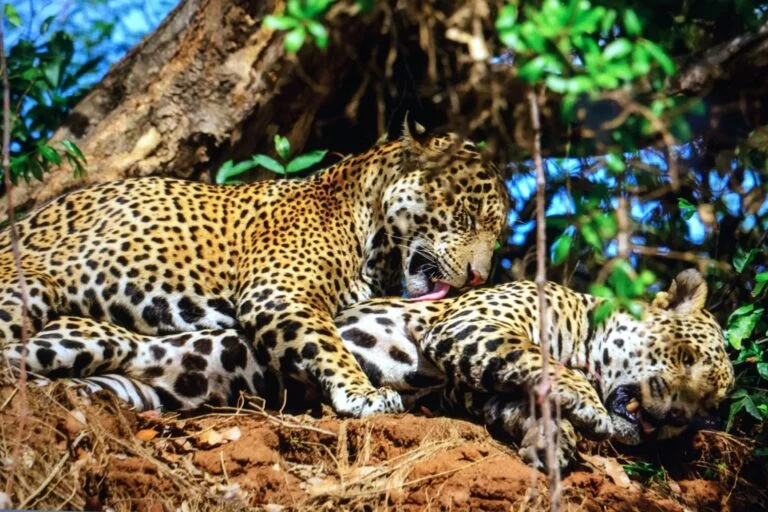
For decades, the standard paradigm of feline ethology has categorized the jaguar (Panthera onca) as an strictly solitary apex predator. Conventional wisdom held that these elusive cats—the largest in the Americas—only sought the company of their own kind during brief mating encounters or when a female was raising dependent cubs. However, a groundbreaking 13-year study conducted in the Brazilian Pantanal, the world’s largest tropical wetland, has shattered this long-standing biological assumption. Researchers have discovered that, in environments where prey is abundant and population density is high, jaguars exhibit a surprisingly sophisticated degree of social behavior, ranging from cooperative hunting and mutual grooming to complex territorial alliances.
The study, led by Valeria Boron of WWF UK and involving a robust team of researchers from the Jaguar ID project, utilized over a decade of observational data to map the social architecture of these powerful predators. The findings suggest that the rigid "solitary" label may be a result of limited observational methods rather than an accurate reflection of the species’ inherent behavioral capacity.
The Evolution of Jaguar Observation
Historically, our understanding of jaguar behavior was severely constrained by the limitations of technology. Prior to the widespread adoption of high-resolution digital imaging and consistent human observation, scientists relied almost exclusively on remote camera traps and genetic sampling from scat or hair follicles. While these methods are invaluable for tracking movement and population health, they are inherently "blind" to the nuances of animal-to-animal interaction. A camera trap may capture a single frame of two cats in proximity, but it cannot discern whether they are preparing to fight, choosing to ignore one another, or engaging in a cooperative social bond.
Since 2013, the Jaguar ID project has revolutionized this field of study by turning the Pantanal’s unique geography into a living laboratory. Because the Pantanal is a vast, open wetland with a massive density of jaguars—often described by locals and guides as a place where a sighting is nearly guaranteed for tour boats—it has become a focal point for long-term monitoring. During the dry season, which spans from June through October, the receding waters concentrate prey and predators alike along riverbanks. This annual phenomenon provided the research team with an unprecedented dataset: over a decade of high-quality photographic and video evidence. By analyzing the unique, fingerprint-like rosette patterns of 459 individual jaguars, researchers were able to track specific social interactions over time, effectively moving from static population counts to longitudinal behavioral sociology.
A Chronicle of Interaction: The 13-Year Data Set
The research team meticulously categorized 167 specific instances of interaction between adult jaguars. The findings were statistically significant, revealing a social landscape far more complex than previously documented:
- Gender Dynamics: Of the observed interactions, 49% involved two males, 31% involved male-female pairings, and 17% involved female-female pairings. The prevalence of male-male interaction is particularly striking, as the traditional view of the species suggested males would be strictly territorial and aggressive toward one another.
- Behavioral Spectrum: The nature of these meetings was highly varied. Approximately 39% of observed interactions were classified as "social," characterized by grooming, playful behavior, or even coordinated hunting. A further 36.5% were "neutral," where individuals shared a space to rest or hunt without direct interference. The remaining 24.5% were "aggressive," involving direct conflict or defensive posturing.
- Kinship and Cooperation: Evidence of prosocial behavior was notably present in related individuals. The study documented instances of siblings from different litters grooming one another, and adult males—often related—patrolling their shared territory in tandem.
The Role of Resource Abundance in Sociality
The core question prompted by these findings is why Pantanal jaguars appear to be "social" while jaguars in other regions, such as the dense forests of the Amazon or the arid scrublands of Mexico, appear to adhere to the traditional solitary model. The answer, according to the research team and outside experts, likely lies in the concept of "resource density."
The Pantanal is an ecosystem of extreme abundance. The high density of capybaras, caimans, and fish means that a territory can support a higher number of apex predators without the intense, lethal competition seen in less productive habitats. When the cost of competition—fighting for food—is outweighed by the benefits of tolerance, natural selection may favor a more flexible, social approach to territory and foraging.
Stijn Verschueren, a conservation biologist at the University of Bern, emphasizes that while this study is a landmark in feline research, it is geographically specific. "All observations come from riverbanks in an area with very high prey and jaguar density," Verschueren noted. "The results are a testament to the adaptability of the species, but they don’t necessarily apply to jaguars in regions where prey is scarce and the need for vast, exclusive territories is a matter of survival."

The Female Perspective: Infanticide and Defensive Parenting
While males displayed a higher propensity for neutral and positive social interactions, the behavioral profile of females was notably different. Females with cubs were rarely seen engaging in cooperative or neutral interactions with other adults. Boron posits that this is a protective mechanism.
"The hypothesis we are working with is that females remain highly defensive because the risk of infanticide is a constant threat," Boron explained. The study documented specific instances of infanticide perpetrated by other females in the region, suggesting that for mothers, the primary social directive is the exclusion of outsiders. Unlike males, whose primary social drive may be territory maintenance and securing access to mates, the female strategy is strictly oriented toward the survival of their specific lineage, leading to a much lower tolerance for social proximity.
Implications for Conservation and Future Research
The discovery that jaguars are capable of social complexity has significant implications for how we manage the species. If social behavior is a learned or adaptive trait, conservation strategies must account for the preservation of "social corridors"—not just paths for travel, but areas where these high-density populations can continue to interact and maintain their social structures.
The research also opens the door to more sophisticated ecological modeling. Understanding how these cats negotiate their social hierarchies can help biologists better predict how habitat fragmentation or climate-driven changes in prey availability might affect population density. If an environment becomes less productive, will these "social" jaguars revert to solitary behavior, or will the loss of these social structures impact their ability to thrive?
Looking ahead, the team is eager to expand the scope of their inquiry. The Mamirauá Reserve in the Amazon has been suggested as an ideal site for a follow-up study. By comparing the social behavior of Amazonian jaguars with those of the Pantanal, scientists can begin to isolate which social traits are hard-wired into the species and which are responses to the "bounty" of the wetland.
Furthermore, there is a call for a more qualitative, descriptive approach to future behavioral papers. As Boron noted, while the statistical breakdown of interactions is vital, the "why" and "how" of these interactions—such as the complex communication required for two males to coordinate a territory patrol—remain the next frontier of feline research.
A Changing Paradigm
The shift from viewing the jaguar as an isolated, monochromatic killer to a complex, socially flexible animal is a reminder of how much remains unknown about even the most charismatic megafauna. As anthropogenic pressure on the Pantanal continues to mount—driven by tourism, land-use changes, and climate variability—the ability of these cats to navigate their social lives will be a key indicator of their resilience.
This 13-year study serves as a masterclass in the importance of longitudinal data. By moving beyond the snapshot-in-time approach, researchers have uncovered a hidden dimension of the jaguar’s existence. The "solitary" hunter is not a universal truth, but a specific adaptation to a specific environment. In the heart of the Pantanal, the jaguar is proving to be a much more nuanced, social, and intelligent creature than we ever dared to imagine. As we continue to encroach upon their habitats, understanding these social bonds may prove just as critical to their survival as the protection of the land itself.

