
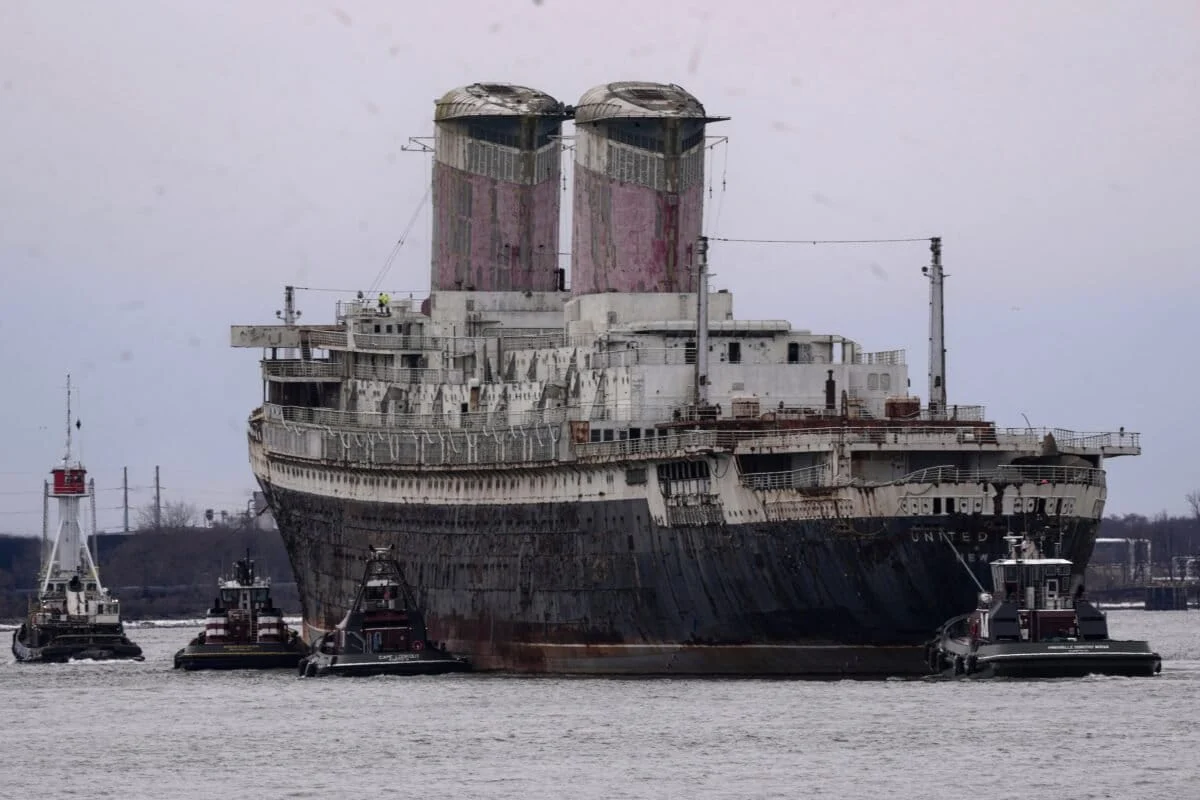
The SS United States, once the undisputed titan of the North Atlantic and a marvel of Cold War-era maritime engineering, has concluded its final voyage. On Wednesday, federal and state officials oversaw the scuttling of the legendary ocean liner approximately 25 miles southwest of Destin, Florida. This monumental engineering operation, costing $13.5 million, marks the transition of the vessel from a rusting relic of a bygone golden age into a permanent, submerged sanctuary for marine biodiversity in the Gulf of Mexico.
A Legacy of Speed and Innovation
Commissioned during the height of the mid-20th century, the SS United States was more than just a luxury liner; it was a testament to American industrial prowess. Designed by naval architect William Francis Gibbs, the ship was constructed with a dual purpose: to provide unparalleled transatlantic speed and to serve as a convertible troop transport vessel for the United States Navy in the event of global conflict.
Upon its maiden voyage in 1952, the vessel shattered the speed record for crossing the Atlantic Ocean, a title it holds to this day. Its streamlined, aluminum-rich construction allowed it to reach speeds exceeding 35 knots, easily outpacing contemporary rivals such as the RMS Queen Mary. For decades, the ship carried heads of state, Hollywood celebrities, and thousands of immigrants, serving as a floating symbol of American prestige. However, the advent of commercial jet travel in the 1960s rendered such ocean liners obsolete, leading to the vessel’s retirement in 1969.
The Chronology of a Long Decline
The path to the Gulf of Mexico was neither short nor simple. Following its retirement, the SS United States languished for over five decades, passing through various owners and temporary moorings.
- 1952: The vessel enters service, setting the Blue Riband record for the fastest transatlantic crossing.
- 1969: The ship is officially withdrawn from service due to the economic shifts caused by the rise of air travel.
- 1990s–2000s: The ship remains docked in Philadelphia, becoming a frequent subject of preservation efforts and restoration proposals that never reached fruition.
- 2023: Legal battles over berthing fees and the deteriorating state of the hull reach a climax, prompting authorities to seek a permanent solution.
- 2025: Plans are finalized to convert the ship into an artificial reef, preventing the historic vessel from being sold for scrap metal.
The decision to scuttle the ship was not taken lightly. For years, preservationists fought to save the vessel, hoping to turn it into a floating hotel or museum. Ultimately, the immense costs associated with hazardous material abatement—specifically the removal of legacy asbestos—made preservation economically unviable.
Engineering the World’s Largest Artificial Reef
The transformation of the 990-foot ship into an artificial reef is a complex undertaking involving marine biologists, environmental agencies, and naval engineers. To ensure the safety of the marine environment, the ship underwent extensive cleaning to strip away fuel, oil, chemicals, and hazardous materials that could leach into the ecosystem.
The site, chosen for its depth and current patterns, is expected to provide a massive, stable substrate for coral colonization. As the structure settles on the seafloor, it will immediately begin attracting various species of fish, including tuna, marlin, and swordfish. According to the Florida Fish and Wildlife Conservation Commission, the sheer scale of the 990-foot hull will create an unparalleled vertical relief, providing shelter and feeding grounds that are currently absent in the relatively flat sandy plains of the Gulf floor.
Economic and Ecological Implications
The $13.5 million investment is projected to yield significant long-term economic dividends for the Florida Panhandle. The region, heavily reliant on tourism and recreational fishing, views the new reef as a premier destination for international diving enthusiasts.
"This project is a triple win," says an official close to the project. "It preserves the legacy of a maritime icon, it boosts the local blue economy by attracting sport fishing and diving tourism, and it provides a massive boost to the regional marine ecosystem."

From an ecological perspective, the ship acts as an "oases in the desert." The Gulf floor in this region consists primarily of sand, which offers little in the way of structural habitat for reef-dwelling fish. By introducing a massive, complex, and durable structure, the artificial reef facilitates the establishment of a robust food chain. Smaller baitfish will colonize the ship’s interior and exterior, which in turn will attract larger pelagic species. This creates a "spillover effect," where the increased fish populations migrate to surrounding areas, benefiting commercial and recreational fisheries throughout the Florida coast.
Stakeholder Reactions
The reaction to the sinking has been mixed, reflecting the ship’s emotional resonance. Preservationists expressed sadness at the loss of a historic landmark, yet many acknowledged that the reefing process is a dignified alternative to the ship-breaking yards of South Asia, where the vessel would have been cut into scrap metal and sold for pennies on the dollar.
Local business owners in Destin and Panama City have largely welcomed the news. "We have been looking for ways to diversify our local economy beyond seasonal tourism," a representative from the local chamber of commerce stated. "Having the world’s largest artificial reef in our backyard makes this region a world-class destination for ocean explorers."
Environmental groups, while cautious, have monitored the process to ensure that all federal guidelines regarding ocean dumping were strictly followed. Because the vessel was cleaned of all environmental contaminants prior to the sinking, the project is viewed as a net positive for ocean conservation, effectively recycling a massive amount of steel into a permanent habitat.
Broader Impact on Marine Policy
The scuttling of the SS United States serves as a case study for the "Ships-to-Reefs" program, a federal initiative designed to manage decommissioned naval and commercial vessels. The program balances the logistical necessity of disposing of obsolete hulls with the ecological benefit of creating artificial reefs.
Data from the National Oceanic and Atmospheric Administration (NOAA) suggests that artificial reefs can significantly increase the biomass of fish in a given area. However, critics point out that these structures must be placed carefully to avoid disrupting natural migration patterns or existing benthic habitats. The selection of the specific site off the Florida coast involved years of environmental impact studies, ensuring that the ship would settle on a barren patch of seafloor rather than damaging existing natural coral formations.
A New Chapter Under the Waves
As the dust settles over the Gulf of Mexico, the SS United States begins its second life. No longer a carrier of passengers crossing the Atlantic at breakneck speeds, it is now a sedentary monument to human engineering. The ship will serve as a living laboratory for marine biologists studying how artificial structures influence biodiversity over decades.
The vessel’s bow, pointing toward the surface, will eventually be encrusted with barnacles, sponges, and hard corals. The grand staircases and empty passenger cabins that once echoed with the sounds of 1950s luxury will now host schools of snapper and grouper.
For the residents of the Florida Panhandle, the ship is no longer a ghost of the past, but a pillar of the future. The $13.5 million project represents a rare moment where history, environmental stewardship, and economic ambition converge. While the SS United States will never again slice through the waves of the Atlantic, it remains, in its final, silent form, a record-setter once more—this time as the most significant, singular contribution to the Gulf’s marine habitat in modern history. The ship’s journey is complete, but its impact on the marine environment has only just begun.

