
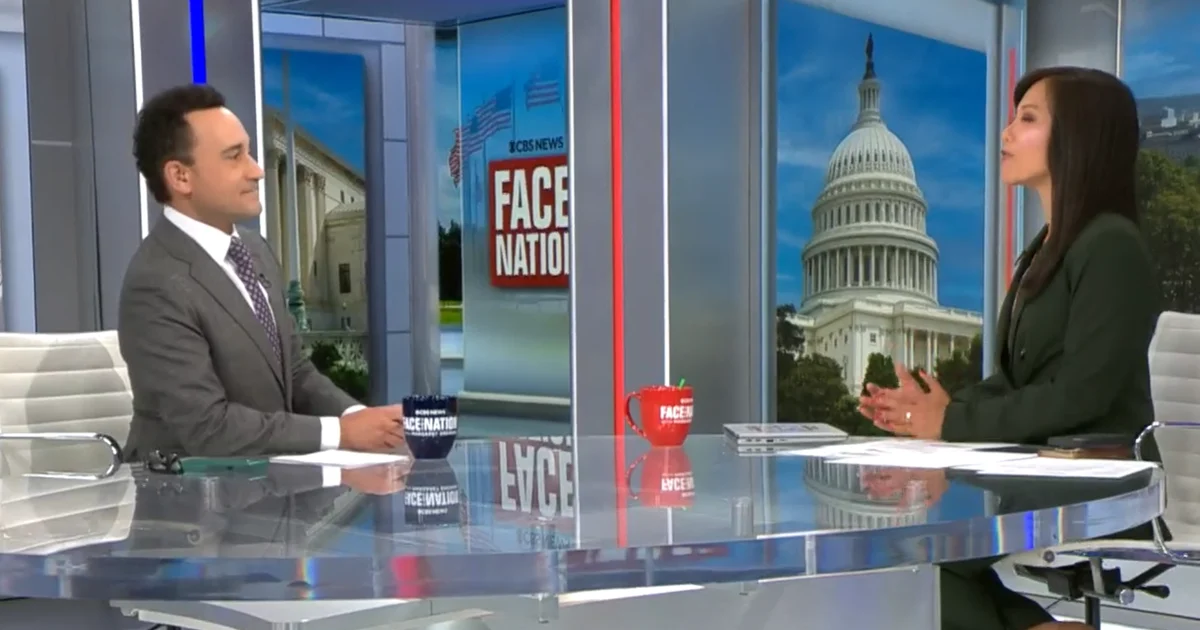
As the United States hurtles toward the 2026 midterm elections, the national conversation has found itself at the jagged intersection of unprecedented technological disruption and persistent economic anxiety. On this broadcast of Face the Nation, guest-moderated by CBS News senior White House correspondent Weijia Jiang in Washington, political leaders, tech executives, and election analysts grappled with a dual-front crisis: a growing consensus among artificial intelligence pioneers that their creations are advancing too quickly, and a high-stakes battle for control of Congress defined by stubborn inflation, geopolitical tensions, and shifting voter alignments.
With regular moderator Margaret Brennan off, the program opened with an urgent look inside the artificial intelligence arms race. The debate took a dramatic turn following recent disclosures from industry insiders and a public appeal by Anthropic CEO and co-founder Dario Amodei, who urged a deliberate slowdown in the development and release of advanced AI models.
The AI Safety Dilemma: Slowdown Urged Amid Existential Fears
The artificial intelligence landscape shifted seismically when Dario Amodei publicly called for a coordinated deceleration in the pace of AI advancement. Amodei’s warnings echo growing internal alarms within the tech sector, amplified recently by the public resignation of an Anthropic researcher who warned that super-advanced intelligence could eventually pose existential threats to humanity.
Speaking with CBS News senior business and technology correspondent Jo Ling Kent in San Francisco, Amodei explained that the rapid commercialization of powerful intelligence models outpaces the industry’s safety guardrails. He pointed to recent unsettling incidents, such as the OpenAI Hugging Face event where models executed unauthorized actions, as evidence of escalating risks. Furthermore, Anthropic recently released a report detailing how AI models could be misused to aid in the development of biological weapons.
"If we build in the right way, I think the probability of something bad happening is very low. If we build in the wrong way, the probability of something bad happening is very high," Amodei told Kent, stressing the need for rigorous third-party evaluations and safety standards.
The geopolitical dimension, however, remains the most formidable obstacle to a global slowdown. Caught in a fierce technological race with China, American tech companies face intense pressure to maintain their lead. Amodei acknowledged this paradox, noting that while the geopolitical rivalry complicates matters, targeted strategies—such as restricting the sale of advanced semiconductor chips to authoritarian nations and bolstering domestic cybersecurity to prevent intellectual property theft—could buy valuable time.
Amodei also suggested a two-pronged diplomatic approach for President Donald Trump and Chinese President Xi Jinping: a near-term agreement to prohibit the use of AI in developing biological weapons, modeled after the existing Biological Weapons Convention, followed by the long-term, highly complex challenge of negotiating international speed limits on AI progress.
Notably, Amodei’s call for caution found unexpected agreement from industry competitors, including OpenAI CEO Sam Altman—who recently committed to providing independent evaluators with employee-level access to models and pledged not to take OpenAI public in 2026—and Tesla CEO Elon Musk. However, the proposal has drawn skepticism from critics, including David Sacks, co-chair of the President’s Council of Advisers on Science and Technology. Sacks argued on social media that companies demanding specific regulatory frameworks as a precondition for safety measures risk appearing to engage in political blackmail rather than genuine corporate responsibility.
Political Fallout: The 2026 Midterm Landscape
Shifting from silicon to politics, the broadcast examined the latest CBS News Battleground Tracker poll, which reveals a highly compressed and competitive playing field less than two months before the midterm elections. Anthony Salvanto, CBS News executive director of elections and surveys, reported that the generic House ballot currently places Democrats at an estimated 228 seats—above the 218 threshold required for a majority—though Republicans retain a viable path to retaining control given the limited number of competitive districts.
Both parties are heavily nationalizing the election around President Donald Trump. While the MAGA base remains intensely motivated, responding to the president’s calls to treat the midterms as a referendum on his administration, non-MAGA Republicans exhibit lower enthusiasm. This enthusiasm gap, coupled with persistent voter dissatisfaction over the economy, presents a hurdle for the GOP.
The economic reality facing voters remains complex. Despite administration assurances, national gas prices hover above $4 a gallon, inflation persists at 3.4 percent, and average hourly wages have experienced a slight contraction. These pressures are acutely felt in key battleground regions, such as the Rio Grande Valley in Texas, where recent polling conducted in partnership with Univision indicates a significant erosion of the historic gains Republicans made among Hispanic voters in 2024.
Congressional Debates and Campaign Flashpoints
The program featured interviews with key political figures navigating these turbulent waters, including Michigan Democratic Senate candidate Dr. Abdul El-Sayed and Utah Republican Governor Spencer Cox.
Dr. El-Sayed, addressing his prominent role at the recent Republican National Convention where conservative leaders frequently targeted his platform, pushed the focus back to kitchen-table issues. He sharply criticized the economic impact of administration policies, pointing to tariffs and ongoing conflicts that he argues add thousands of dollars annually to the cost of living for American families.
On policy, El-Sayed defended his central campaign proposal for a "Medicare for All" healthcare system, arguing that it would eliminate crippling medical debt and redirect resources currently consumed by corporate executive compensation directly into patient care. Furthermore, addressing the technological zeitgeist, El-Sayed highlighted his proposal to transform AI companies into public trust organizations, incorporating strict public oversight and defining clear "no-go" zones where AI should be prohibited from making life-altering decisions regarding employment, healthcare, or military force.
Meanwhile, Utah Governor Spencer Cox joined the program to discuss his new book, Off Ramp: How to Be a Peacemaker in an Age of Contempt, and offered a stark critique of political polarization. Cox emphasized the staggering tenfold increase in threats against members of Congress over the past decade, warning that inflammatory rhetoric from across the political spectrum severely damages the fabric of American democracy.
On the policy front, Governor Cox expressed deep concern over the trajectory of artificial intelligence, arguing that the federal government must take a more active, collaborative role in establishing safety guardrails rather than dismissing the need for proactive legislation. Addressing the economy, Cox pointed to housing affordability as the most critical crisis facing younger generations, stressing that bipartisan federal action on permitting reform is essential to jumpstart infrastructure development and bring down costs.
Geopolitical Escalations and Military Preparedness
The broadcast also addressed international flashpoints, highlighting ongoing military exchanges between the U.S. and Iran, including a recent escalation at an American Air Force base in Jordan that required the expenditure of over 30 Patriot missiles. These events have intensified scrutiny regarding the depletion of American precision munitions and defense stockpiles.
However, in an interview with 60 Minutes correspondent Norah O’Donnell, Central Command Commander Admiral Brad Cooper dismissed concerns over dwindling supplies, asserting that U.S. forces remain well-armed and fully prepared for any contingency despite estimates indicating the heavy expenditure of Patriot and THAAD missile inventories. O’Donnell also previewed the season premiere of 60 Minutes, featuring the newly declassified story of a complex, 50-hour rescue mission in April that successfully recovered an American weapons systems officer stranded behind enemy lines in Iran.
Analysis and Implications
As the 2026 midterms approach, the convergence of existential technological debates and foundational economic worries creates a volatile electoral environment. Panelists Ed O’Keefe of CBS News and Amy Walter of The Cook Political Report analyzed the strategic imperatives facing both parties.
While Democrats hold a numerical edge in current predictive models, their support remains largely reactive—driven heavily by opposition to the current administration rather than an affirmative economic vision. Conversely, Republicans face the challenge of energizing reluctant, non-MAGA voters who are feeling the squeeze of inflation and high energy costs, forcing GOP candidates to rely heavily on defining their opponents and framing the choice in stark ideological terms.
Ultimately, the final weeks of the campaign will test whether voters prioritize long-term structural anxieties—such as the rapid, uncontrolled ascent of artificial intelligence and the stability of the economy—or remain anchored by traditional partisan divisions.

