
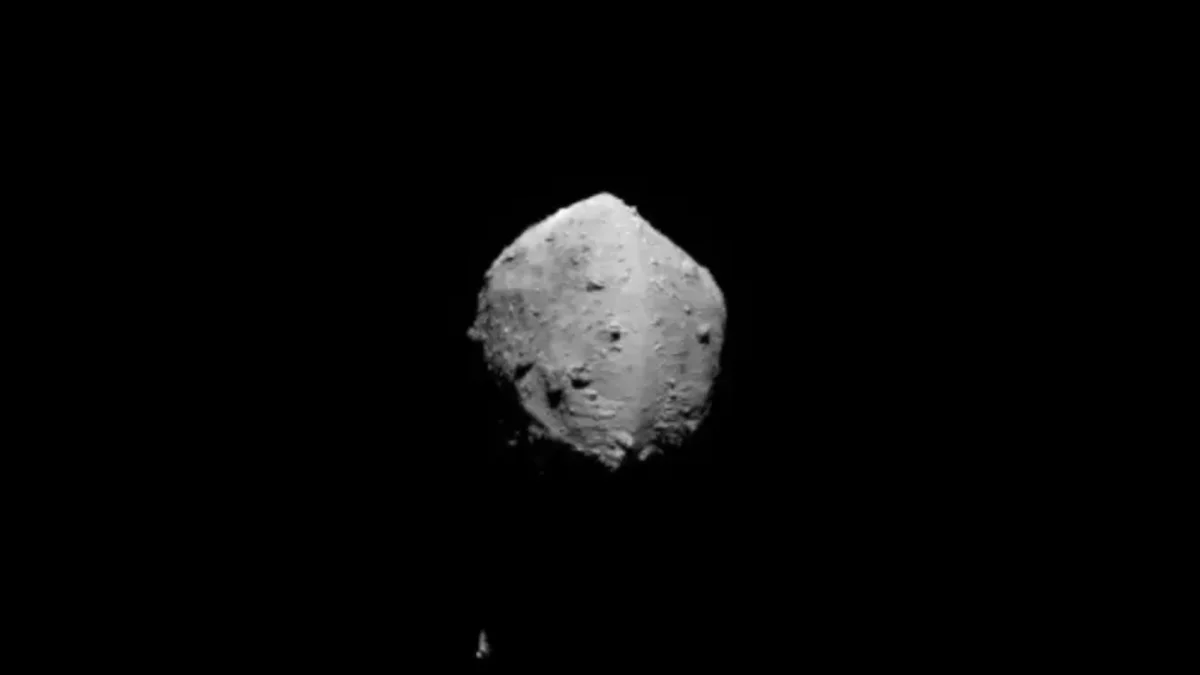
In September 2022, NASA’s Double Asteroid Redirection Test (DART) mission achieved a milestone in human history when it successfully impacted the asteroid moonlet Dimorphos, altering its orbital period around its parent body, Didymos. This controlled collision, conducted at a staggering velocity of approximately 14,000 miles per hour, was the first-ever demonstration of a kinetic impactor technique designed to protect Earth from potential future asteroid threats. While the immediate aftermath of the impact was observed by Earth-based telescopes and the DART spacecraft’s own camera until the final moments of destruction, a new era of granular analysis has begun. On November 5, the European Space Agency’s (ESA) Hera spacecraft, acting as a dedicated forensic investigator, beamed back its first high-resolution imagery of the Didymos system, marking the commencement of a comprehensive two-year survey of the impact site.
A New Perspective on a Celestial Laboratory
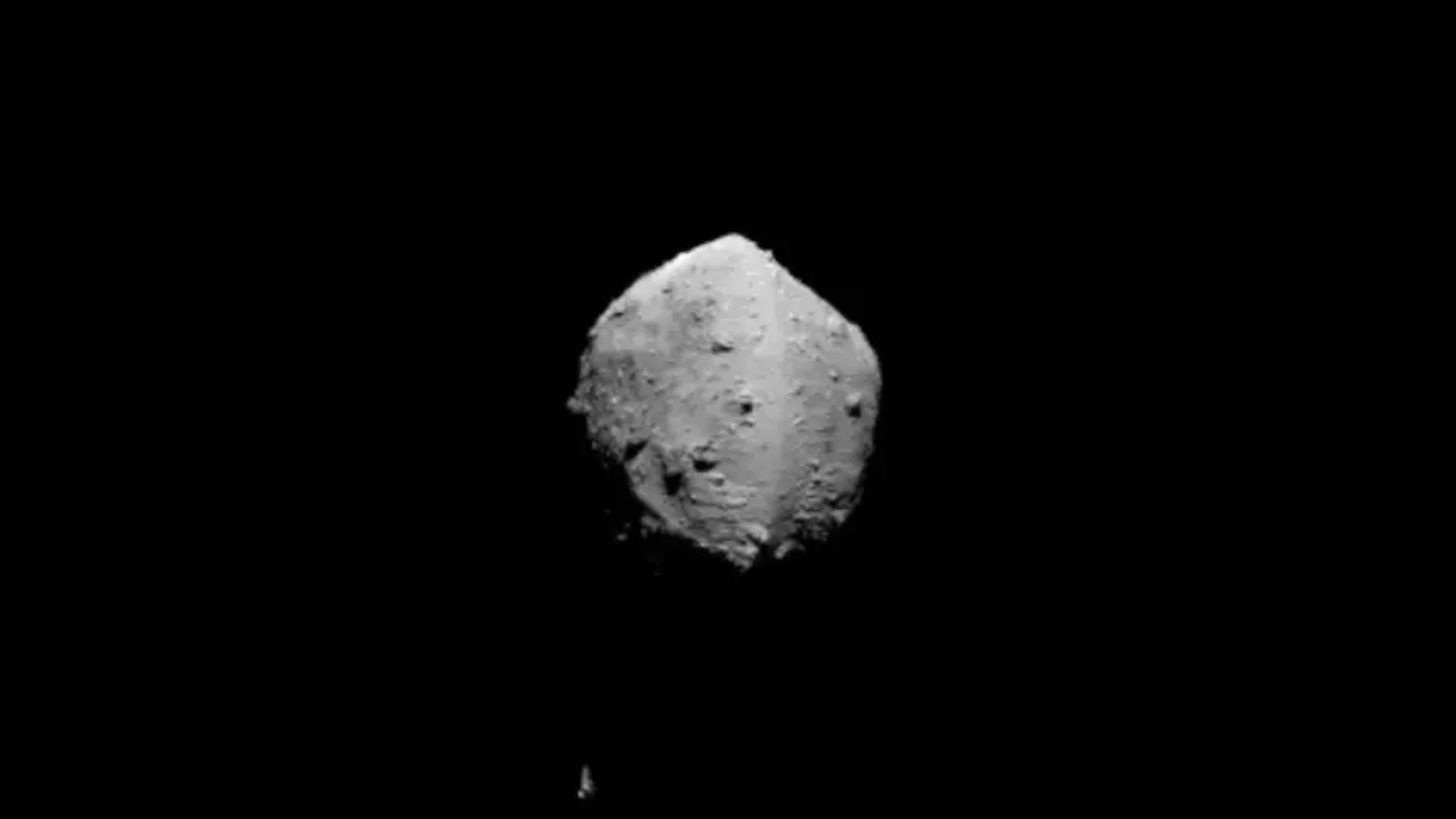
The image, captured from a distance of approximately 37 miles, provides an unprecedented look at the primary asteroid, Didymos. Measuring roughly 2,559 feet in diameter, Didymos serves as the anchor for the binary system. Although the specific crater created by the DART impact resides on the smaller moonlet, Dimorphos, the data gathered by Hera is vital for understanding the mechanical properties of the asteroid pair.
Patrick Michel, the Hera mission’s principal investigator, expressed the scientific community’s enthusiasm during the initial reveal of the data. The ability to view the side of Didymos that remained obscured during the DART mission’s final approach provides a hemispherical completeness that was previously impossible. By mapping the topographical features of the primary body, researchers can better understand the gravitational relationship between the two objects and how they have evolved in the wake of the 2022 intervention.
Chronology of the DART-Hera Campaign
The DART mission was conceived by NASA’s Planetary Defense Coordination Office to test the "kinetic impactor" strategy. The mission profile proceeded through several critical phases:
- November 2021: NASA launches the DART spacecraft aboard a SpaceX Falcon 9 rocket.
- September 26, 2022: DART makes contact with Dimorphos at 7:14 p.m. EDT. The impact resulted in a measurable shift in the moonlet’s orbit, shortening its trek around Didymos by 32 minutes—significantly exceeding the mission’s goal of 73 seconds.
- October 2024: The ESA launches the Hera spacecraft to conduct a detailed post-impact survey, ensuring the safety of the mission and the integrity of the data collected.
- November 2026: Hera reaches the binary system, initiating its primary science phase.
- November 25, 2026: The ESA is scheduled to release a more comprehensive set of imagery and spectral data detailing the surface composition of both asteroids.
Supporting Data and Technical Context
The DART mission was more than a test of trajectory; it was an experiment in material science. The kinetic impactor was a car-sized spacecraft weighing approximately 1,260 pounds. Upon impact, it ejected over 2 million pounds of rock and dust, creating a debris tail that stretched for thousands of miles. This massive ejection of material actually contributed to the effectiveness of the deflection, as the momentum of the departing debris acted as a secondary thruster, pushing the asteroid further than the impact alone would have achieved.
Hera’s primary mission objective is to measure the mass of Dimorphos, which remains a key unknown variable. By determining the mass, scientists can calculate the bulk density and internal structure of the moonlet. Is it a solid rock, or is it a "rubble pile"—a loosely bound collection of debris held together by weak gravity? The answer to this question is essential for planetary defense; an asteroid with a solid core requires different deflection energy than one that is essentially a floating cluster of gravel.
Official Responses and Collaborative Efforts
The Hera mission is a collaborative triumph for international space agencies. While NASA led the initial kinetic impact, the ESA’s Hera mission provides the essential "ground truth" that was impossible to capture in real-time during the high-speed collision. Michael Kueppers, a lead scientist on the Hera project, noted that the current images are merely the preliminary steps in a long-term analytical process. The team is currently utilizing specialized instruments on Hera, including high-resolution cameras and altimeters, to map the surface features of both bodies.
"We have exciting work ahead of us to sort it out," Kueppers stated. "We look forward to seeing much more of both bodies and systemically mapping all the changes we identify." This systematic mapping will involve identifying boulder distribution, crater morphology, and evidence of surface shifting that may have occurred due to the seismic waves generated by the 2022 collision.
Broader Implications for Planetary Defense
The implications of the DART-Hera success extend well beyond the Didymos system. By verifying the results of the DART mission, Hera is effectively validating the models used by planetary scientists to predict how an asteroid might react to an artificial impact. If an Earth-bound asteroid were discovered in the future, the time required to mount a defense mission could be limited. Understanding the internal structural integrity of asteroids allows planners to decide whether a single-impact approach is sufficient or if a more complex nuclear or multi-impactor strategy is required.
Furthermore, the study of Didymos and Dimorphos provides insights into the formation of our solar system. Binary asteroids are common, yet they remain under-studied. By investigating how these two bodies interact, scientists are gaining a clearer picture of how smaller celestial bodies form, accumulate, and interact with the solar wind and radiation pressure over millions of years.
Future Phases of the Investigation
As Hera continues its mission, the spacecraft will deploy two CubeSats—Milani and Juventas—which will perform closer, more intimate observations of the asteroids. These smaller craft will be capable of performing radar tomography of the interior of Dimorphos and sampling the surface dust to analyze its mineralogical composition.
The upcoming data release on November 25 is expected to provide the first clear views of the crater left by DART. Scientists are particularly interested in the ejecta patterns surrounding the impact zone, which will reveal the "strength" of the material that constitutes the moonlet. As the data flows back to Earth, the global scientific community stands ready to integrate these findings into a unified model of planetary defense, ensuring that should a threat arise, humanity will be prepared with the necessary data to act decisively.
The success of the Hera mission confirms that space exploration is a long-term commitment, where the dividends are paid in knowledge and security. As the spacecraft continues to orbit and photograph the binary pair, it serves as a testament to the capacity for international cooperation in the face of universal challenges. The Didymos system, once just a distant point of light, has become the most well-documented asteroid system in the history of astronomy, setting the standard for future planetary defense endeavors.

