
The Logistics of Extraterrestrial Construction
For decades, the primary barrier to establishing a long-term lunar presence has been the "tyranny of the rocket equation." Every kilogram of material sent from Earth into low-Earth orbit, and subsequently to the Moon, carries a prohibitive cost. NASA’s current Artemis program aims to return humans to the Moon, but establishing a permanent, habitable base requires significant structural shielding against cosmic radiation, thermal extremes, and micrometeoroid impacts.
By leveraging the lunar regolith—the loose, heterogeneous layer of dust and rocky debris that blankets the Moon—scientists hope to bypass the need for traditional terrestrial supply chains. The University of Arkansas research team, led by then-undergraduate Cole McCallum and supervised by Assistant Professor of Mechanical Engineering Wan Shou, has provided a critical proof-of-concept for this goal. Their method circumvents the need for binding agents, which have historically been the "Achilles’ heel" of lunar construction research.
Laser Powder Bed Fusion: A Precision Approach
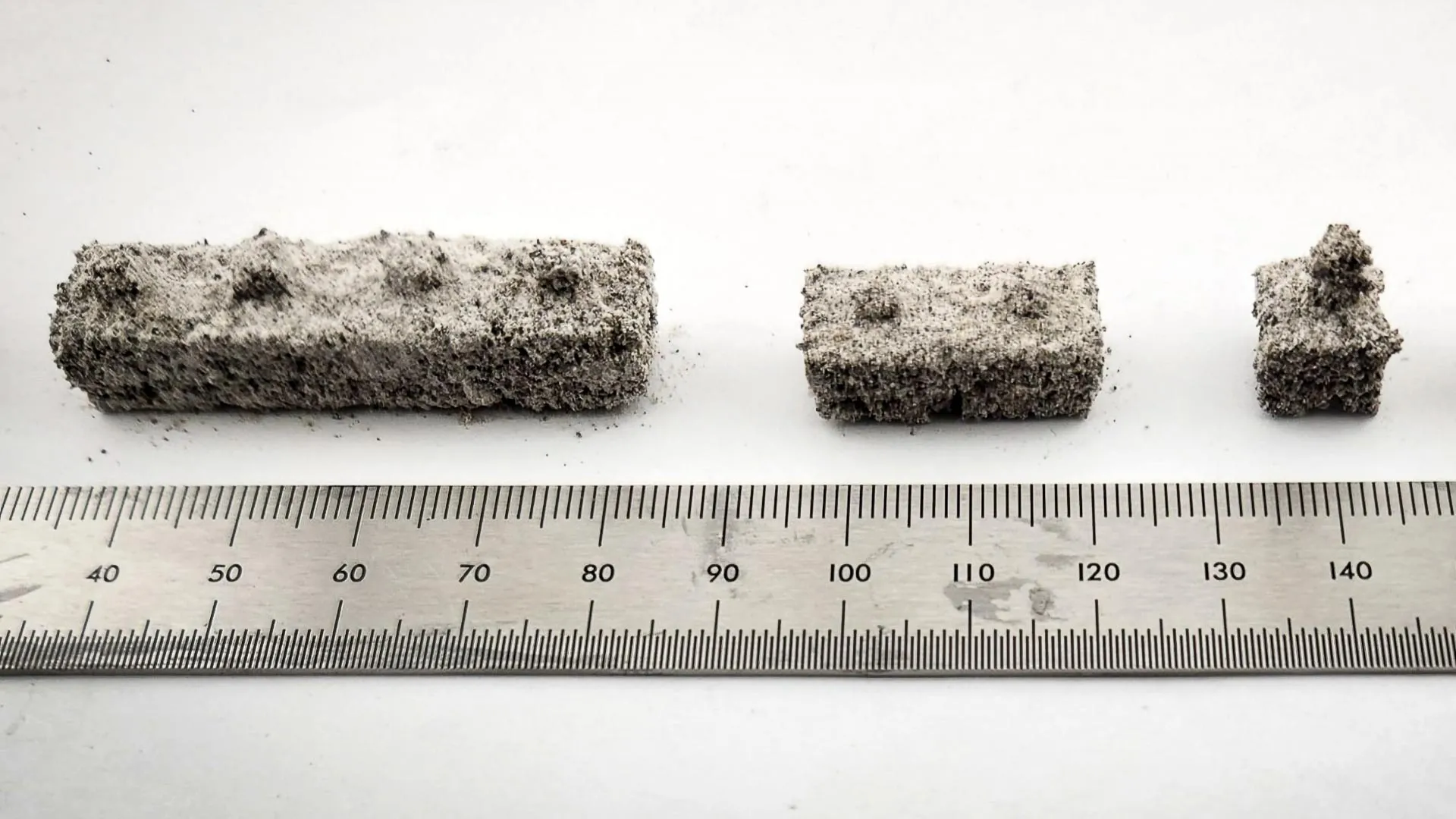
The core of the team’s success lies in a sophisticated additive manufacturing process known as laser powder bed fusion (LPBF). Unlike conventional 3D printing, which often uses polymers or resins, this technique works with raw, inorganic lunar simulant. The process involves depositing a thin, uniform layer of Lunar Highlands Regolith Simulant (LHS-1) onto a build platform. A high-energy, concentrated light source—a laser—then scans the surface, heating the particles until they reach their melting point and sinter together.
This process is repeated layer by layer, with the platform descending slightly each time to accommodate a new coat of powder. The result is a solid, three-dimensional object formed entirely from the regolith itself. The use of LHS-1, a commercially available material engineered to replicate the mineralogical and chemical composition of the lunar soil samples returned by the Apollo missions, ensures that the findings are scientifically grounded in real-world lunar conditions.
Overcoming the Binder Dependency
Previous academic and industrial attempts to manufacture lunar bricks have almost universally relied on binding agents—chemical adhesives or epoxies designed to solidify the loose dust. While these binders effectively create rigid structures, they introduce a significant dependency on Earth-based supplies. If a construction project requires tons of binding chemicals, the logistical savings of using local regolith are largely negated.
The University of Arkansas study marks the first time researchers have successfully sintered lunar simulant into modular, interlocking blocks without any additives. McCallum noted that the particles bond directly to one another through thermal fusion. "There’s nothing else it’s binding to. The regolith powder is binding to itself," he explained. This self-sintering capability is a major step toward total autonomy in lunar manufacturing.
The bricks produced in this study were designed with interlocking geometries, including cross and H-shaped profiles. These designs allow the blocks to function like modular construction kits, enabling the assembly of larger, more complex structures without the need for traditional mortar or mechanical fasteners.
Structural Limitations and Future Research
Despite the enthusiasm surrounding the discovery, the researchers remain transparent about the current limitations of their bricks. In its current iteration, the material possesses higher porosity and lower structural integrity than traditional concrete or bricks infused with binders.
"These structures we’re making can be self-supported," McCallum stated, adding a note of caution. "But I would be hesitant to say our process could be used for something that’s supporting other loads at this moment yet."
The challenges of transitioning this technology from a university laboratory to the lunar surface are non-trivial. Professor Wan Shou highlighted that the physics of additive manufacturing under Earth’s gravity and atmospheric pressure do not perfectly translate to the Moon. Lunar gravity is roughly one-sixth that of Earth, and the Moon is an environment of extreme vacuum. Future studies must determine how the laser-sintering process behaves when particles are not pinned down by terrestrial gravity and how the lack of atmosphere affects heat distribution during the sintering process.
A Catalyst for Undergraduate Scientific Development
The project also stands as a case study for the value of undergraduate-led research. McCallum, a Little Rock native, joined Professor Shou’s lab early in his collegiate career, eventually graduating with dual degrees in mechanical engineering and physics. His trajectory—from local laboratory experiments to a prestigious fellowship at ISAE-SUPAERO in Toulouse—highlights the importance of fostering hands-on research environments in higher education.
As an inaugural Lafayette Fellow, McCallum represents the next generation of aerospace engineers who will likely oversee the actual construction of lunar bases. He credits the "trial and error" nature of the regolith project for his professional development. The experience of navigating failed prints, optimizing laser parameters, and refining material density taught him the resilience required for high-stakes aerospace engineering.
Broader Implications for the Artemis Era
The implications of this research extend far beyond the university laboratory. As NASA and international space agencies shift their focus toward long-term occupation, the ability to build "in-situ" becomes a matter of mission success. If structural materials can be printed on-site, astronauts could theoretically construct radiation-shielded habitats, landing pads, and storage bunkers using nothing more than a laser printer and the lunar landscape.
A timeline for this technology remains speculative, but the progress made in the last five years indicates a rapid acceleration in additive manufacturing capabilities. Following the successful testing of this binder-less method, the next phase of research will likely focus on:
- Scaling: Increasing the size and production speed of the bricks.
- Environmental Simulation: Testing the printing process in vacuum chambers that mimic the lunar thermal environment.
- Mechanical Testing: Assessing how the bricks withstand extreme temperature cycling—ranging from 127°C in the lunar sun to -173°C in the shade—over long durations.
The University of Arkansas team’s work provides a foundational step toward the industrialization of the Moon. By proving that the regolith itself can serve as the primary building block, they have moved the needle toward a future where lunar colonies are not just outposts sustained by Earth, but self-sufficient nodes in the solar system.
As the scientific community continues to analyze the findings published in NPJ Advanced Manufacturing, the focus will shift to how these modular blocks can be integrated into broader habitat designs. If the porosity issues can be mitigated through improved laser modulation or thermal post-processing, the prospect of "printing" a lunar base from the ground up may transition from a compelling scientific hypothesis to a tangible engineering reality in the coming decades.
The work of McCallum and Shou serves as a reminder that the most significant leaps in space exploration are often forged on the ground, through the meticulous, repetitive, and often difficult process of scientific discovery. As humanity prepares to return to the Moon, the humble brick—reimagined through the lens of modern additive manufacturing—may prove to be the most important piece of technology in the history of human expansion.

