
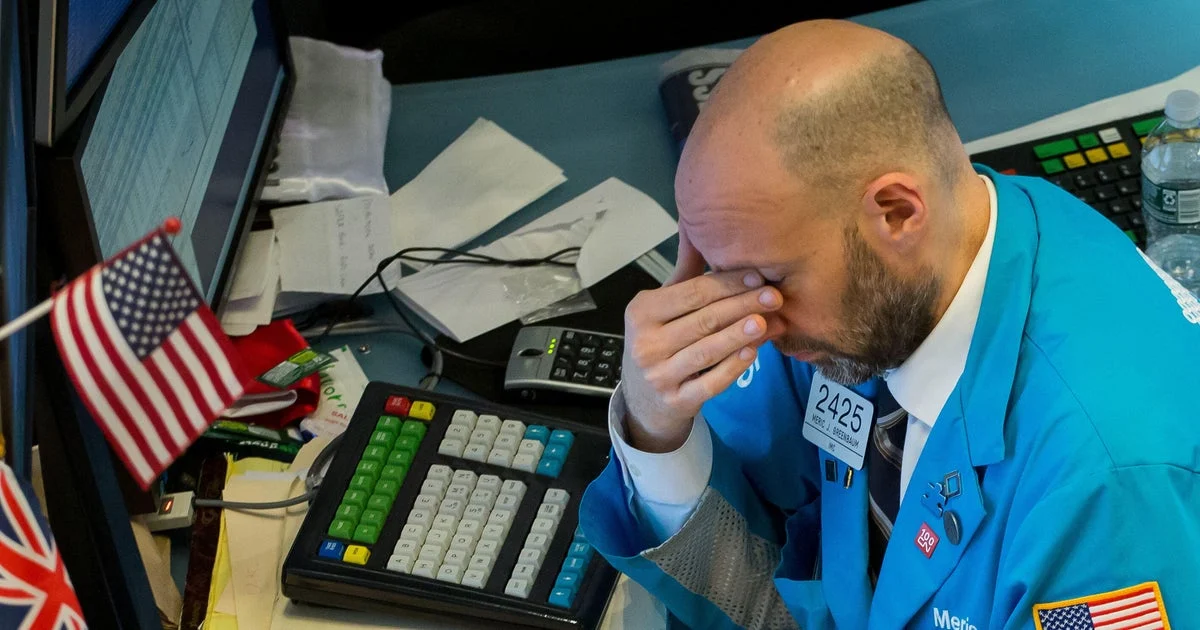
The United States stock market suffered a sharp and widespread reversal on Thursday, November 5, 2026, as investors pivoted from post-election optimism to anxiety regarding the regulatory future of the artificial intelligence sector. Following a historic rally on Wednesday, major indices plummeted as Wall Street began to digest the implications of a shift in congressional control. The primary driver of the downturn was a growing consensus that a Democrat-led Congress may prioritize environmental and local zoning concerns, potentially creating significant bottlenecks for the construction of energy-intensive data centers essential to the ongoing AI boom.
The tech-heavy Nasdaq Composite Index led the decline, falling 1,422 points, or 5.5%, to settle at 24,315. The S&P 500, a bellwether for the broader economy, retreated 335 points, or 4.6%, closing at 7,354. Meanwhile, the Dow Jones Industrial Average, which had enjoyed its most significant single-day gain of the year just twenty-four hours prior, surrendered 1,835 points, or 3.4%. This volatility underscores the fragility of investor sentiment in an environment where political shifts are increasingly viewed through the lens of industrial policy.
A Chronology of Volatility
The market’s recent trajectory has been defined by rapid oscillations tied to the 2026 midterm cycle. On Wednesday, November 4, the markets surged to record highs as the resolution of the midterm elections provided a sense of legislative certainty. For many traders, the end of electoral ambiguity—regardless of the specific outcome—was a signal to move back into risk-on assets.
However, the mood shifted by Thursday morning as research notes began to circulate regarding the specific legislative agendas of the incoming congressional majority. Analysts began to emphasize the "headline risk" associated with the energy demands of large-scale AI infrastructure. By the time the closing bell rang on Thursday, the enthusiasm of the previous day had been almost entirely erased, leaving market participants to reassess the long-term viability of the AI investment thesis.
The Data Center Dilemma
At the heart of the selloff is the massive physical footprint required by modern artificial intelligence. Data centers are the backbone of the AI revolution, requiring immense amounts of electricity and water to cool high-performance computing clusters. In recent months, public opposition to these facilities has grown, with local communities expressing concerns over grid strain and environmental impact.
Market watchers, including Chris Larkin, a managing director of trading and investing for E*TRADE from Morgan Stanley, pointed to "visible cracks" in the AI ecosystem. The concern is that the new congressional makeup may provide a platform for opponents of these projects to advocate for stricter federal oversight or environmental standards. If the pace of data center construction is throttled, the foundational assumption of the current AI bubble—that unlimited computing power will be available to support infinite scaling—could be challenged.
Sector-Specific Impact and Semiconductor Struggles
The impact of this sentiment was most acutely felt in the semiconductor and cloud infrastructure sectors. Nvidia, the leader in AI-focused graphics processing units, saw its shares decline by 7.5%, compounding a 3.2% loss from the previous day. Advanced Micro Devices (AMD) faced an even steeper decline, shedding 14.6% of its market value. CoreWeave, which has become a proxy for the growth of cloud-based AI infrastructure, fell 12.1%.
These companies are heavily leveraged against the continued expansion of data centers. Their business models rely on the assumption that global demand for AI chips will remain unabated for the foreseeable future. A slowdown in physical infrastructure deployment would effectively cap the total addressable market for these hardware providers, forcing analysts to reconsider their long-term earnings projections.
Beyond the tech sector, Trump Media & Technology Group (TMTG) continued to face downward pressure. Shares of the company, which owns Truth Social, fell 11% to hover around $4 per share. This decline continues a trend of extreme volatility for the stock, which reached an all-time low in the wake of the midterms, reflecting broader uncertainty about the future of digital media and political-tech alignment.
Economic Context and Global Factors
While the focus remains on the domestic political landscape, the broader financial environment remains complex. Brent crude oil prices rose 2.6% to $97.11 per barrel on Thursday, partially offsetting the massive 9% drop witnessed earlier in the week. This volatility in the energy sector is linked to persistent geopolitical tensions, particularly regarding the ongoing conflict involving Iran.
The interplay between energy costs and AI infrastructure is significant. High energy prices increase the operational expenditure of data centers, further complicating the profitability of AI startups and hyperscalers. If energy markets remain volatile, the combined burden of regulatory hurdles and rising utility costs could lead to a consolidation of the industry, where only the most well-capitalized firms can afford to sustain their growth.
Implications for the AI "Bubble"
Wall Street is now engaging in a broader debate regarding whether the AI boom has entered its final stages. Adam Crisafulli of Vital Knowledge noted that the midterms served as a catalyst for a reality check. "Whether the midterms shock turns out to be the catalyst that derails the AI equity boom remains to be seen," analysts suggested, "but it strengthens the sense that the current surge is in its final innings."
A "bubble" in financial terms is characterized by valuations that have decoupled from fundamental metrics. If investors conclude that the regulatory and infrastructure roadblocks are insurmountable in the short term, they are likely to rotate out of growth-heavy tech stocks and into defensive sectors, such as utilities or consumer staples. This shift could trigger a wider market correction, ending the era of easy capital that has defined the tech sector since the inception of the current generative AI wave.
Institutional and Political Outlook
The Democratic victory in the midterms has set the stage for a period of legislative friction. While the markets previously cheered the lack of gridlock, the specific legislative priorities of the new majority are now being analyzed for potential headwinds to corporate growth.
For the technology sector, the coming months will likely involve intense lobbying efforts. Companies will need to demonstrate that their data centers can operate within a framework of sustainable energy and community cooperation. If they fail to do so, the "AI infrastructure" argument—that these facilities are a public good essential for national competitiveness—may lose influence in Washington.
As the market enters the final quarter of 2026, the volatility observed this week serves as a stark reminder of the intersection between political outcomes and high-growth technology. Investors are no longer merely looking at interest rates or quarterly earnings; they are now forced to factor in the legislative reality of a nation grappling with the physical and environmental demands of the digital future. The coming weeks will likely see a period of price discovery as the market determines whether the tech sector’s current downturn is a temporary reaction to election-induced anxiety or the beginning of a structural shift in the tech-led economy.

