
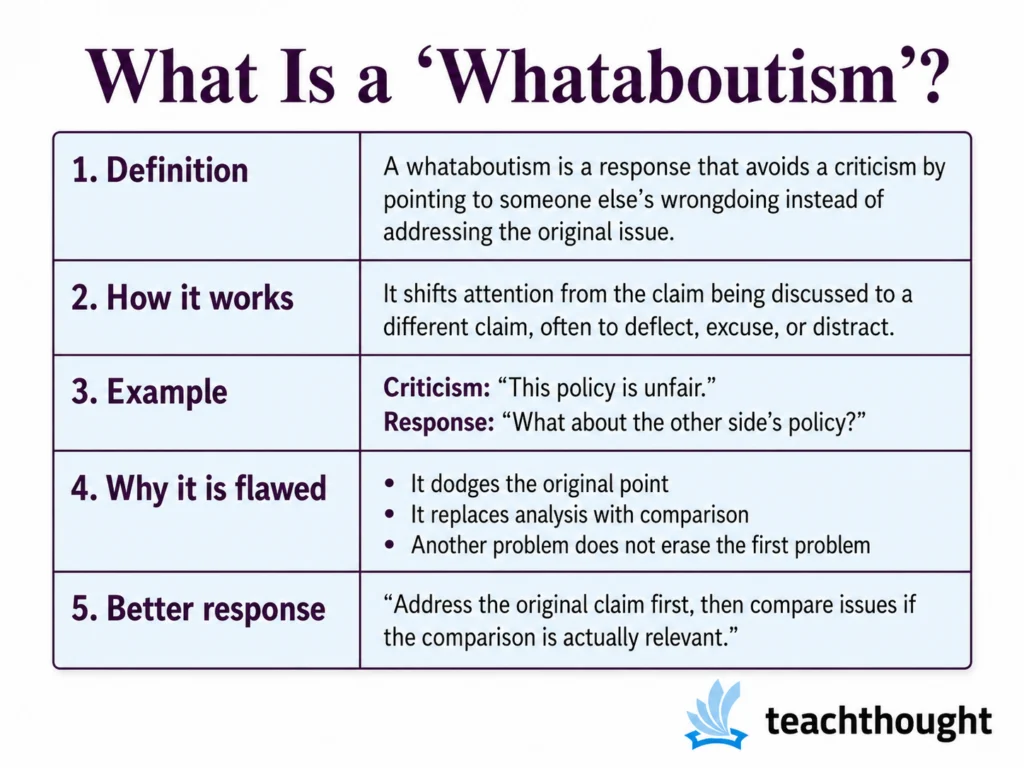
In the landscape of modern debate, whether across the geopolitical stage, digital media platforms, or academic classrooms, arguments rarely proceed in a linear, disciplined fashion. Instead, discussions frequently derail into a familiar rhetorical maneuver: whataboutism. Defined broadly as the practice of responding to an accusation, criticism, or direct question by pointing to a different problem or counter-offense, whataboutism functions not as a tool for genuine comparison, but as an effective shield of avoidance. By pivoting away from the topic at hand with the implicit or explicit inquiry of “What about this other thing?”, speakers can derail accountability while maintaining an outward facade of fairness and logic.
As public discourse grows increasingly polarized, identifying and dissecting this conversational tactic has become a critical competency for educators, journalists, and everyday citizens alike. While drawing comparisons remains a cornerstone of analytical thinking, distinguishing between a valid contextual analogy and a deliberate diversion is essential for maintaining productive dialogue.
Historical Context and Evolution of the Term
Although the conversational tactic itself is as old as human rhetoric, the term "whataboutism" rose to prominence during the Cold War. Historically, it was used to describe the propaganda strategies of the Soviet Union. Whenever Western critics condemned human rights abuses, economic stagnation, or political suppression within the Soviet bloc, Soviet officials and state media routinely countered by highlighting racial segregation, poverty, or foreign interventions in the United States. The standard rhetorical pivot—often colloquially encapsulated as "And you are lynching Negroes"—served to neutralize foreign criticism not by addressing the merits of the accusation, but by shifting the moral burden back onto the accuser.
In the post-Cold War era, and particularly with the advent of 24-hour news cycles and social media, whataboutism transcended international diplomacy. Today, it permeates domestic politics, corporate public relations, legal defenses, and interpersonal disputes. Modern communication technologies, which reward rapid-fire engagement and emotional polarization over nuanced deliberation, have supercharged this rhetorical habit. In digital forums, users deploying whataboutism can instantly flood a discussion with tangential grievances, effectively paralyzing consensus and exhausting opponents who attempt to steer the conversation back to the original issue.
The Anatomy of Deflection: Related Logical Fallacies
To fully understand whataboutism, it must be examined alongside the classic logical fallacies and argumentative maneuvers with which it shares a deep structural kinship. While these terms possess distinct technical definitions, they frequently overlap in practice:
- Tu Quoque (You Too): This fallacy attempts to discredit an opponent’s argument by accusing the opponent of hypocrisy or of having committed the same offense. For instance, if a public official is accused of financial mismanagement and responds by pointing out that their predecessor engaged in similar behavior, they are utilizing a tu quoque defense. While the accusation of hypocrisy may be accurate, it fails to exonerate the accused party or address the original charge.
- Red Herring: A classic diversionary tactic, a red herring introduces an entirely unrelated topic into the discussion to distract observers from the central issue. Unlike tu quoque, which relies on a parallel accusation, a red herring can pivot to a completely disparate subject simply to hijack the conversational momentum.
- False Equivalence: This error in reasoning occurs when two vastly different situations are treated as morally or logically equivalent while crucial contextual differences are ignored. Whataboutism frequently relies on false equivalence to make a minor infraction appear equal to a severe violation, or vice versa, thereby neutralizing valid distinctions.
- Deflection: A broad umbrella term for any conversational maneuver designed to avoid direct engagement with a claim, question, or piece of evidence. Deflection can take the form of counter-questioning, emotional appeals, or structural pivots.
Chronology of a Debate: How Whataboutism Derails Discourse
The lifecycle of an argument compromised by whataboutism typically follows a predictable trajectory, illustrating how a focused inquiry dissolves into circular recrimination.
- The Initial Claim or Question: A participant raises a specific, verifiable point of criticism or responsibility. For example, a supervisor tells an employee, "You missed the deadline for the quarterly financial report."
- The Deflection Point: Rather than engaging with the evidence—acknowledging the delay, explaining mitigating circumstances, or accepting responsibility—the respondent introduces an external grievance. The employee replies, "What about Sarah? She hasn’t even finished her data analysis, yet nobody is talking about her."
- The Divergence: The conversation fractures. The original issue (the financial report deadline) is momentarily abandoned as the participants begin debating Sarah’s workload, performance history, and departmental fairness.
- The Gridlock: The discussion becomes circular. Every subsequent piece of evidence is met with a corresponding counter-accusation. By the end of the exchange, accountability has evaporated, and the original problem remains unresolved.
Why Whataboutism Feels Persuasive
The enduring prevalence of whataboutism is not a result of poor human intellect, but rather a testament to its psychological potency. Whataboutism often succeeds because it frequently contains a grain of truth. The secondary issue raised by the speaker is often entirely real. The systemic flaws, hypocrisy, or errors attributed to the other party may be completely factual. Furthermore, the person employing the tactic often genuinely feels aggrieved, unfairly targeted, or singled out while others escape scrutiny.
This emotional resonance makes whataboutism exceedingly difficult to dismantle in real time. When an individual feels defensive, pointing out a broader pattern of inconsistency provides an immediate sense of vindication.
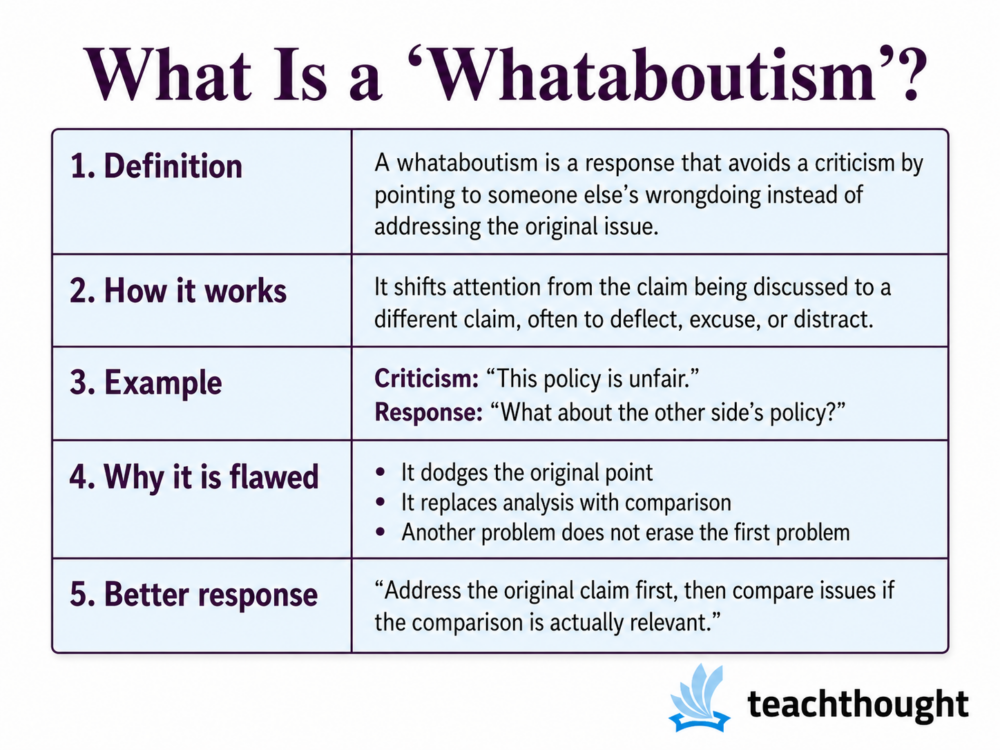
However, the fundamental flaw remains: a true observation about an external wrong does not cancel out the responsibility for the local infraction. A writer can accurately identify bias in a rival publication while still being required to substantiate their own unsupported claims. A student can correctly note that a peer failed to contribute to a group project while still being held accountable for their own lack of participation.
The Core Problem: Shifting the Question
The primary structural damage inflicted by whataboutism is its capacity to silently alter the foundational question of a debate. Healthy critical inquiry rests on specific evaluative questions: Is this empirical claim accurate? Was this specific administrative action justified? Did this individual fulfill their contractual obligation?
Whataboutism systematically replaces these questions with a completely different inquiry: Did someone else commit a similar or worse infraction?
When this substitution occurs, the nature of the discourse fundamentally changes. Accountability is rendered nearly impossible because no single actor can ever be held responsible for their actions if they can indefinitely point to a worse actor elsewhere. In legal, academic, and journalistic settings, this erosion of specific accountability degrades the quality of factual investigation and consensus-building.
Pedagogical Implications and Critical Thinking Strategies
For educators and institutions dedicated to fostering robust critical thinking skills among students, recognizing and combating whataboutism is a central priority. Classrooms, seminar rooms, and public forums are laboratories for evidence-based reasoning. When students default to whataboutism during a disagreement, it signals a need to reinforce structured questioning techniques.
Academic frameworks such as Socratic Seminars, targeted critical thinking prompts, and formal debate structures naturally inoculate discussions against deflection. By training students to anchor their claims in primary evidence and requiring them to address counterarguments directly before introducing external comparisons, educators help students separate relevant analytical analogies from hollow deflections.
The distinction is subtle yet vital: a constructive comparison illuminates the mechanics of the original issue by placing it in a broader context. Whataboutism, conversely, replaces the original issue entirely to escape scrutiny.
Conclusion
Whataboutism remains a powerful, pervasive rhetorical reflex designed to evade accountability through strategic distraction. While it often exploits genuine truths and real instances of hypocrisy, its ultimate function is to derail focused inquiry and prevent constructive problem-solving. For critical thinkers, journalists, and students alike, the goal is not to abandon the use of comparative context, but to wield it with precision. By consistently asking what a comparison actually clarifies—and ensuring that the original question is never lost in the shuffle—participants in modern discourse can move past superficial deflection and return the focus to evidence, responsibility, and truth.

