
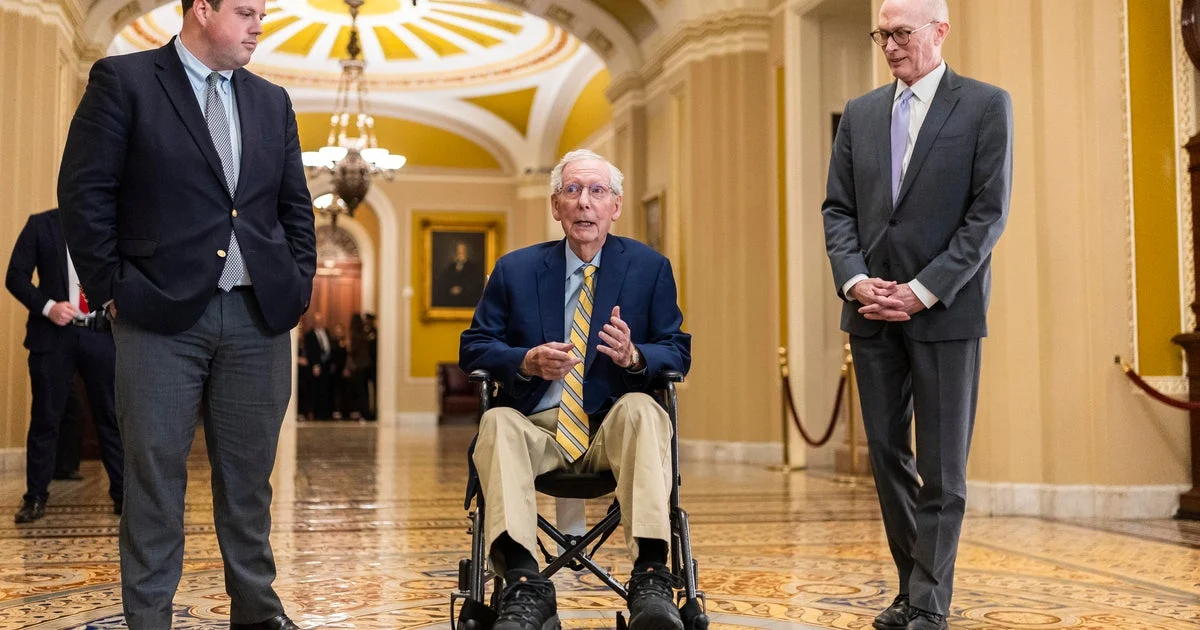
WASHINGTON — Senate Republican Leader Mitch McConnell made his long-awaited return to Capitol Hill on Monday, stepping back onto the Senate floor for the first time in three months following a severe physical injury sustained earlier in the summer. The appearance of the long-serving Kentucky senator effectively put to rest a wave of intense political speculation, media inquiries, and whispered concerns among colleagues regarding his capacity to finish his current term.
Entering the Senate chamber in a wheelchair, the veteran lawmaker was present to discharge his constitutional duties, casting a critical vote on an ongoing judicial nomination. The return marks a pivotal moment for the Senate Republican caucus, which has navigated a delicate legislative landscape during his prolonged absence. Prior to his arrival, McConnell released a concise and forward-looking statement via social media to address his return directly.
"Today, I’ll cast my first Senate vote since I took a bad fall back in June. I’m really looking forward to being back on the Senate floor and seeing my colleagues," McConnell stated.
The three-month hiatus underscored the fragile nature of Senate health dynamics and the intense scrutiny faced by aging leadership across the American political spectrum. While McConnell’s office had maintained regular communication regarding his rehabilitation process, the strict privacy surrounding the specifics of his medical condition had fueled a continuous cycle of rumors within Washington circles.
Background Context and the June Incident
The origins of McConnell’s extended absence trace back to a severe fall he experienced at his residence in June 2026. According to medical disclosures provided by his office at the time, the incident resulted in significant orthopedic trauma requiring immediate medical intervention, surgical procedures, and an extensive physical therapy regimen.
For a lawmaker who has built a reputation over decades as a tireless procedural tactician and a fixture of the Capitol corridors, a three-month absence is unprecedented outside of scheduled congressional recesses. McConnell, who has served in the United States Senate since 1985, has experienced a series of well-documented health challenges in recent years, each met with intense public interest. These incidents have frequently ignited broader national conversations concerning the advanced age of federal officeholders and the physical toll of high-stress legislative leadership.
Despite his advancing years and previous health scares—including a series of freezing episodes during press briefings in a prior congressional session—McConnell has consistently resisted calls from critics to step aside. His supporters have repeatedly pointed to his legislative acumen, institutional memory, and mastery of Senate rules as indispensable assets to the Republican conference, arguing that his physical limitations have not diminished his strategic capabilities.
Timeline of the Three-Month Hiatus
The timeline of McConnell’s absence highlights the rigorous demands placed upon congressional leaders and the vulnerabilities introduced when a key vote is sidelined:
- Late June 2026: McConnell suffers a severe fall at his home, prompting immediate hospitalization and subsequent orthopedic surgery. His office announces a temporary step-back from Senate duties to focus on intensive rehabilitation.
- July 2026: As the Senate enters the busy summer legislative period, McConnell’s absence is keenly felt during key committee markups and preliminary debates. Leadership duties are temporarily absorbed by senior members of his whip team and conference leadership.
- August 2026: During the annual August congressional recess, speculation regarding McConnell’s political future intensifies. Anonymous sources within both parties weigh in on whether he will return for the fall legislative sprint. His staff maintains that his recovery is progressing according to medical milestones.
- Early September 2026: Rumors circulate regarding a targeted return date. Leadership offices begin preparing for his physical accommodation on the Senate floor, factoring in wheelchair accessibility and mobility aids.
- September 14, 2026: McConnell officially returns to Capitol Hill, enters the Senate chamber in a wheelchair, and participates in a live roll-call vote on a judicial nomination, ending his 90-day absence.
Official Responses and Colleague Reactions
The reaction from Capitol Hill was swift, with lawmakers from both sides of the aisle acknowledging the milestone. Senate leadership on both sides of the aisle had maintained a supportive public posture throughout the ordeal, recognizing the personal human element of recovery alongside the stark political reality of a closely divided chamber.
Senate Minority (or Majority, depending on the current chamber majority) colleagues expressed visible relief upon seeing the Kentucky Republican return to the chamber. Several senators approached his desk to welcome him back, offering handshakes and brief words of encouragement ahead of the vote.
Political analysts noted that McConnell’s return provides a psychological and tactical boost to the Senate GOP conference. With critical budgetary deadlines, appropriations bills, and judicial confirmations pending on the autumn calendar, having a unified and physically present leadership structure is viewed as paramount by Republican strategists.
Outside of Washington, reactions varied along predictable political fault lines. Supporters praised his resilience and determination to fulfill the mandate entrusted to him by the voters of Kentucky. Conversely, watchdogs and political opponents used the occasion to reiterate broader arguments concerning term limits, age ceilings for federal officials, and the transparency of medical disclosures for elected leaders.
Broader Implications for the Senate and Leadership
Mitch McConnell’s resumption of his Senate duties carries profound implications for the remainder of the 2026 legislative calendar. The modern United States Senate operates on razor-thin margins, where a single absent vote can shift the outcome of tightly contested confirmations, executive branch appointments, and legislative packages.
During the three months that McConnell was away, the Senate machinery was forced to adapt, relying heavily on whip operations to ensure quorum and secure outcomes on critical votes. However, the prolonged vacancy at the helm of the GOP conference served as a stark reminder of the generational transition currently underway within American political leadership. As younger members eye future leadership slots, McConnell’s insistence on completing his term demonstrates his enduring commitment to steering the conservative agenda from the floor.
Moving forward, medical professionals and Capitol Hill observers will be watching closely to determine the pace of McConnell’s reintegration. While Monday’s appearance in a wheelchair indicates that full physical recovery is still ongoing, his immediate participation in a roll-call vote signals that his cognitive engagement and legislative focus remain undiminished.
As the fall legislative session gathers momentum, McConnell’s physical presence in the chamber ensures that his formidable institutional influence will once again be a direct factor in every major negotiation, cementing his legacy as one of the longest-serving and most consequential legislative leaders in modern American history.

