
Four years after NASA executed the groundbreaking Double Asteroid Redirection Test (DART), planetary defense has entered an unprecedented era of close-range forensic science. The European Space Agency’s (ESA) Hera spacecraft has successfully rendezvoused with the Didymos binary asteroid system, transmitting back the first high-resolution imagery of the cosmic scar left by human intervention. The initial data confirms that the kinetic impact did not merely carve a crater into the target asteroid, Dimorphos; it fundamentally reshaped its morphology, hurled hundreds of boulders into orbit, and left the smaller body tumbling unpredictably through space.
The arrival of Hera marks a critical milestone in international space cooperation and planetary defense validation. While telescopes on Earth and a tiny trailing CubeSat provided immediate confirmation of success back in 2003—err, 2022—astronomers and mission planners have spent the intervening years operating with incomplete data. The arrival of Hera bridges that knowledge gap, transforming a successful demonstration of technology into a comprehensive, high-precision scientific dataset.
Chronology of a Cosmic Collision: From Conception to Rendezvous
The narrative of this interplanetary investigation spans nearly a decade of careful planning, culminating in monumental milestones that have permanently changed our understanding of small bodies in the solar system.
In November 2021, NASA launched the DART spacecraft aboard a SpaceX Falcon 9 rocket from Vandenberg Space Force Base in California. The mission’s objective was singular and dramatic: target Dimorphos, the 500-foot-wide moonlet orbiting the larger asteroid Didymos, and slam into it at high velocity to test kinetic impactor technology.
On September 26, 2022, the solar-powered DART probe achieved its objective, executing a bullseye impact at approximately 13,700 miles per hour (6.14 kilometers per second). The collision released roughly 10 billion joules of energy, instantly vaporizing parts of the spacecraft and violently excavating the surface of Dimorphos. Ground-based and space-based observatories, including the Hubble and James Webb Space Telescopes, watched as a massive plume of dust and debris streamed millions of miles into space. Subsequent orbital measurements revealed that the impact had shortened Dimorphos’s 12-hour orbit around Didymos by an astounding 33 minutes—exceeding NASA’s most optimistic pre-mission expectations by a factor of 25.
Following the initial excitement, the scientific community recognized that a destructive flyby could only yield limited insights. To truly understand the mechanics of the collision, a dedicated rendezvous mission was required. This led to the development of ESA’s Hera spacecraft, which lifted off from Cape Canaveral, Florida, in October 2024. Following a carefully calculated two-year cruise phase—which included a gravity-assist flyby of Mars—Hera arrived at the Didymos-Dimorphos system in late 2026, positioning itself to conduct the first-ever detailed post-impact survey of an asteroid.
Anatomy of a Cataclysm: Hera Reveals a Reshaped World
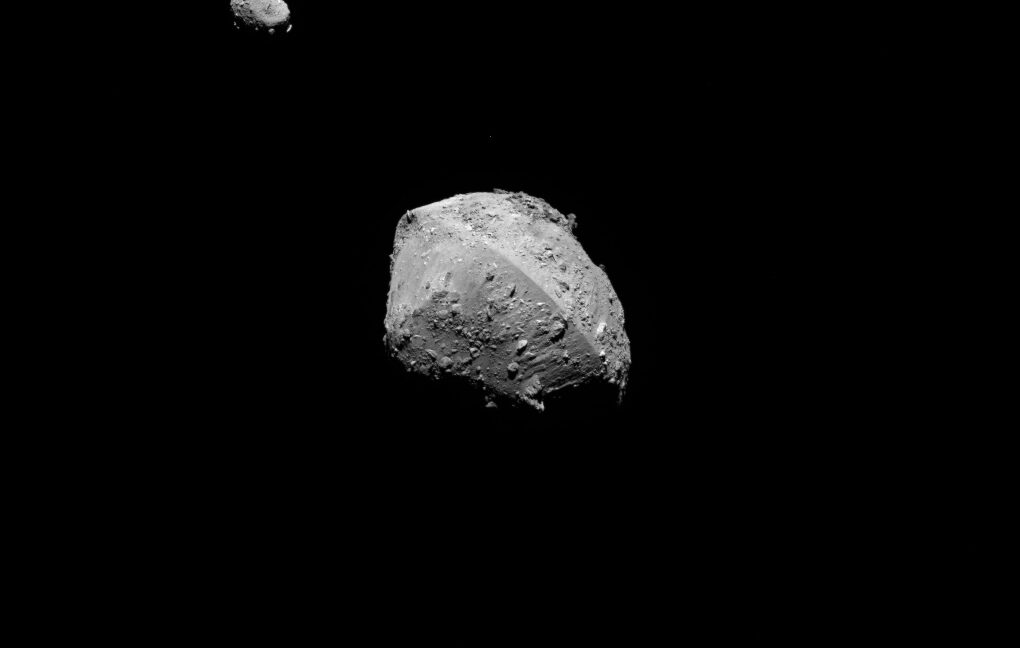
Upon reaching the binary system, currently orbiting the Sun approximately 120 million miles (193.5 million kilometers) from Earth, Hera’s advanced instrument suite immediately went to work. The early imagery released by ESA has astonished planetary scientists, revealing that the car-sized DART impactor punched above its weight class.
Instead of leaving a standard, localized impact crater, the energy transfer triggered a near-global transformation. The resulting crater is stadium-sized, occupying a massive portion of Dimorphos’s total surface area. According to mission investigators, the asteroid exists in a strange transitional state between localized cratering and total structural deformation.
Furthermore, while Didymos—measuring roughly 2,500 feet across—maintains a stable, uniform rotation, its companion is suffering from severe dynamical instability. Mission scientist Michael Kueppers noted that the severe kinetic shockwave left Dimorphos tumbling wildly in its orbit, disrupting its gravitational equilibrium and altering its rotational dynamics in ways researchers are only beginning to model.
The Boulder Swarm: Discovering Hundreds of Accidental Moons
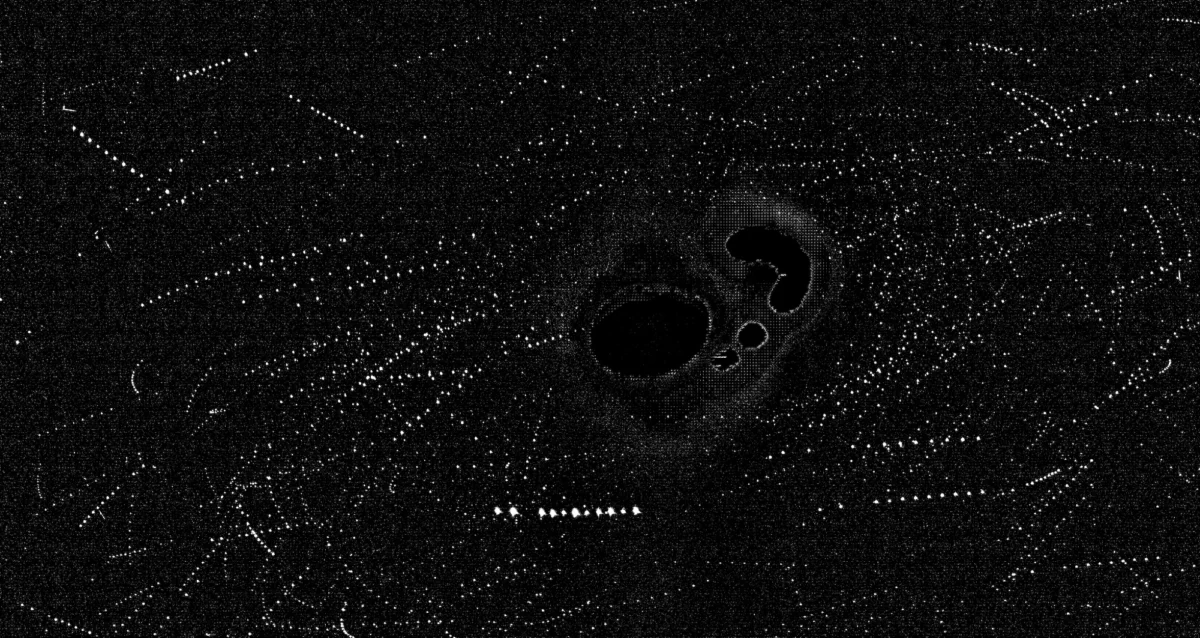
One of the most unexpected findings from Hera’s initial reconnaissance is the vast cloud of debris accompanying the binary system. While Hubble images captured a prominent dust tail shortly after the 2022 impact, Hera’s hyperspectral camera—specifically the Hyperscout-H instrument—revealed an immense swarm of solid rock fragments.
On November 6, operating from a distance of approximately 18.6 miles (29.9 kilometers) from the asteroids, Hera captured a series of long-exposure frames. When image processors digitally subtracted the bright bodies of Didymos and Dimorphos, the true scale of the debris field emerged. Hundreds of distinct dot trails appeared, representing rock fragments ranging in size from footballs to washing machines.
"Hera came to visit two asteroids, and we found hundreds of companions," said Naomi Murdoch, a planetary scientist at the Institut Supérieur de l’Aéronautique et de l’Espace in Toulouse, France.
While the most logical hypothesis attributes this boulder field to the kinetic violence of the DART impact, scientists are exercising caution. Because humanity has never studied a binary asteroid system at this level of sustained proximity, researchers cannot yet rule out the possibility that some of these orbiting fragments are ancient relics left over from the formation of Dimorphos itself. Resolving this question is one of Hera’s primary objectives over the coming months.
The Path Ahead: Future Operations and Planetary Defense Implications
Hera’s mission at the Didymos-Dimorphos system has only just begun. Over the next six months, the spacecraft will execute increasingly close flybys, mapping the surface topography, measuring internal densities, and assessing the precise mass distribution of both bodies.
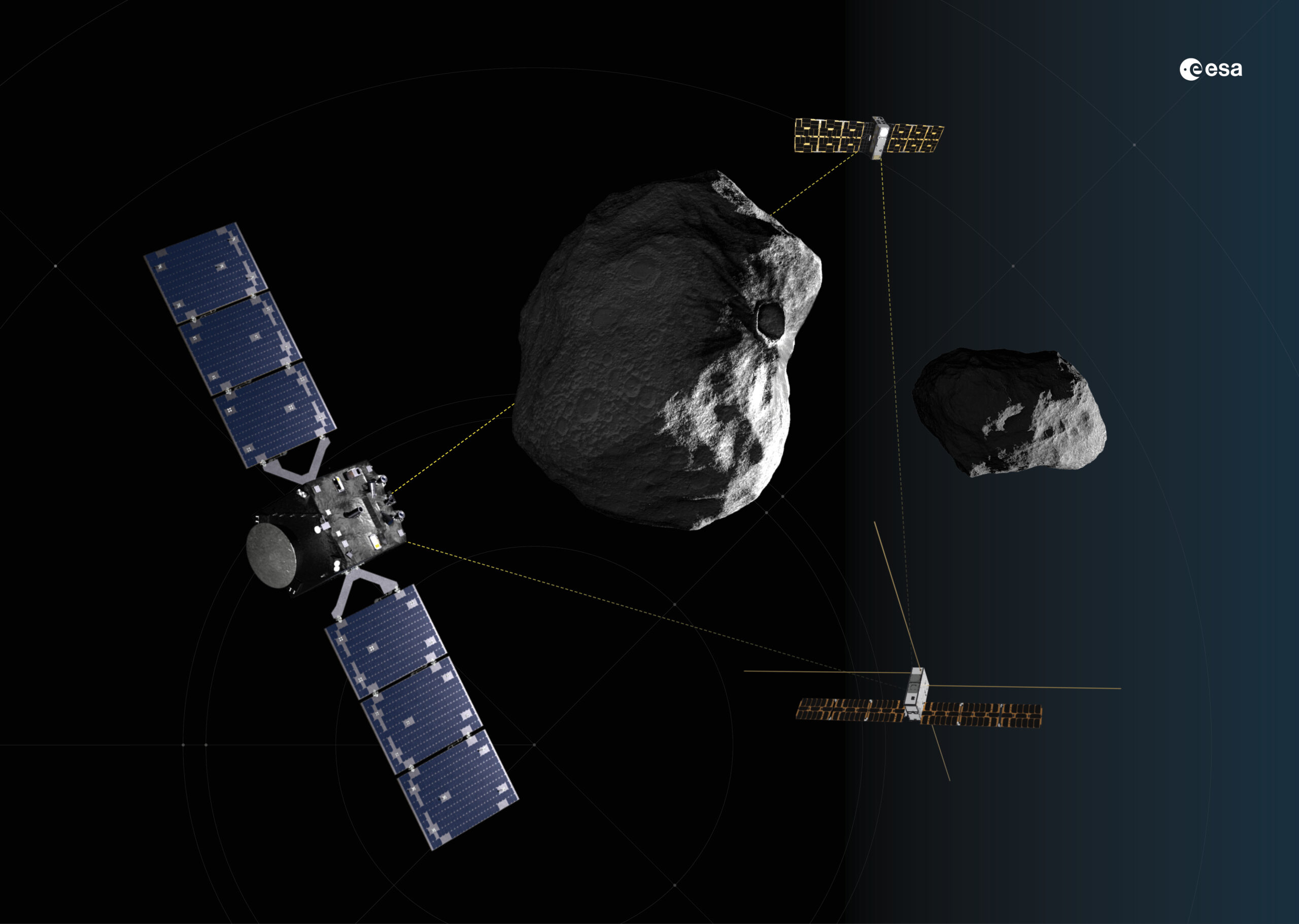
A critical component of this extended phase involves the deployment of two sub-satellites, Juventas and Milani. These small CubeSats will venture closer to Dimorphos, ultimately attempting touchdowns on the asteroid’s rugged surface. By deploying radar and gravimeter instruments directly from the surface and orbit, the CubeSats will gather unprecedented data concerning the asteroid’s internal composition and structural integrity.
The ultimate value of this multi-million-dollar international effort lies in predictability. Near-Earth objects vary wildly in porosity, composition, structural strength, and size. By anchoring advanced computer models to real-world empirical data gathered from Dimorphos, scientists will transition from theoretical estimations to verified engineering standards.
Patrick Michel, Hera’s principal investigator from the Côte d’Azur Observatory in Nice, France, emphasized the monumental stakes of the endeavor. "Once we understand, we have a breakthrough, which really solves planetary defense," Michel stated.
As Hera continues its orbital ballet around Didymos and Dimorphos, humanity is steadily constructing the empirical foundation required to safeguard the planet. By dissecting the aftermath of a controlled cosmic collision, scientists are ensuring that if a threatening asteroid ever targets Earth in the future, our response will be informed, precise, and definitively successful.

