
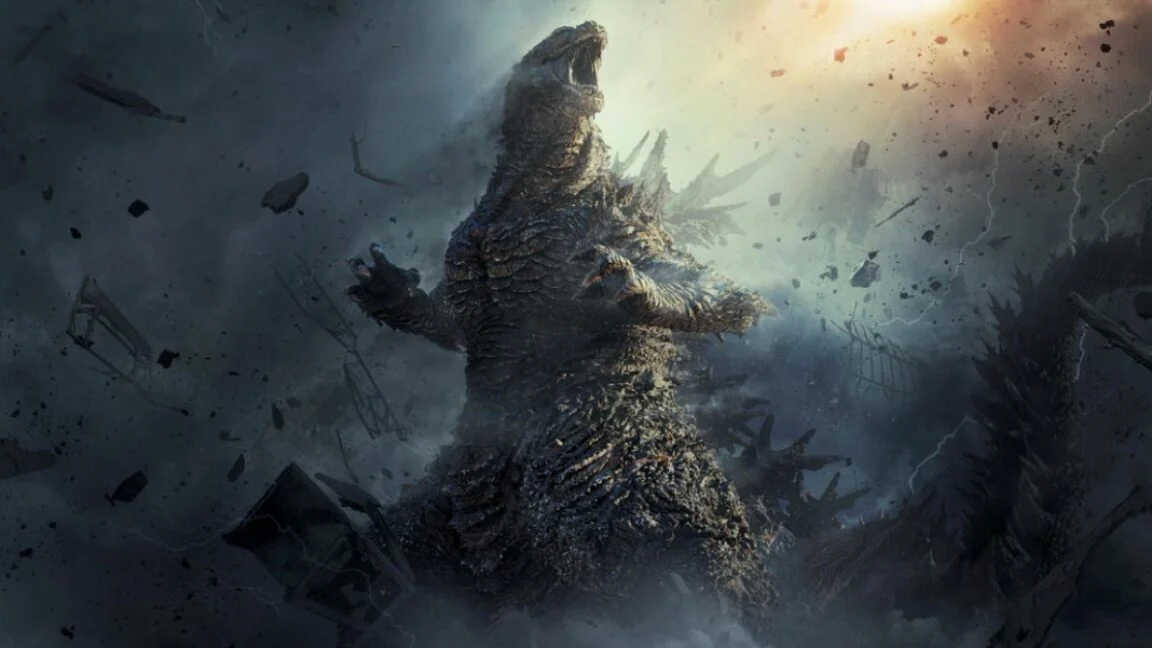
The cinematic landscape of the 21st century has continually redefined the boundaries of visual effects storytelling, yet few franchises have maintained the cultural longevity and technical evolution of Japan’s premier monster series. Set precisely two years after the cataclysmic events depicted in its predecessor, Godzilla Minus Zero re-establishes its narrative universe by returning to the lives of survivors attempting to rebuild amidst the ruins of post-war reconstruction. Ryunosuke Kamiki and Minami Hamabe reprise their acclaimed roles as Kōichi Shikishima and Noriko, alongside Mio Nagatani as Akiko. The domestic tranquility they desperately seek, however, is short-lived. A catastrophic celestial arrival—a mysterious meteorite—heralds the emergence of a new biological anomaly. Utilizing serpentine tentacles to consume local wildlife before rapidly mutating into a formidable dragon-like organism, this entity is immediately recognized by enthusiasts and long-term followers of the genre as King Ghidorah, whose terrifying silhouette was heavily teased across pre-release promotional campaigns.
The introduction of this iconic antagonist shifts the narrative from a localized struggle for survival into a sprawling geopolitical and scientific crisis. Kenji Noda, portrayed by Hidetaka Yoshioka—distinguished by his signature wavy gray hair and his authoritative position as the director of the Large-Scale Disaster Response Bureau—swiftly identifies the necessity of enlisting Kōichi’s expertise. Recognizing the former pilot’s unique tactical familiarity with catastrophic airborne and terrestrial threats, Noda incorporates him into an emergency coalition tasked with neutralizing the impending destruction. Meanwhile, meteorological data and atmospheric anomalies are expertly monitored by scientist Makoto Aoyama, played by Masami Nagasawa. Aoyama’s division successfully tracks Ghidorah’s trajectory by analyzing unprecedented electrical storms and erratic weather patterns. Despite this advanced technological tracking, the combined forces of scientific research and civil defense face a paralyzing deficit: an absolute lack of strategy regarding how to permanently incapacitate a biological entity of this magnitude and destructive capacity. Compounding these existential stakes is the inevitable narrative convergence, as pre-release expectations and logical plotting confirm the eventual return of a regenerated Godzilla to the geopolitical theater.
Evolution of Production Values and Visual Mastery
Director Takashi Yamazaki has successfully preserved the stark, atmospheric visual tone that rendered the preceding film a critical and commercial triumph. By blending the classic, reverent aesthetic of Showa-era creature features with twenty-first-century cutting-edge digital craftsmanship, Yamazaki has established a new benchmark for practical-digital hybrid filmmaking. Benefiting from a significantly expanded production budget—the direct result of the unprecedented global financial success of the previous installment—the director has noticeably elevated the sophistication of the special effects department.
Furthermore, Godzilla Minus Zero achieves a historic milestone for the franchise and the Japanese film industry as a whole: it is the first domestic motion picture filmed specifically for the IMAX format. Industry analysts and technical reviewers have widely noted that the native IMAX presentation offers an unparalleled sensory experience, maximizing the scale of the destruction and the intricate detailing of the computer-generated assets. A substantial portion of the enhanced budget was directly funneled into creature design, animation, and rendering pipelines. Ghidorah’s physical transformation is depicted with meticulous detail; following a coordinated military bombing campaign, the creature undergoes a violent biological mutation, evolving into its classic, highly anticipated three-headed King Ghidorah configuration. This iteration introduces a devastating new tactical capability: a specialized "gravity beam" capable of generating localized gravitational fields strong enough to levitate entire residential structures—and, in a pivotal sequence, Godzilla itself—high into the stratosphere before violently plummeting them back to earth.
Chronology of the Narrative and Tactical Escalation
To fully understand the structural progression of Godzilla Minus Zero, it is essential to examine the chronological sequence of events that govern the narrative arc. The timeline unfolds systematically over several key phases, establishing a deliberate pacing that contrasts quiet human drama with apocalyptic spectacle.
Phase One: The Interlude of Peace and the Celestial Arrival
The narrative begins precisely twenty-four months after Godzilla’s initial devastation of Tokyo. Kōichi Shikishima, Noriko, and young Akiko are shown attempting to integrate into a society struggling with post-war economic recovery. This fragile equilibrium is shattered when a blazing meteorite strikes a remote rural prefecture. Initial reports from regional authorities describe strange biological phenomena, including rapid ecological depletion and livestock mutilation caused by serpentine appendages.
Phase Two: Mobilization and Scientific Detection
Within seventy-two hours of the impact, the Large-Scale Disaster Response Bureau, under the leadership of Kenji Noda, initiates emergency protocols. Meteorologist Makoto Aoyama detects anomalous electromagnetic fields accompanying unusual storm systems moving inland from the coast. Recognizing the signature of a major kaiju event, Noda coordinates with maritime and ground self-defense forces while personally seeking out Kōichi Shikishima to secure his firsthand tactical insights regarding monster behavior and survival strategies.
Phase Three: The Transformation and Military Engagement
Ghidorah’s rapid terrestrial expansion prompts a full-scale conventional military response. Armed forces deploy heavy artillery and aerial bombing runs against the expanding creature. Rather than perishing, the organism absorbs the kinetic and thermal energy, triggering a rapid cellular mutation. The creature sheds its juvenile form to reveal the definitive three-headed King Ghidorah. During this engagement, the entity deploys its gravity beam technology, incapacitating the military defense grid and lifting urban infrastructure into the air, demonstrating absolute aerial and terrestrial dominance.
Phase Four: The Regeneration of the Titan and the Ultimate Clash
Faced with total annihilation and the failure of conventional military arsenals, the scientific coalition detects subterranean seismic shifts. Godzilla, having healed and regenerated from its previous injuries, breaches the surface to confront the alien interloper. The resulting conflict forms the explosive climax of the motion picture, matching massive scale with precise choreography to deliver a defining cinematic confrontation within the genre.
Budgetary Realities and Economic Implications
The financial trajectory of the modern monster film industry relies heavily on international distribution, premium-format ticket sales, and merchandising. Godzilla Minus Zero represents a calculated financial risk by Toho Studios, which authorized a substantially higher budget than typically allocated for domestic Japanese productions. Industry financial analysts suggest that the investment was heavily justified by the global resurgence of interest in giant monster cinema, driven largely by Western adaptations alongside Toho’s own critically acclaimed domestic releases.
The decision to film natively in IMAX cameras incurred significant logistical expenses, requiring specialized crew training, complex lighting configurations, and massive data management pipelines. However, preliminary box office data indicates that premium-format ticket sales have vastly outperformed baseline projections. In major metropolitan markets across Asia and North America, IMAX screenings have consistently recorded high occupancy rates, proving that audiences are willing to pay a premium for high-fidelity visual spectacles. This commercial success signals a major shift in how Japanese studios approach blockbuster financing, potentially paving the way for larger budgets, extended post-production schedules, and increased global simultaneous release strategies for future installments in the franchise.
Critical Reception and Audience Reactions
Upon its theatrical release, Godzilla Minus Zero drew widespread acclaim from both mainstream film critics and dedicated genre enthusiasts. Reviewers have frequently praised Yamazaki’s ability to balance grand-scale destruction with intimate, character-driven storytelling—a thematic core that has defined the most successful iterations of the franchise since its inception in 1954.
Audience reactions, measured through exit polling and major cinematic review platforms, have highlighted the emotional resonance of the human characters, particularly the continuation of Kōichi’s psychological healing. The transition from a bleak, survivor-focused drama in the previous film to an epic, multi-monster conflict in Godzilla Minus Zero was managed with sufficient narrative cohesion to satisfy fans of both traditional dramatic storytelling and unadulterated kaiju action. Social media discourse immediately following the premiere focused heavily on the design and execution of King Ghidorah, specifically praising the physical realization of the gravity beam mechanic and the sheer scale of the final battle choreography.
Broader Impact on the Kaiju Genre and Future Outlook
The release and subsequent triumph of Godzilla Minus Zero carry significant implications for the future of the kaiju genre on a global scale. For decades, giant monster cinema was frequently categorized as a niche market defined by rubber suits, practical miniatures, and campy subtexts. While those elements remain foundational to the historical appreciation of the medium, recent productions have successfully repositioned the genre as a legitimate platform for high-end dramatic storytelling, socio-political commentary, and cutting-edge visual effects engineering.
By demonstrating that a Japanese production can successfully utilize advanced digital rendering pipelines, native IMAX cinematography, and complex narrative structures while maintaining the thematic integrity of its origins, Toho Studios has established a new gold standard for international creature features. The seamless integration of King Ghidorah into the continuity established by the preceding film also opens up expansive possibilities for future cinematic expansions. Whether the studio chooses to explore additional classic antagonists from its extensive library or focus on deeper geopolitical ramifications within this alternate post-war timeline, the critical and commercial validation of Godzilla Minus Zero ensures that the legacy of these cinematic titans will continue to dominate the global box office for years to come.

