
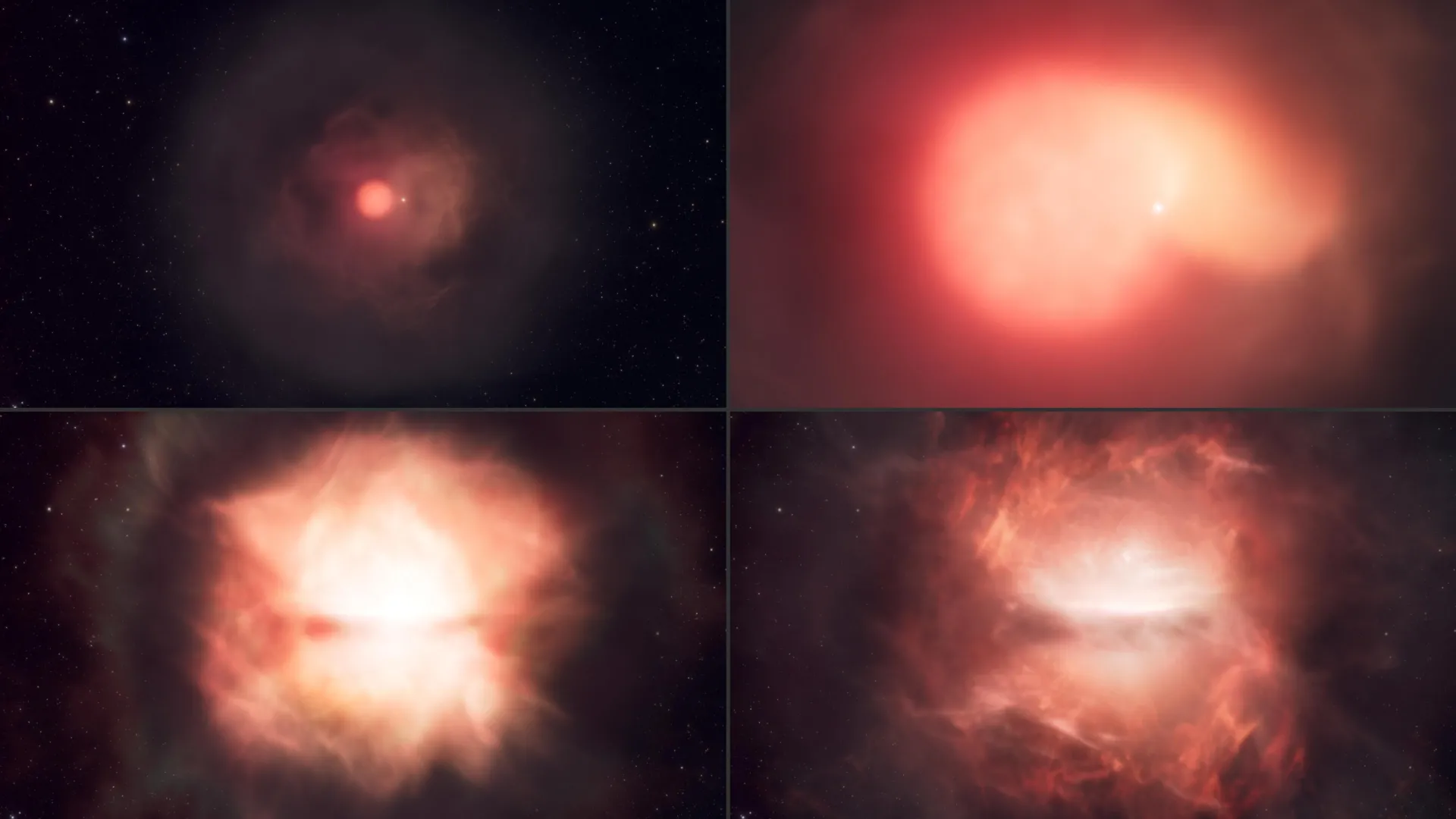
In a landmark achievement for modern astrophysics, an international team of researchers has documented the rare and violent process of a stellar merger within the Andromeda galaxy. This cosmic event, involving a massive supergiant star and a smaller, Sun-like companion, offers the first real-time observation of a phenomenon known as "common envelope evolution." By leveraging the unprecedented sensitivity of the James Webb Space Telescope (JWST) alongside a decade of archival data from multiple observatories, scientists have successfully reconstructed the final, turbulent years of the system now designated as AT 2025abao—affectionately dubbed "Bao."
The discovery provides a unique window into the life cycles of binary star systems, which are ubiquitous throughout the universe. While binary systems are common, the specific process by which one star is consumed by another has long remained a theoretical hurdle in stellar evolution models. The observation of Bao confirms that this "unification" can occur with surprising speed, fundamentally altering our understanding of how stars live, interact, and ultimately die.
A Chronology of a Cosmic Collision
The journey of Bao, as reconstructed by the research team, spanned centuries of relative stability followed by a chaotic, seven-year endgame. For millennia, the two stars—the colossal "Big Bao" and its smaller companion, "Little Bao"—orbited one another in a gravitational dance. Big Bao, a supergiant roughly seven times the mass of our Sun, possessed a radius 350 times that of our host star and radiated with 18,000 times the Sun’s luminosity. Little Bao, by contrast, was a modest star with approximately 70% of the Sun’s mass.
The stability of this system began to erode when the smaller star started brushing against the outer, diffuse atmosphere of its massive companion. This interaction triggered a process of orbital decay, where friction within the giant’s outer layers drained the companion’s energy, forcing it into an ever-tightening spiral toward the supergiant’s core.
The timeline of the final phase was remarkably accelerated. Unlike other documented mergers that might require thousands of orbital periods, the final unification of the Bao system occurred over just seven orbits—a mere seven years in cosmic time. By early 2023, infrared surveys began detecting subtle increases in the system’s brightness, signaling that Little Bao was actively stripping away the outer layers of its host. By 2024, observations confirmed the release of dust and gas into the surrounding space.
The climax arrived in late 2025. Following a period of rapid fading in visible light—a classic indicator of dust formation obscuring the system—the Zwicky Transient Facility recorded a violent eruption on October 17, 2025. The brightness peaked within a single week, a speed that caught the astronomical community off guard and prompted an urgent, multi-observatory response.
The Role of Technological Synergy
The ability to observe this event in such granular detail was made possible by a rare convergence of wide-field surveys and deep-space imaging. The detection of the precursor activity relied heavily on the NEOWISE mission, which provided the long-term baseline necessary to identify the initial shifts in luminosity. Subsequent data from the WINTER survey and the SPHEREx telescope provided the crucial mid-mission evidence of the system’s instability.
However, the most pivotal observations were captured by the James Webb Space Telescope. Granted "Director’s Discretionary Time" on December 24, 2025, the JWST provided mid-infrared data that peered through the veil of expelled dust. This data allowed researchers to confirm the merger and analyze the energy released during the final collapse. Viraj Karambelkar, a NASA Hubble Fellow at Columbia University and lead author of the study published in Nature, characterized the event as a "bomb exploding inside a living star," emphasizing that the Webb telescope’s follow-up—conducted just 47 days after the peak eruption—was the earliest ever recorded for such a phenomenon.
Scientific Implications: Common Envelope Evolution
The study of AT 2025abao serves as a cornerstone for understanding common envelope evolution. This phase occurs when a star expands to the point that it engulfs its companion, creating a shared atmosphere that exerts significant drag on the smaller object. Whether the two stars merge or survive as a tight, binary pair depends on the efficiency of energy transfer within this envelope.
Until now, much of our understanding of this process relied on theoretical simulations. The Bao data has provided a reality check for these models. "We previously believed an outburst from a star of this size would take years to develop," noted co-author Nadia Blagorodnova of the University of Barcelona. "Seeing the brightness rise and peak within a week fundamentally changes our temporal expectations for these events."
The implications extend far beyond the fate of one stellar pair. Binary systems are the progenitors of some of the most energetic phenomena in the universe, including supernovae, neutron star mergers, and the gravitational waves detected by LIGO. By observing how these systems evolve, astronomers can better predict the frequency and characteristics of these high-energy events. For instance, stars that survive the common envelope phase may go on to become millisecond pulsars or black holes, depending on their remaining mass and rotation rates.
A New Era of Time-Domain Astronomy
The investigation into Bao highlights the maturation of time-domain astronomy, a field dedicated to monitoring the changing sky for transient phenomena. The success of the research team in identifying the "warning signs"—the subtle brightening and subsequent dust expulsion—suggests that with the right tools, we can catch these events as they occur rather than analyzing their remnants after the fact.
This capability is poised to expand exponentially. The upcoming operations of the Nancy Grace Roman Space Telescope, particularly its Galactic Bulge Time-Domain Survey, are expected to produce a "firehose" of similar data. By monitoring millions of stars for minute changes in brightness, the Roman telescope will likely identify dozens, if not hundreds, of similar stellar interactions.
"There is a massive shift coming in how we study stellar death and evolution," said Kishalay De, an assistant professor at Columbia University. "We are moving from a reactive mode to a proactive one, where we can track the precursors of these massive collisions in real-time."
Future Research and Remaining Questions
While the merger of the Bao system has been confirmed, questions remain regarding the "rejuvenated" star that emerged from the event. The surviving object is a hybrid of two distinct stellar bodies, and its internal structure, chemical composition, and long-term stability are currently subjects of intense modeling. Researchers intend to continue monitoring the system to determine how the newly merged mass settles and whether it will eventually exhibit signs of anomalous rotation or unusual chemical signatures in its outer atmosphere.
The collaboration between ground-based observatories, legacy satellite missions like NEOWISE, and the cutting-edge capabilities of the JWST represents a blueprint for future astrophysical research. By integrating multi-wavelength observations with sophisticated computer simulations, the scientific community has successfully demystified one of the most complex interactions in the stellar kingdom.
As the data from the Bao eruption continues to be analyzed, it will undoubtedly refine our models of binary evolution. The event acts as a bridge between the theoretical physics of the late 20th century and the high-fidelity observational era of the 21st. For now, the "rejuvenated" star remains a testament to the violent, transformative processes that shape the Andromeda galaxy and, by extension, the evolution of galaxies across the observable universe.
The study, which received partial funding from NASA’s Astrophysics Data Analysis Program, underscores the ongoing commitment of international space agencies to unlocking the secrets of our cosmic origins. With every transient event identified and tracked, the map of our stellar neighborhood becomes more detailed, revealing the intricate, often explosive, connections that link the birth of stars to the fundamental structure of the cosmos. As we look toward the next generation of space telescopes, the story of Bao serves as a compelling reminder that the universe is not a static canvas, but a dynamic, ever-changing environment where the death of one system often marks the dramatic, energetic birth of another.

