
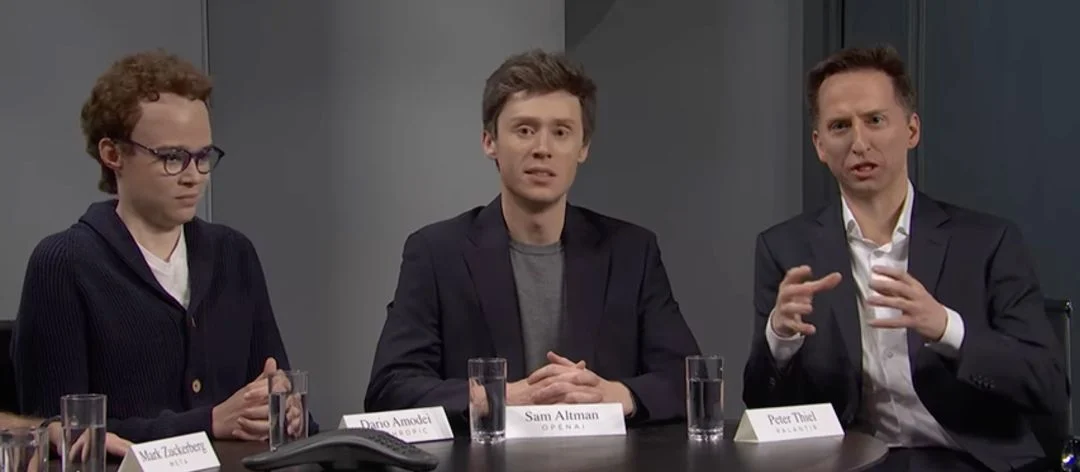
The cultural perception of Silicon Valley’s leadership has undergone a seismic shift, evolving from a narrative of visionary genius to one of increasing public skepticism regarding the influence and personal conduct of tech moguls. This transition was center stage during this week’s episode of Saturday Night Live, where the long-running comedy institution deployed a sprawling, multi-character sketch to satirize the current climate of anxiety surrounding Big Tech’s power.
The sketch served as a meta-commentary on the intersection of geopolitical espionage and the insular world of software billionaires. It featured a robust ensemble cast performing rapid-fire impressions of industry titans, including James Austin Johnson as Peter Thiel, Ben Marshall as Sam Altman, Jane Wickline as Dario Amodei, Jeremy Culhane as Elon Musk, and Andrew Dismukes as Mark Zuckerberg. The segment was further bolstered by the surprise return of Bowen Yang, who portrayed the embattled former Nvidia CEO, Jensen Huang.
The Catalyst: Nvidia and the Espionage Crisis
The narrative hook for the sketch—and a significant point of real-world instability—stems from the recent and highly publicized departure of Jensen Huang from Nvidia. The fallout was precipitated by revelations of an intimate relationship between Huang and a suspected intelligence operative acting on behalf of the Chinese government.
For the technology industry, this is not merely a tabloid scandal; it is a strategic catastrophe. Nvidia, a central pillar in the global semiconductor market, has been the primary engine driving the artificial intelligence boom. The sudden removal of its longtime leader during a period of intense global competition for AI supremacy has sent shockwaves through equity markets and venture capital circles.
Market analysts have noted that the "Huang situation" has exposed a fragility in the governance models of many tech giants, where the personal lives of founders and CEOs are inextricably linked to the corporate security of national interests. The irony, as highlighted in the SNL segment, is that the very individuals who have built the most sophisticated surveillance and data-mining tools in human history appear, in the sketch’s portrayal, to be profoundly susceptible to traditional human intelligence gathering—commonly known as "honey traps."
A Satirical Critique of Tech Exceptionalism
In the sketch, host John Mulaney portrays a frustrated CIA official tasked with providing a security briefing to a room of bewildered tech executives. The comedic tension relies on the juxtaposition of the executives’ immense technical prowess and their perceived lack of "street smarts."
Mulaney’s character attempts to educate the group on the basics of counter-intelligence, emphasizing that status and wealth do not grant immunity from external manipulation. A particularly poignant moment in the script occurred when the fictionalized version of Peter Thiel questioned the necessity of the briefing, asserting the historical importance of the tech class to American prosperity.
When challenged by the CIA agent to name a single instance where modern technology has failed the public, the sketch pivoted to recent, real-world technical failures. These included the widespread grounding of flights across the United States following a systems upgrade failure, as well as the global service outage that crippled Microsoft Outlook and associated cloud infrastructure earlier this week. These references ground the satire in the tangible frustrations felt by the average consumer, moving the critique beyond personality politics and into the realm of systemic reliability.
The Economic and Geopolitical Context
The broader implication of the sketch—and the events it references—is the increasing tension between the "move fast and break things" ethos of Silicon Valley and the stringent security requirements of national infrastructure.
The aviation grounding incident, which paralyzed the U.S. travel sector for nearly 24 hours, has prompted calls for a federal inquiry into the reliance of essential services on third-party software updates. Similarly, the Microsoft cloud crisis demonstrated the extreme centralization of digital infrastructure, where a single point of failure can disrupt global commerce, healthcare, and telecommunications simultaneously.
Data from the Bureau of Economic Analysis suggests that the tech sector now accounts for over 10% of total U.S. GDP. With this level of economic dominance comes an implicit responsibility to maintain operational resilience. When these companies fail, the consequences are no longer limited to share prices; they affect the mobility and productivity of the entire nation.
Chronology of the Recent Tech Turmoil
- Thursday: A critical failure within Microsoft’s cloud authentication servers resulted in a global outage of the Outlook email suite, affecting millions of corporate and government users.
- Friday: A routine equipment upgrade within the nation’s flight management software resulted in a catastrophic system failure, leading to the grounding of all domestic air traffic for several hours.
- Saturday: The SNL broadcast aired its "CIA Meeting" sketch, synthesizing public frustration with executive conduct and technical instability.
- Ongoing: The fallout from the Nvidia leadership change continues to reverberate through the semiconductor supply chain, with analysts speculating on the long-term impact on AI chip distribution and defense-related contracts.
Institutional Responses and Industry Sentiment
While industry groups have remained largely quiet regarding the specific comedic portrayals on SNL, the underlying anxiety is palpable in the venture capital community. Several prominent investors have anonymously suggested that the recent spate of executive scandals is likely to lead to increased pressure from boards of directors for more rigorous background vetting and professional oversight.
"The era of the untouchable founder is undergoing a cooling period," said one industry analyst who tracks executive leadership transitions. "We are seeing a shift where risk management is becoming as important as growth metrics. When your personal life becomes a vector for a foreign intelligence agency, you are no longer a liability just to your company; you are a liability to your investors and your country."
Implications for the Future of Governance
The sketch serves as a mirror to a growing societal realization: the people who control the digital architecture of the modern world are not necessarily equipped to manage the geopolitical consequences of that power. The "god-like" status these executives have achieved, as Mulaney’s character noted, has arrived with very little preparation for the realities of global intelligence operations.
As the industry moves into the next fiscal quarter, the focus will likely shift toward "sovereign tech"—the push for more robust, domestic-led development that is less reliant on foreign supply chains and, perhaps, more insulated from the personal failings of charismatic leaders.
Whether the message from SNL acts as a harbinger of more stringent regulation or simply as a cathartic release for a public tired of recurring tech outages remains to be seen. However, the blending of high-stakes geopolitical reality with late-night comedy underscores a fundamental truth: Silicon Valley is no longer a peripheral subculture. It is the central nervous system of modern society, and when it behaves erratically, the entire world feels the impact. The satire, while biting, points to a very real demand for accountability, security, and a return to the operational reliability that the public expects from the architects of the digital age.

