
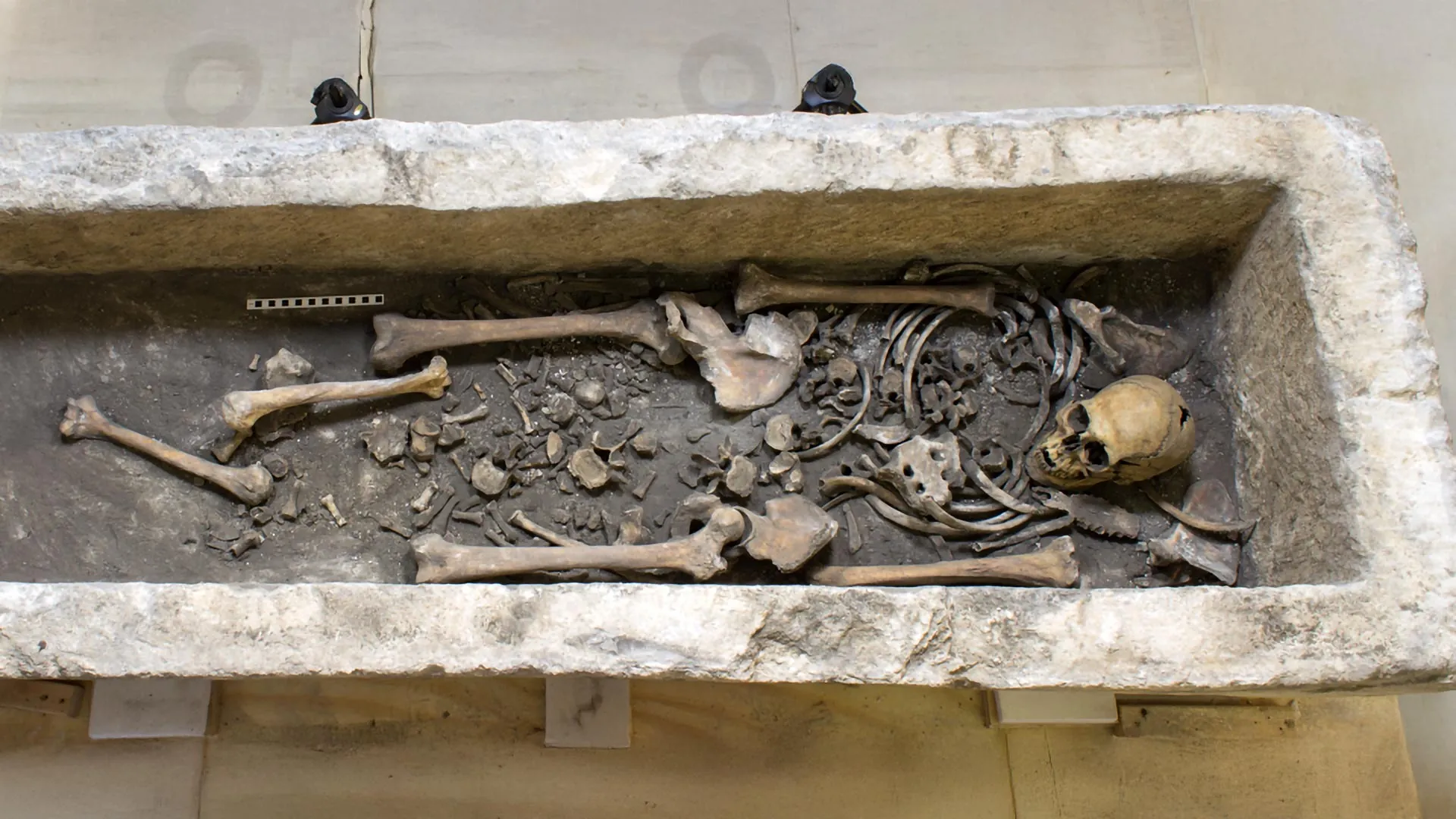
For over 150 years, a limestone sarcophagus housed within the hallowed grounds of Westminster Abbey has stood as a silent puzzle, its contents seemingly at odds with its external markings. While the stone vessel bears an inscription identifying its original occupant as Valerius Amandinus—a wealthy Briton from the late Roman era—the physical evidence contained within tells a vastly different story of medieval repurposing and ecclesiastical prestige. Recent archaeological investigations, culminating in a comprehensive analysis published in the Journal of the British Archaeological Association, have finally begun to reconcile these contradictions, suggesting that the coffin served as the final resting place for a high-ranking Benedictine abbot during the late Saxon period.
A Chronology of Discovery and Misconception
The history of the sarcophagus is a complex narrative of accidental discovery, misidentification, and eventual scientific clarification. The first modern encounter with the artifact occurred in 1820, when construction workers operating near the north side of Westminster Abbey inadvertently struck the stone coffin, fracturing its lid into six distinct fragments. At the time, the site was associated with the location of King Henry III’s original 13th-century sacristy.
It was not until 1869 that the sarcophagus was formally excavated and documented. For generations, the burial was viewed through the lens of its Roman inscription, which dates to the 4th century AD. However, a significant anomaly—a large, incised Latin cross on the lid—pointed to a much later origin. Stylistic analysis of this carving placed it in the 10th or 11th century, creating a temporal gap of several hundred years between the coffin’s manufacture and the carving of the Christian symbol.
The mystery deepened in the 20th century, as the whereabouts of the skeleton once found within the coffin became unclear. Many researchers operated under the assumption that the remains had been lost or mislaid during the various renovations and archaeological surveys conducted throughout the Abbey’s long history. This belief persisted until 2016, when the sarcophagus was moved to a specialized conservation studio for further study. Upon removing the heavy lid, researchers from Pre-Construct Archaeology (PCA) were astonished to find the remains were not only present but remarkably intact.
Scientific Breakthroughs: Carbon Dating and Bioarchaeology
The identification of the occupant required a multidisciplinary approach, blending historical record with modern forensic science. A bone sample was submitted to the Scottish Universities Environmental Research Centre for high-precision radiocarbon dating. The results, providing a date range between 987 and 1052 AD, effectively eliminated the Roman-era Valerius Amandinus as the occupant and firmly established the burial within the late Saxon period.
This chronological window aligns with a transformative era for Westminster Abbey. During this time, the Abbey functioned as a prominent Benedictine monastery, and the prestige afforded to its leadership was immense. The bioarchaeological profile of the skeleton further supports the status of a high-ranking official. James Young Langthorne, a specialist at PCA, conducted a detailed osteological examination of the remains. His analysis revealed the occupant to be a male between 35 and 49 years of age, standing approximately 5 feet 9 inches tall.
These findings corrected a previous assessment from the 19th century, which had erroneously described the individual as a "robust young man" of shorter stature. The updated profile—a mature, well-nourished adult—is consistent with the dietary and lifestyle expectations of a high-ranking church official in the 11th century.
The Leading Candidates: Aelfwig and Wulnoth
Professor Warwick Rodwell, the Consultant Archaeologist at Westminster Abbey, has synthesized these findings to propose that the occupant was likely one of two men who served as Abbots of the monastery during this specific era.
The first candidate is Aelfwig, who served as Abbot and died around 1020 AD. Aelfwig is considered a strong candidate due to his deep, long-standing connection to the institution; he was a monk at Westminster before ascending to the position of Abbot. His intimate knowledge of the Abbey’s internal culture and his tenure during a period of transition make him a logical recipient of such a unique burial.
The second candidate is Wulnoth, who succeeded Aelfwig and died in 1049 AD. Like Aelfwig, Wulnoth was a figure of sufficient stature to warrant an elaborate and honorable burial. Professor Rodwell notes that either man fits the physiological profile of the remains, provided one assumes they were in their early twenties upon appointment and neared fifty at the time of death.
The Art of Medieval Recycling
The decision to inter a high-status ecclesiastical leader within an ancient Roman sarcophagus provides significant insight into the cultural and economic priorities of the medieval period. Rather than commissioning a new, ornate stone vessel—which would have required immense resources and labor—those responsible for the burial opted for the reuse of a Roman antiquity.
This was not merely a matter of convenience; it was a deliberate act of appropriation. By carving a prominent Latin cross into the Roman lid, the medieval builders effectively "baptized" the vessel, reclaiming a pagan relic for Christian use. The discovery of a white lime residue inside the sarcophagus offers a final piece of the puzzle. According to Professor Rodwell, this outline confirms the presence of a wooden coffin that had been placed inside the stone container. While the timber has long since decayed, leaving only the chemical signature of the lime used in the burial process, the evidence confirms a multi-layered burial rite intended to preserve the body with the utmost care.
Broader Implications and Institutional Significance
The ongoing study of the sarcophagus is linked to the broader archaeological project surrounding the construction of the King Charles III Sacristy. This new facility, which is set to open in 2026, serves as a catalyst for the recent, highly detailed examination of the site’s heritage. The collaboration between Westminster Abbey and commercial heritage organizations like PCA demonstrates the evolving standard of care for historic remains.
From an academic perspective, this case study underscores the importance of revisiting "solved" historical mysteries with contemporary technology. The shift from the 19th-century reliance on inscriptions to the 21st-century reliance on carbon dating and forensic osteology has fundamentally altered the historical narrative of the Abbey.
Furthermore, the act of "recycling" a Roman coffin for an Abbot speaks to the complex relationship the medieval Church had with the Roman past. By burying a leader in an artifact that carried the prestige of an ancient, wealthy Briton, the Abbey may have been intentionally aligning its own spiritual authority with the physical legacy of a bygone empire.
Conclusion
While the specific identity of the man in the sarcophagus—whether Aelfwig or Wulnoth—may never be confirmed with absolute certainty due to the lack of contemporary burial records, the scientific consensus is clear. The sarcophagus is a testament to the intersection of Roman archaeology and Saxon piety. The remains represent a figure of significant spiritual and administrative power, laid to rest with careful consideration for both his status and the materials available at the time.
For visitors to Westminster Abbey, the sarcophagus, now displayed in the Queen’s Diamond Jubilee Galleries, serves as a tangible link to the late Saxon era. It stands as a reminder that the history of the Abbey is not merely written in documents, but is physically inscribed in the very stones and artifacts that have been unearthed from beneath its floorboards over the last two centuries. The mystery, while perhaps not fully closed, has been transformed from a speculative riddle into a well-supported historical inquiry, shedding light on the lives of those who shaped one of England’s most important religious institutions.

