
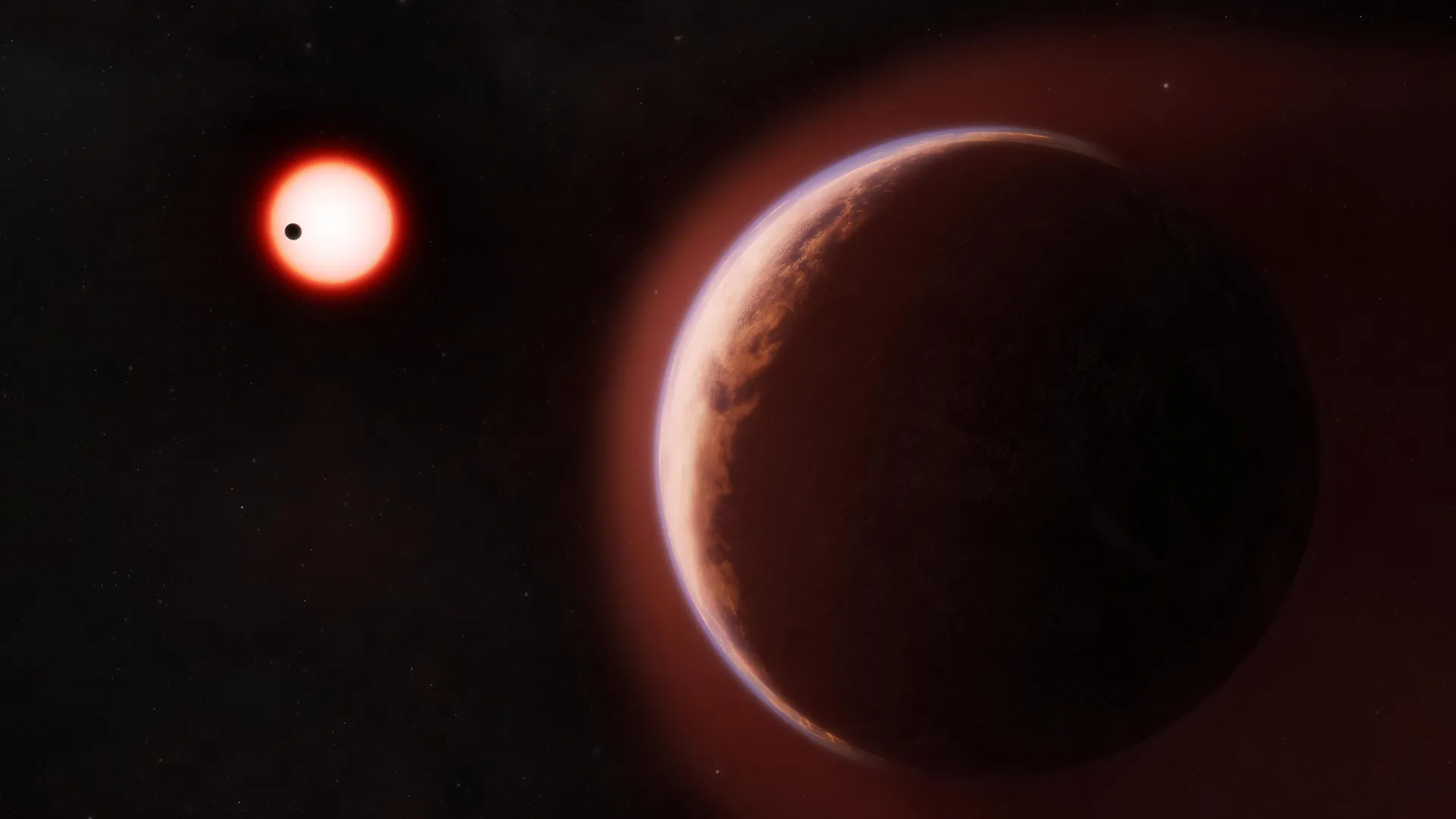
The ongoing quest to find life beyond Earth has reached a watershed moment with the groundbreaking detection of an atmosphere surrounding a rocky, Earth-sized planet situated within the habitable zone of another star. This pivotal discovery provides the most compelling evidence to date that planets with Earth-like temperatures and solid compositions may not only be prevalent beyond our solar system but could also harbor conditions conducive to life as we understand it. The findings, published on July 16th in the esteemed scientific journal Science, represent a significant advancement in exoplanetary research, moving from theoretical possibility to observational confirmation.
Unveiling a Hidden Atmosphere: The Helium Signature of LHS 1140 b
The focus of this landmark research is LHS 1140 b, an exoplanet approximately 48 light-years away from Earth. While thousands of exoplanets have been identified by astronomers, confirming the presence of atmospheres around rocky worlds, particularly those in habitable zones, has remained an exceptionally formidable challenge. The breakthrough came through the meticulous observation of helium escaping from LHS 1140 b, a phenomenon predicted by theoretical models developed by the research team. This escaping helium acts as a definitive signature, indicating that the planet possesses a substantial atmosphere.
LHS 1140 b orbits a red dwarf star, a type of star that is smaller, cooler, and more numerous than our Sun. Crucially, the planet resides within its star’s habitable zone – the region where temperatures are theoretically suitable for liquid water to exist on a planet’s surface. The presence of liquid water is considered a fundamental prerequisite for life as we know it, making planets within this zone prime targets for astrobiological investigation.
"An atmosphere is essential for a planet to support life as we know it," stated lead author Collin Cherubim, who recently completed his Ph.D. in Earth and Planetary Sciences at Harvard University. "This is the first time anyone has found an atmosphere on a rocky planet in the habitable zone of another star." Cherubim’s doctoral research, which culminated in this discovery, involved a sophisticated interplay of theoretical modeling and observational astronomy.
A Decade of Progress: From Speculation to Confirmation
The journey to this discovery has been a long and arduous one, spanning decades of astronomical progress. Twenty years ago, the very existence of terrestrial-type planets beyond our solar system was a subject of intense debate and speculation. The subsequent discovery of thousands of exoplanets, including numerous rocky worlds, shifted the scientific focus. "Twenty years ago we wondered whether other terrestrial-type planets even existed," commented Robin Wordsworth, Gordon McKay Professor of Environmental Science and Engineering and Professor of Earth and Planetary Sciences at Harvard, and one of Cherubim’s dissertation advisors. "Then we learned they’re common, and found some in the habitable zone. The next question was whether any of them had managed to keep an atmosphere. Now we know at least one has."
This study distinguishes itself by not only identifying a rocky planet in the habitable zone but by providing clear, empirical evidence that it has retained an atmosphere, potentially for billions of years. Previous studies had hinted at the possibility of atmospheres on such worlds, but the signal was either too faint or too ambiguous to confirm definitively.
The WINERED Spectrograph: A Key Instrument in the Discovery
The critical observations that led to the detection of LHS 1140 b’s atmosphere were made using the Warm Infrared Echelle (WINERED) Spectrograph, an advanced instrument housed at the Magellan Observatory in Chile. The research team capitalized on a rare celestial alignment: LHS 1140 b and another exoplanet transited, or passed in front of, their host star on the same night.
During a transit, a planet’s atmosphere can absorb and filter specific wavelengths of starlight. By analyzing the light that passes through the atmosphere, scientists can deduce its chemical composition. The WINERED spectrograph’s sensitivity allowed Cherubim and his team to detect the faint spectral signature of helium escaping from LHS 1140 b.
"Collin analyzed the planets we knew about and predicted that this one would have a helium atmosphere," explained David Charbonneau, Cherubim’s joint advisor, head of the Harvard Department of Astronomy, and an astronomer at the Center for Astrophysics | Harvard & Smithsonian. Charbonneau, initially skeptical about the feasibility of detecting such a subtle signal from a rocky world, was ultimately convinced by the robust data. "Then he organized telescope time, got the data, and the detection was statistically rock solid."
The accompanying planet observed during the same transit showed no discernible atmospheric signature, further highlighting the unique atmospheric retention of LHS 1140 b. This comparative observation underscores the significance of the finding, demonstrating that not all rocky planets in habitable zones are guaranteed to possess atmospheres.
A Model Confirmed: The Science Behind the Detection
The success of this study is deeply rooted in Cherubim’s theoretical model, which posited that the upper atmosphere of LHS 1140 b would exhibit a steady outflow of helium into space. This prediction was not arbitrary; it was based on a sophisticated understanding of planetary atmospheric dynamics and the specific characteristics of LHS 1140 b and its host star. Red dwarf stars, while dimmer than our Sun, are known for their intense stellar flares and high levels of ultraviolet radiation. These energetic emissions can strip away planetary atmospheres over time. Therefore, the discovery of a retained atmosphere on LHS 1140 b suggests it possesses mechanisms for atmospheric replenishment or is remarkably resilient.
The theoretical framework predicted a specific spectral signature for this escaping helium, a signature that the WINERED instrument was uniquely equipped to detect. The alignment of the theoretical prediction with the observational data represents a significant validation of the team’s modeling capabilities and their understanding of exoplanetary atmospheres.
Implications for the Search for Life
The longevity of LHS 1140 b’s atmosphere, estimated to have survived for over three billion years, makes it an exceptionally promising target for future research. This extended period offers ample opportunity for complex chemical processes to occur, potentially leading to the development of life.
The implications of this discovery extend far beyond LHS 1140 b. It suggests that ground-based telescopes, equipped with advanced spectrographs like WINERED, may be capable of studying the atmospheres of other rocky exoplanets by searching for escaping gases. This opens up a new avenue for identifying potentially habitable worlds without the need for expensive and complex space-based observatories, at least in the initial stages of atmospheric characterization.
Cherubim’s future research aims to fully characterize the chemical composition of LHS 1140 b’s atmosphere. This detailed analysis could reveal the presence of biosignatures – gases or combinations of gases that are strongly indicative of biological activity. Furthermore, he hopes to ascertain if the planet hosts surface oceans or other features that are crucial for habitability.
"This has been a model validation, and hopefully it’s just the first of many more observations to come," Cherubim stated, expressing optimism for future discoveries. The team plans to adapt their successful model to search for additional rocky worlds with atmospheres, potentially accelerating the pace of exoplanet habitability studies.
A New Era of Exoplanet Exploration
The detection of an atmosphere around LHS 1140 b marks a paradigm shift in exoplanet research. It transitions the field from simply identifying potentially habitable planets to actively characterizing their environments. This discovery provides a tangible and compelling target for detailed study, fueling optimism that the ultimate goal – finding life beyond Earth – may be closer than ever before. The scientific community eagerly anticipates the next steps, which promise to build upon this monumental achievement and further illuminate our understanding of planetary diversity and the potential for life in the cosmos. This discovery is not merely an isolated scientific finding; it is a beacon of hope and a testament to human curiosity and ingenuity in unraveling the universe’s greatest mysteries.

