
The expansion of curbside organic waste collection represents one of the most rapid shifts in modern municipal infrastructure across North America. According to nationwide data compiled by BioCycle, the number of U.S. households with access to dedicated food waste collection surged to 14.9 million in 2023, reflecting a remarkable 49 percent increase from the 10 million households recorded just two years prior. Driven by ambitious climate targets and tightening state-level landfill bans, cities and towns are racing to roll out green bins, brown bins, and specialized organics carts to divert food scraps from traditional disposal sites.
However, bridging the gap between infrastructure deployment and active daily participation remains a persistent operational challenge for municipal leaders. While a handful of high-performing municipalities report near-universal citizen engagement, participation rates in other jurisdictions languish below 30 percent. This disparity carries significant environmental consequences. Organic waste constitutes approximately 24 percent of all municipal solid waste entering U.S. landfills, according to the U.S. Environmental Protection Agency (EPA). More critically, the anaerobic decomposition of this food waste accounts for an estimated 58 percent of all fugitive methane emissions released by municipal landfills—a potent greenhouse gas with a warming potential drastically higher than carbon dioxide in the short term. Consequently, an unused curbside green bin sitting idle at a residential property is far from a neutral outcome; it represents a missed opportunity to mitigate potent climate forcing.

Understanding the Terminology and Operational Landscape
Terminology surrounding organic waste collection varies widely by geography, often creating initial confusion for residents transitioning to new sorting habits. In Toronto, the municipal program is formally designated as the Green Bin program, while New York City utilizes distinctive brown collection carts. Elsewhere, residents encounter variations such as organics carts, compost carts, or food scraps bins. Despite the chromatic and nominal differences, the underlying mechanics remain consistent: organic materials are segregated at the source, collected via dedicated municipal routes, and transported to centralized commercial composting facilities or anaerobic digestion plants rather than conventional landfills.
Municipal program guidelines also differ significantly regarding acceptable contents. While some jurisdictions accept only certified compostable bags, others permit newspaper or Kraft paper wrapping, and certain municipalities mandate that food scraps be deposited completely loose within the cart. Navigating these regional discrepancies is essential, as introducing non-compliant items or improper liners can result in entire truckloads being flagged for contamination, leading to uncollected bins and administrative penalties for residents.
The Human Factor: Uncovering the Root Causes of Program Attrition
While civic enthusiasm often accompanies the initial rollout of municipal composting programs, maintaining long-term household compliance proves difficult. Common barriers cited by environmental agencies include confusion over accepted materials, forgetfulness regarding collection schedules, and general inconvenience. Yet, waste management professionals increasingly point to a primary, highly unglamorous deterrent that rarely appears in formal academic literature: the "yuck factor" associated with bin maintenance.

Organic waste is inherently moisture-dense. Produce, fruit peels, and food remnants naturally release cellular water as they break down, creating a viscous, highly odorous leachate that pools at the bottom and clings to the walls of both countertop caddies and large curbside carts. When households are left to contend with sticky residue, persistent foul odors, insect infestations, and the arduous weekly chore of hosing out decomposing sludge, compliance frequently drops.
Empirical evidence demonstrates that mitigating these unpleasant aspects directly influences recycling rates. Between 2023 and 2024, the Essex County Council in the United Kingdom implemented a year-long Food Recycling Project aimed at evaluating barriers to household participation. Distributing a comprehensive resource package—consisting of an informational leaflet, a waste-bin notification sticker, and a complimentary supply of certified compostable liners—to over 375,000 households, the local authority observed immediate behavioral shifts. In the first three months following the rollout, food recycling tonnage increased by an average of 21 percent compared to a control group, easily eclipsing the council’s original 10 percent target.
While the Essex County case study highlighted the efficacy of providing physical containment tools, it also illuminated a fundamental economic hurdle: large-scale, ongoing subsidies for specialized single-use liners are financially unsustainable for the vast majority of municipal governments and individual households alike.

Re-Engineering Container Dynamics: The Rise of Mechanical Solutions
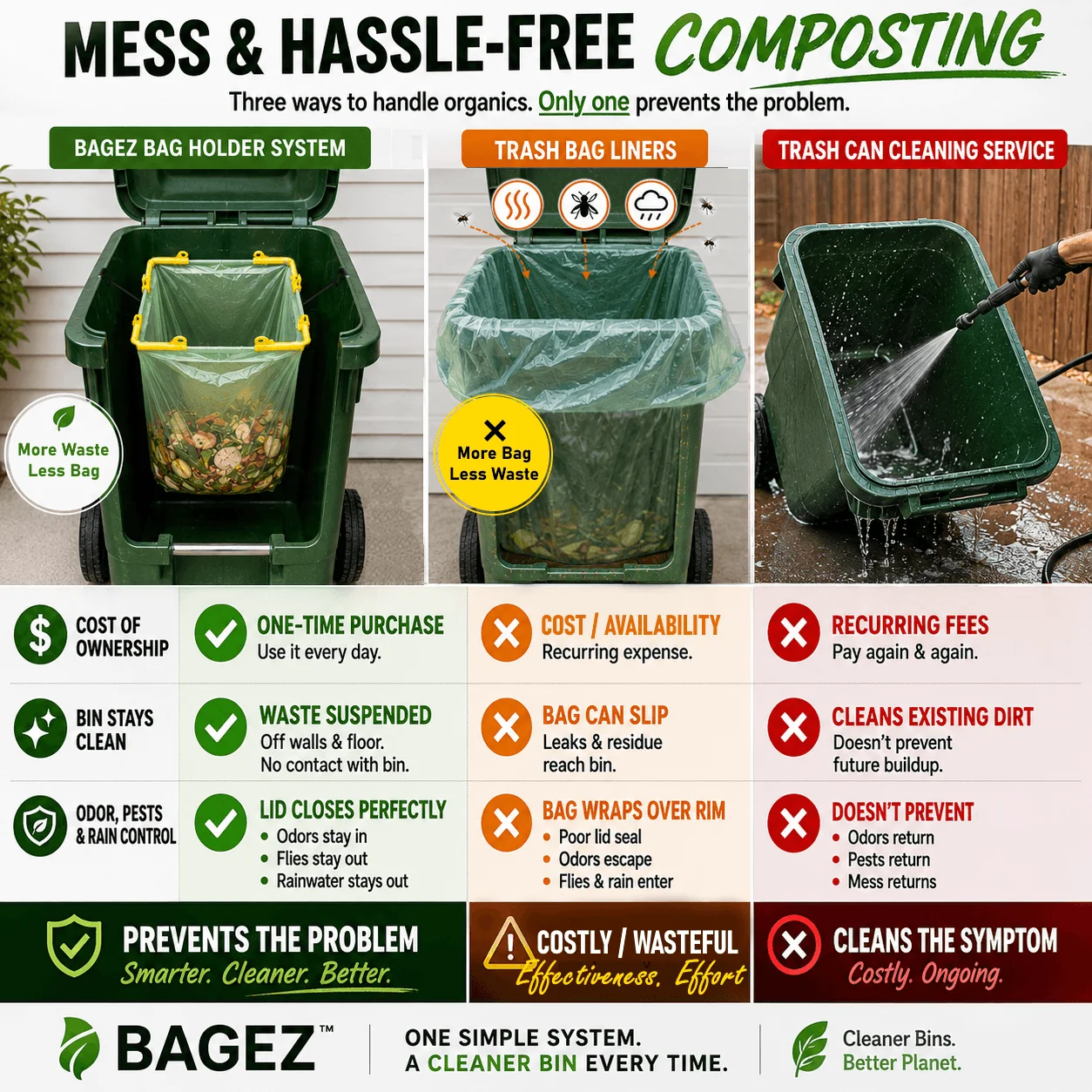
Addressing the physical degradation of curbside bins without relying on recurring disposable subsidies has spurred private sector innovation in waste management accessories. Traditional containment methods generally fall into two categories: high-cost, recurring bin-cleaning subscription services that remediate the mess after it occurs, or oversized, expensive full-cart liners that fail to match actual residential waste volumes.
Data from the landmark MITRE-Gallup household food-waste survey—the largest study of its kind in the United States, encompassing nearly 10,000 households—revealed that the average American household generates approximately 6.2 cups of edible food waste weekly, scaling to roughly 8.8 cups when factoring in unavoidable inedible components such as peels, cores, and bones. This total translates to slightly more than half a gallon per week, indicating that standard kitchen generation rates fall far short of filling large multi-gallon curbside carts with food scraps alone.
Recognizing this volume discrepancy, hardware innovations such as BagEZ have emerged to alter the mechanics of curbside collection. Operating on the principle of suspended containment, the device utilizes a collapsible steel frame equipped with locking clips that secure a standard 13-gallon (49-liter) kitchen bag—or alternative approved sizes—suspended directly within the center of the green bin.

By preventing the bag from making direct contact with the interior walls and base of the cart, air is permitted to circulate freely around the perimeter. Consequently, exterior condensation evaporates rather than pooling into a stagnant leachate puddle. This dry-bin environment disrupts the primary catalysts for foul odors, fly propagation, and subsequent maggot infestation, effectively neutralizing the maintenance burden that drives program attrition. Furthermore, maintaining a dry, contained micro-environment enhances the efficacy of supplemental odor-management techniques, such as targeted applications of baking soda, food-grade diatomaceous earth, or natural deterrents like peppermint and clove sachets designed to discourage urban wildlife.
Broader Implications for Municipal Sustainability
As municipalities face mounting regulatory pressure to meet landfill diversion targets, the success of organic waste programs will increasingly depend on user experience and behavioral economics. Infrastructure alone—no matter how widespread—cannot overcome deeply ingrained domestic friction points.
Industry analysts emphasize that sustainable waste diversion requires systems that align with human behavior rather than working against it. By lowering the operational friction of daily sorting, eliminating intensive cleaning requirements, and utilizing appropriately sized containment tools, cities can foster durable, long-term participation habits. Transforming the green bin from an avoided domestic chore into a seamless, clean routine is a critical step in reducing fugitive methane emissions and advancing broader circular economy objectives across North America.

