
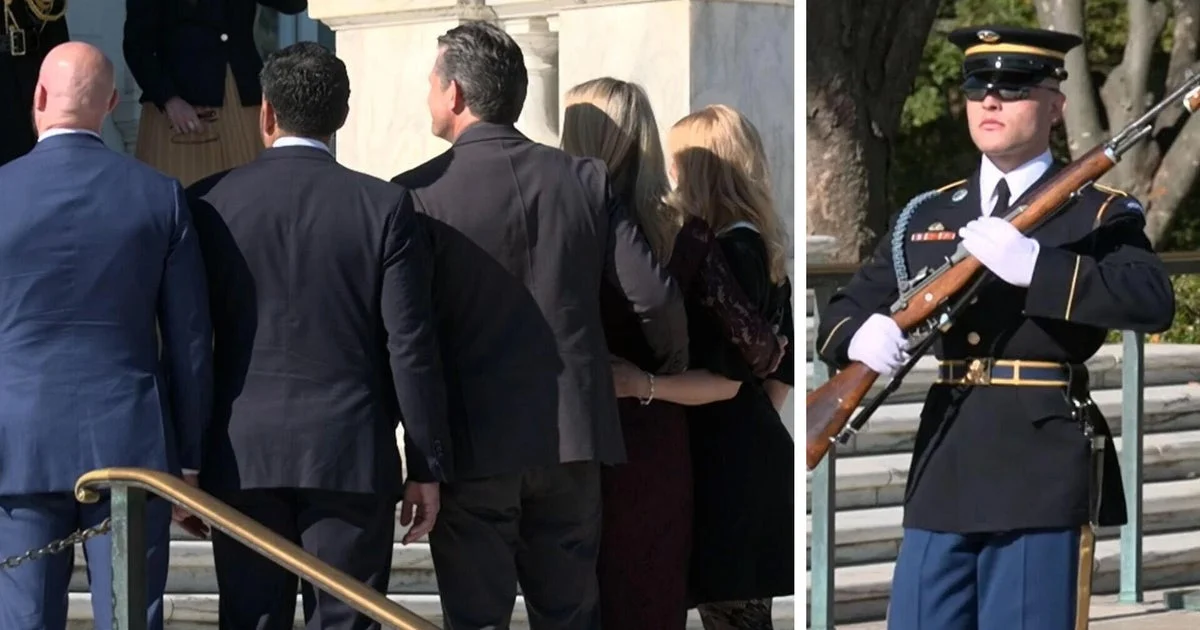
WASHINGTON — Decorum and military protocol collided in a high-profile public setting on Wednesday, November 11, 2026, when a U.S. Army sentinel stationed at the Tomb of the Unknown Soldier sharply reprimanded a visiting delegation that included Defense Secretary Pete Hegseth. The incident, which quickly circulated across major news networks and social media platforms, occurred during a solemn Veterans Day observance at Arlington National Cemetery. While minor protocol corrections by sentinels are a routine occurrence at the hallowed burial ground, the inclusion of the nation’s top civilian defense official and members of his senior staff elevated the moment from a standard security enforcement to a national news story.
The confrontation highlights the strict, unyielding adherence to discipline required of the elite soldiers who guard the Tomb of the Unknown Soldier twenty-four hours a day, regardless of the rank, title, or prominence of the visitors standing before them.
Chronology of Events on Veterans Day
The sequence of events began on the morning of Wednesday, November 11, 2026, as the nation marked Veterans Day. Defense Secretary Pete Hegseth, accompanied by his wife, chief of staff Ricky Buria, and several key defense aides, arrived at Arlington National Cemetery to participate in a formal wreath-laying ceremony at the Tomb of the Unknown Soldier.
The delegation was part of a larger, high-level governmental presence at the cemetery. President Donald Trump and First Lady Melania Trump were also in attendance to honor America’s fallen service members, participating in a subsequent commemorative ceremony held at the nearby Memorial Auditorium.
Following the conclusion of the formal wreath-laying at the monument itself, Secretary Hegseth and his entourage paused near the memorial to pose for a commemorative photograph. Witnesses and subsequent video footage indicate that as the group wrapped up the photo session and began to turn and walk away from the plaza, an audible laugh rang out from within the party.
The sound shattered the mandated silence of the sacred site. Without hesitation, a U.S. Army sentinel from the 3rd U.S. Infantry Regiment, known traditionally as "The Old Guard," barked out a stern, practiced command across the plaza: "All visitors will maintain an atmosphere of silence and respect at all times."
The sharp rebuke brought an immediate hush to the immediate area, drawing the attention of bystanders and press corps members covering the presidential and cabinet-level visits. CNN was first to break the story later that day, followed rapidly by confirmation and coverage from CBS News and other national media outlets.
Official Responses and Damage Control
As video clips of the incident spread rapidly across digital platforms—most notably via a widely shared post by CBS News on X (formerly Twitter)—Pentagon officials moved quickly to address the optics of the reprimand and manage any potential public relations fallout.
Chief Pentagon Spokesman Sean Parnell issued a formal statement on behalf of the Department of Defense later that afternoon. Parnell sought to neutralize any narrative suggesting that the defense secretary or his staff were intentionally disrespecting the memorial site.
"The Secretary and the entire Department have always honored—and will always honor—the sacrifices our military men and women have made to keep America safe," Parnell stated. "While commemorating this solemn day, a soldier correctly and respectfully reminded everyone to maintain decorum."
Through this carefully worded response, the Pentagon validated the sentinel’s actions, emphasizing that the Department of Defense fully supports the unyielding enforcement of rules at Arlington National Cemetery. However, neither the Pentagon nor individual members of the visiting delegation clarified precisely who within the group had produced the offending laughter, nor whether Secretary Hegseth himself had contributed to the noise. Given the ambient acoustics of the plaza and the tight grouping of aides, wives, and security personnel, pinpointing the exact source of the noise from available footage remains difficult.
Background and Significance of the Tomb of the Unknown Soldier
To understand why a simple laugh elicited such a severe public rebuke, one must examine the profound historical and cultural significance of the Tomb of the Unknown Soldier. Situated on a hilltop in Arlington National Cemetery overlooking Washington, D.C., the monument memorializes U.S. service members whose remains have not been identified.
Originally established on November 11, 1921, with the burial of an unidentified World War I soldier, the site later expanded to receive unidentified remains from World War II, the Korean War, and, temporarily, the Vietnam War (though the Vietnam Unknown was later identified through DNA testing and reinterred). Today, it stands as the symbolic heart of American military remembrance.
The sentinels who guard the tomb belong to Company A of the 3rd U.S. Infantry Regiment ("The Old Guard"). Becoming a tomb guard is one of the most prestigious and grueling assignments in the United States military. Candidates undergo an intense selection and training process where they must memorize vast amounts of cemetery history, master flawless drill movements, and maintain pristine uniforms. Only a fraction of those who volunteer successfully earn the coveted Tomb Guard Identification Badge.
A core responsibility of these sentinels is the absolute preservation of the solemn atmosphere surrounding the monument. The plaza directly in front of the tomb is a place of quiet reflection, mourning, and deep respect. Visitors are explicitly instructed prior to their arrival—and through posted signage—to refrain from talking loudly, making unnecessary noises, using mobile devices inappropriately, or displaying disrespectful behavior.
Routine Enforcement of Decorum
While an incident involving a cabinet secretary making national headlines is rare, the reprimand itself is a remarkably common occurrence at Arlington National Cemetery.
Contrary to the belief that sentinels ignore minor infractions by high-ranking officials, the guards are trained to treat all visitors equally when it comes to maintaining the sanctity of the post. According to historical data and interviews with former members of the regiment, sentinels routinely challenge unruly or disruptive crowds multiple times a day.
In a 2022 interview with the U.S. Army, Staff Sgt. Chadwick Winget, a former sentinel and member of the elite regiment, noted that guards typically have to verbally address crowds two to three times every single day. Common infractions include tourists talking too loudly, children running, individuals attempting to step past barriers for photographs, or visitors failing to remove hats or quiet electronic devices.
When a sentinel determines that decorum has been breached, they use a standard, authoritative script designed to cut through background noise and remind the public of where they are. Phrases like the one delivered to Secretary Hegseth’s group are practiced repeatedly during training to ensure they can be projected with absolute clarity and authority, regardless of the distraction.
Broader Implications and Public Reaction
The incident has sparked broader conversations regarding public etiquette at national monuments and the behavior expected of political leaders in public spaces. In an era dominated by hyper-connected media and instantaneous digital recording, public figures are constantly under a microscope, where a momentary lapse in judgment or an unfortunate piece of timing can instantly become a public relations challenge.
For Secretary Hegseth—who stepped into the high-profile role of leading the Department of Defense with a background as an Army National Guard veteran, author, and television host—the episode serves as a stark reminder of the visibility attached to his office. Even though his spokesman quickly affirmed the actions of the sentinel, critics and commentators on social media seized upon the moment to debate the level of situational awareness displayed by the delegation.
Conversely, military supporters and veterans’ advocates widely praised the unidentified Army sentinel. Across veterans’ forums and military defense channels, the soldier’s swift and unwavering response was lauded as a shining example of military professionalism. The incident reinforced the notion that at Arlington National Cemetery, the ordinary enlisted soldier standing watch is the ultimate arbiter of respect, superseding the rank of cabinet secretaries, generals, and even presidents.
As Veterans Day 2026 recedes into history, the event at the Tomb of the Unknown Soldier will likely be remembered not for any policy shift or political scandal, but as a vivid demonstration of institutional integrity. It stands as proof that the traditions safeguarding America’s most sacred war memorial remain completely impervious to political hierarchy, ensuring that the unknown dead continue to receive the absolute silence and reverence they were promised.

