
WASHINGTON — In a high-stakes security incident near the heart of the United States government, federal law enforcement officers arrested an undocumented Venezuelan national who was allegedly found inside a stolen vehicle carrying multiple high-powered firearms and making explicit threats to assassinate President Donald Trump.
The suspect, identified by the Department of Homeland Security (DHS) as 29-year-old Ronny Yordrix Guanipa Chrinos, was taken into custody on Thursday evening by U.S. Secret Service personnel. The apprehension occurred on Constitution Avenue, just blocks from the White House complex, after officers noticed suspicious activity surrounding a parked motor vehicle.
The incident has immediately reignited intense national debates concerning border security, immigration enforcement protocols, the tracking of individuals released into the interior of the United States, and the escalating security challenges facing federal protective details in the nation’s capital.
Encounter and Arrest on Constitution Avenue
According to official reports released by the Department of Homeland Security and the U.S. Secret Service, the sequence of events began late Thursday afternoon. Secret Service personnel conducting routine perimeter patrols noticed a vehicle parked along Constitution Avenue exhibiting suspicious behavior.
Officers approached the vehicle to investigate the situation and made contact with the sole occupant, later identified as Chrinos. During the initial interaction, Chrinos reportedly made spontaneous statements to the officers, claiming that he was hearing voices in his head instructing him to travel to Washington, D.C., and assassinate President Trump.
Acting on these alarming statements, officers expanded their investigation. A query of the vehicle’s license plate and identification numbers revealed that the automobile had been reported stolen. When questioned about the contents of the vehicle, Chrinos admitted to law enforcement that there were weapons inside.
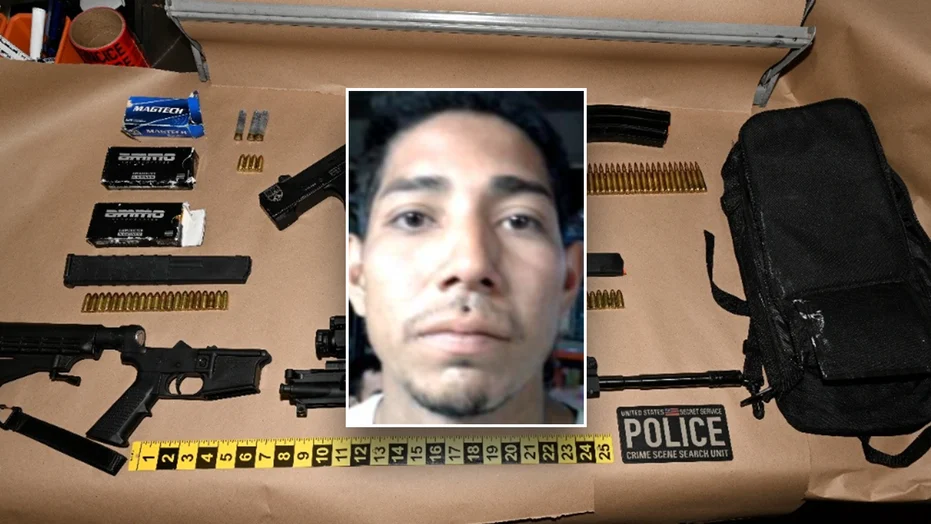
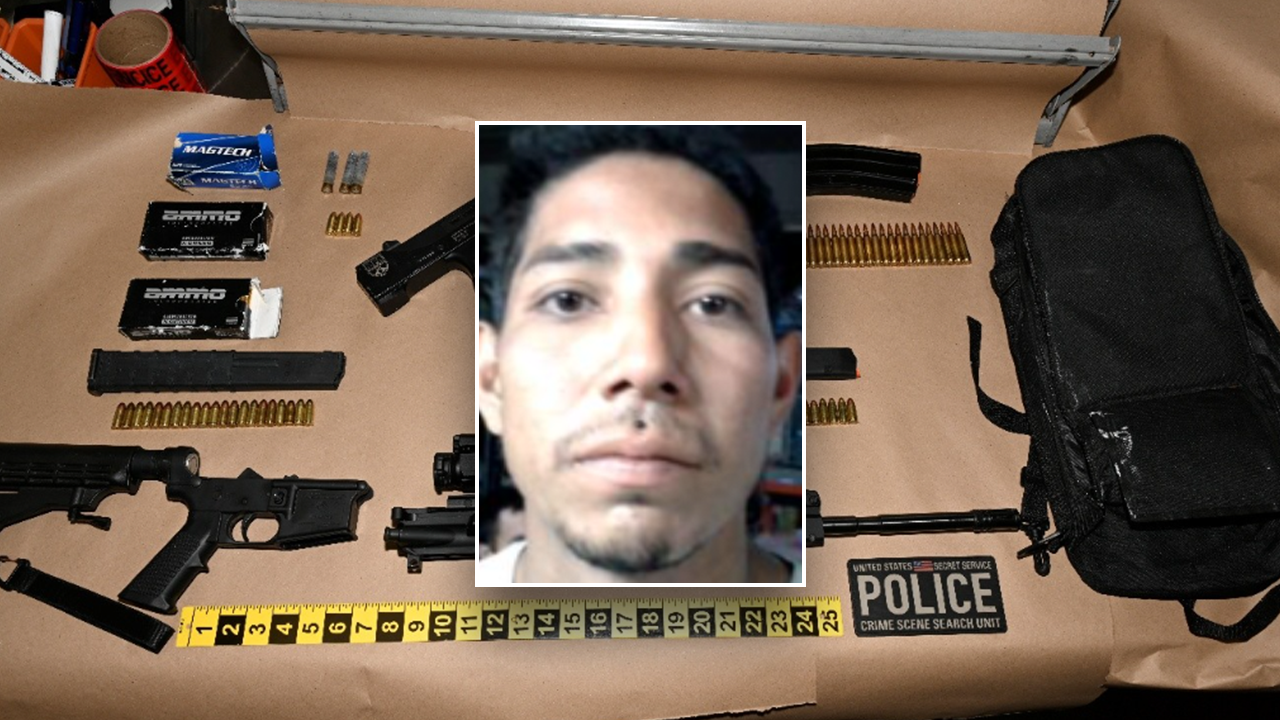
A subsequent search of the automobile yielded a substantial cache of weaponry and tactical gear. Law enforcement recovered three distinct firearms, including an AR-15-style semi-automatic rifle, a Mac-10 submachine gun, and a Glock 43X handgun. In addition to the firearms, officers recovered multiple high-capacity magazines and dozens of rounds of loose ammunition.
Chrinos was safely taken into custody without further incident. Following his arrest, the U.S. Immigration and Customs Enforcement (ICE) agency lodged an immigration detainer against him with the U.S. Marshals Service, where he is currently being held pending federal and local charges.
Immigration History and Background
The disclosure of Chrinos’s immigration status has brought renewed scrutiny to federal border management policies. According to federal officials, Chrinos is an illegal alien who originally entered the United States across the southern border near Eagle Pass, Texas, in March 2024.
Upon his initial crossing, Chrinos was apprehended by agents of U.S. Border Patrol. However, under standard processing procedures utilized during the Biden administration, he was subsequently released into the United States interior while awaiting immigration court proceedings.
The revelation that an individual released under these immigration policies was later arrested near the White House in possession of an AR-15 rifle and an alleged assassination plot has drawn sharp commentary from lawmakers and security experts alike. Critics of past border enforcement strategies argue that inadequate vetting and the widespread release of undocumented migrants into communities pose significant vulnerabilities to national security. Conversely, immigration advocates emphasize that the vast majority of migrants seek economic opportunity or asylum, and caution against broad generalizations stemming from isolated criminal acts.
Chronology of the Investigation
- March 2024: Ronny Yordrix Guanipa Chrinos illegally crosses the U.S.-Mexico border near Texas and is apprehended by U.S. Border Patrol.
- Spring 2024: Chrinos is processed and released into the interior of the United States pending further immigration hearings.
- Thursday Afternoon: U.S. Secret Service officers notice a suspicious vehicle parked along Constitution Avenue in Washington, D.C., near the White House complex.
- Thursday Evening: Officers approach the vehicle, engage the driver, and detain Chrinos after he makes verbal threats against President Trump and admits to possessing weapons.
- Post-Arrest: Law enforcement searches the vehicle, recovering an AR-15-style rifle, a Mac-10, a Glock handgun, and extensive ammunition. ICE files a detainer with the U.S. Marshals Service.
Official Responses and Security Implications
The thwarted threat underscores a troubling upward trend in the volume and severity of security breaches and threats directed at high-ranking federal officials and protected sites in Washington, D.C.
U.S. Secret Service Director Sean Curran released a formal statement addressing the incident, highlighting both the professionalism of the agency’s personnel and the broader macroeconomic and societal factors driving security concerns.
"This is the latest example of Secret Service personnel relying on extensive training and experience to deescalate a volatile situation that posed an imminent threat to our protectees and other Americans," Curran said.
While expressing confidence in the agency’s tactical readiness and protective methodologies, Curran did not mince words regarding the frequency of incoming threats.

"While our personnel are trained to respond to situations like this and we remain confident in our tactics, we are alarmed by the increase in threat cases that continue to arise," Curran continued. "The Secret Service will continue expanding our focus on proactively investigating and identifying individuals who make threats to our protectees, in order to disrupt threats before they arrive in Washington."
Security analysts note that protecting the White House complex and other federal landmarks has grown increasingly complex in recent years. The proliferation of accessible firearms, combined with individuals experiencing acute mental health crises or ideological radicalization, creates a volatile operational environment for federal law enforcement agencies.
Broader Context and Analytical Outlook
The arrest of Chrinos touches upon several critical intersections of American public policy: national security, mental health, urban policing, and immigration reform.
From a law enforcement perspective, the incident validates the layered defense posture maintained by the Secret Service, United States Park Police, and the Metropolitan Police Department of the District of Columbia. The proactive posture of patrolling officers—spotting a vehicle appearing out of place on a high-security thoroughfare like Constitution Avenue—prevented what could have been a catastrophic security failure.
Simultaneously, the case highlights the ongoing challenges surrounding mental health intervention within transient populations. Chrinos’s reported statements regarding "voices in his head" point to underlying psychological distress, a factor that frequently complicates threat assessment protocols for protective intelligence agencies. Law enforcement must constantly differentiate between rhetorical venting, ideological extremism, and individuals suffering from severe psychiatric episodes who nevertheless possess the lethal means to carry out violence.
As the judicial process unfolds, federal prosecutors are expected to bring multiple felony charges against Chrinos, ranging from firearms violations and the possession of a stolen vehicle to federal charges related to making threats against the President of the United States. Concurrently, congressional committees are likely to request a full accounting of Chrinos’s initial border encounter, subsequent release, and tracking history to determine whether procedural breakdowns occurred within immigration enforcement networks.
The investigation remains active and ongoing as federal investigators scour digital devices, interview acquaintances, and retrace Chrinos’s movements from his entry in Texas to his arrival in the nation’s capital.

