
Public discourse surrounding the American education system is currently dominated by a polarizing debate: are the nation’s most disadvantaged students being systematically starved of financial resources, or is the reality of school funding more equitable than common narratives suggest? For policymakers, educators, and parents, the answer remains frustratingly elusive. Over the past decade, five major research reports—from the Brookings Institution, EdBuild, the Urban Institute, EdTrust, and the Education Law Center—have reached conclusions that appear to directly contradict one another. While some analyses assert that schools serving high concentrations of Black, Hispanic, and Native American students are underfunded by billions, others suggest that these districts receive more per-pupil funding than their wealthier, predominantly white counterparts. This confusion is not the result of flawed mathematics, but rather the consequence of deeply divergent methodologies, variable definitions of "equity," and the complex architecture of American school finance.
A Chronology of Conflicting Narratives

The tension between these reports is a relatively recent development in the public consciousness, though the underlying data has been studied for decades. In 2019, EdBuild released a landmark analysis that became a touchstone for advocates and journalists, including Nikole Hannah-Jones, who cited it in The New York Times. The report famously calculated that, on a national scale, schools in predominantly nonwhite districts receive $23 billion less in annual funding than their heavily white counterparts. This figure galvanized the movement for education reform, framing the funding gap as a clear-cut case of racial inequity.
However, in July 2026, the narrative shifted abruptly when Brookings Institution economist Sarah Reber published findings that challenged this prevailing wisdom. Reber’s analysis suggested that, contrary to the "underfunding" narrative, high-poverty and predominantly nonwhite districts have, for decades, spent as much as, or more than, their more affluent peers. The reaction within the policy community was immediate. In August 2026, the nonprofit EdFund hosted a webinar titled "When Narratives Collide" to address the growing confusion among stakeholders. The event underscored a fundamental reality of educational research: the answer to a question often depends entirely on how the question is framed.
Methodological Discrepancies: The "Why" Behind the Data

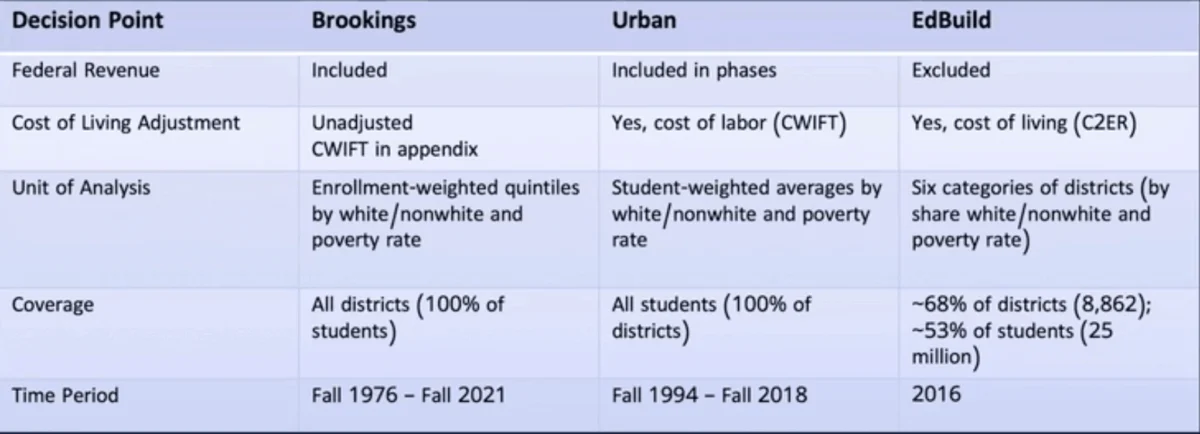
To understand why these reports diverge, one must look at the specific "calculators" used by researchers. The primary points of contention revolve around whether to include federal aid, how to adjust for regional costs, and how to define the populations being studied.
The inclusion of federal funding is perhaps the most significant differentiator. The Brookings Institution’s research calculates total revenue from all government sources—federal, state, and local. When the full spectrum of funding is included, poor school districts frequently appear to have higher per-pupil spending. This is largely because the federal government provides over $50 billion in aid, including $18 billion in Title I funding specifically designated for schools with high concentrations of low-income students, as well as significant funding for students with disabilities and school nutrition programs.
Conversely, organizations such as EdBuild, EdTrust, and the Education Law Center often focus exclusively on state and local revenue. Their rationale is rooted in the belief that federal funds are intended to supplement, rather than replace, local investment. Zahava Stadler, the former policy director at EdBuild and current director of the education funding equity initiative at New America, argues that when states rely on federal dollars to bridge the gap in their own funding commitments, they are essentially "passing the buck." From this perspective, including federal aid in the total calculation obscures whether state governments are fulfilling their constitutional and moral obligations to provide equitable base-level funding.

Regional Cost Adjustments and Purchasing Power
The second major methodological divide concerns the adjustment for regional cost differences. Because teachers represent the largest share of any school district’s budget, the cost of labor is a critical variable. A dollar spent in an affluent, high-cost metropolitan area like the San Francisco Bay Area does not buy the same amount of educational services as a dollar spent in rural Alabama.
Reports that do not adjust for these regional variances often present a skewed view of reality. The Urban Institute has attempted to bring clarity to this by allowing users to toggle between raw spending data and data adjusted for teacher labor costs. When EdBuild conducted its research, it went even further by adjusting for a wider basket of costs, including local housing prices. These adjustments often reveal that while a city district might spend more dollars per student on paper, the higher cost of living and labor results in less actual "purchasing power," leading to fewer teachers and aides per classroom compared to more affordable districts.

The Divergence of Race and Poverty
A third, often overlooked factor is that poverty and race—while statistically correlated—are not interchangeable variables in school finance. Many of the nation’s poorest students reside in predominantly white, rural districts. Conversely, Black and Hispanic students are disproportionately concentrated in urban centers, where teacher salaries and other operational costs are significantly higher.
This distinction explains why some studies find that poor students receive more funding while students of color receive less. For example, a recent EdTrust report noted that while districts serving mostly Black, Hispanic, and Native American students received $1,300 less in state and local dollars per student compared to white districts, districts serving primarily low-income students actually received $200 more annually than those serving more affluent populations. Because urban districts often serve both low-income students and students of color, the high cost of urban labor acts as a "tax" on their budget, effectively eroding the extra funding they receive.

Implications for Policy and Practice
The lack of consensus among researchers has profound implications for policymakers who are attempting to address educational inequality. If the goal is to provide a "level playing field," the definition of that playing field matters. Bruce Baker, a prominent education economist at the University of Miami, has estimated that to bring disadvantaged students up to national proficiency standards in core subjects like reading and math, districts may need to invest tens of thousands of dollars more per pupil than they currently do.
Even researchers like Sarah Reber, whose work highlights the increased spending in poor districts, acknowledge that more money does not necessarily equate to adequate resources. "Do districts serving children in poverty have what they need?" Reber asked during a recent interview. "The answer is not universally no, but it’s often no."

Furthermore, the geographic lottery plays a massive role in student outcomes. The Education Law Center’s 2025 report highlighted a stark reality: the amount a child receives for their education is heavily dependent on the state in which they reside. New York, which ranks as one of the highest-spending states in the nation, spends $17,000 more per student than Idaho. This state-level variance is often far more dramatic than the variance between rich and poor districts within a single state.
Moving Toward a More Nuanced Understanding
For observers of educational policy, the lesson is one of healthy skepticism. When a report declares that schools are either "fair" or "deeply unfair," the underlying methodology must be interrogated. The current landscape of school finance research suggests that we are moving toward a more sophisticated understanding of the problem, one that acknowledges that the "funding gap" is a multifaceted issue involving federal, state, and local responsibilities, labor market conditions, and demographic realities.

To resolve these contradictions, the dialogue must shift away from aggregate national averages and toward more granular, context-specific analysis. As the debate continues, the most essential questions for any stakeholder remain: Which funding streams are being counted? What adjustments have been made for regional cost of living? And, most importantly, against which peer group is the district being compared? Only by answering these questions can the American public begin to discern the true state of equity in its schools and move toward a system that provides every child with the resources necessary to succeed.

