
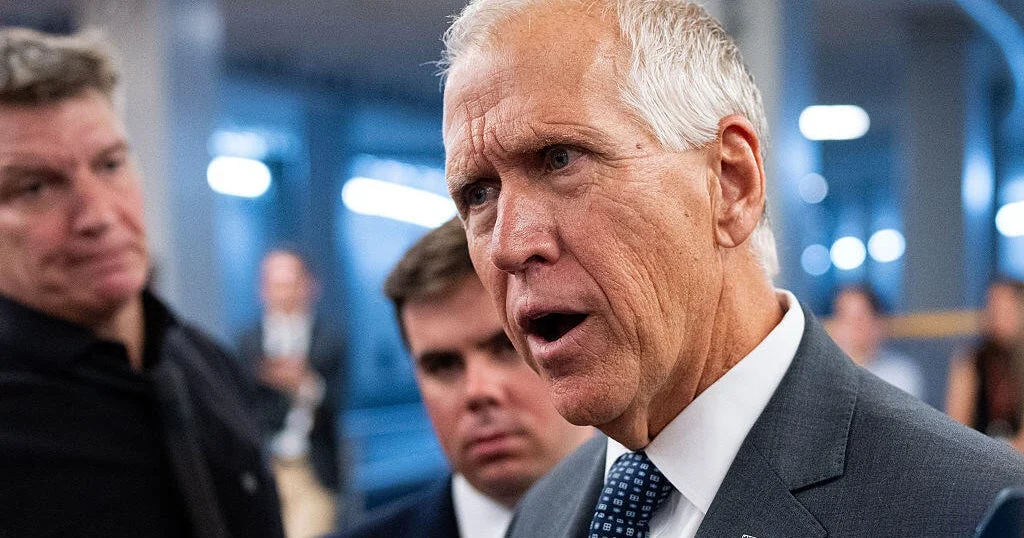
Republican Senator Thom Tillis has publicly questioned the strategic rationale behind President Donald Trump’s decision to host Chinese President Xi Jinping for a lavish state dinner at the White House this week, labeling the diplomatic outreach a confusing departure from the administration’s previously hawkish stance on Beijing. In an interview with CBS Evening News, the retiring North Carolina senator described the event as a “WTF moment,” expressing deep concern over the optics of the red-carpet reception during a period of escalating geopolitical tensions.
The criticism from a senior member of the President’s own party underscores a growing rift within the Republican caucus regarding the administration’s foreign policy pivot. While the White House has framed the visit as an essential step toward stabilizing the global economy, critics argue that the hospitality sends the wrong message to democratic allies and emboldens a regime accused of significant human rights violations.
A Diplomatic Pivot: From Trade War to State Dinner
The current thaw in relations represents a dramatic reversal from the confrontational atmosphere that defined the early months of the 2025 presidential term. Upon his return to office last year, President Trump aggressively escalated economic pressure on China, implementing sweeping tariffs on Chinese imports. Beijing responded in kind, triggering a volatile trade war that saw both nations hike duties on thousands of goods to levels exceeding 100%.
The economic instability caused by these measures rippled through global markets, disrupting supply chains and prompting domestic industries to call for a resolution. By late 2025, the two nations reached a tentative “tariff truce,” seeking to mitigate the damage to their respective economies. The current state visit appears to be the culmination of that truce, with President Trump characterizing the summit as a foundation for a “truly great friendship.”
However, the rapid transition from aggressive economic warfare to high-level diplomatic pageantry has left many lawmakers perplexed. Senator Tillis noted that the administration’s public rhetoric has shifted from framing China as an existential competitor to a partner with whom the U.S. can cultivate a “productive relationship.” Tillis questioned whether this change was prompted by confidential intelligence briefings, noting that the public has been provided no clear justification for the sudden warming of ties.
Human Rights and Strategic Friction
Senator Tillis’s objections are not rooted solely in diplomatic optics; they reflect a substantive disagreement over the administration’s silence on critical issues. During his interview, Tillis cited the ongoing, well-documented human rights abuses against the Uyghur population in Xinjiang, as well as persistent allegations of Chinese espionage and unauthorized access to U.S. voter data.
Furthermore, the senator highlighted the strategic concerns regarding the Indo-Pacific region, specifically pointing to reports that Iran has utilized Chinese-supplied intelligence to target U.S. military assets. These reports, combined with the administration’s decision to delay a planned arms shipment to Taiwan, have fueled concerns that the White House may be sacrificing long-term security commitments in exchange for short-term economic gains.
The delay in military aid to Taiwan is particularly sensitive. As China continues to conduct large-scale military exercises in the Taiwan Strait, the hesitation to arm the island democracy is seen by many in Congress as a sign of weakness or a calculated concession to Beijing. Tillis emphasized that any attempt to build a relationship with the Chinese Communist Party must be predicated on accountability, rather than the appearance of appeasement.
Comparison to Allied Relations
The criticism of the Xi visit is compounded by the perception of unequal treatment regarding other world leaders. Senator Tillis explicitly contrasted the elaborate reception afforded to President Xi with the more austere treatment of Ukrainian President Volodymyr Zelenskyy. In the eyes of many foreign policy hawks, the White House’s priorities appear skewed, favoring the appeasement of an autocrat over the reinforcement of partnerships with nations actively resisting authoritarian expansion.
The optics of the state dinner—featuring the full pomp and circumstance of the U.S. executive branch—stand in stark contrast to the administration’s recent debates over providing financial and military aid to Ukraine. For those who view the current global landscape as a battle between democratic and autocratic blocs, the decision to prioritize the Chinese leader over democratic allies is a point of significant contention.
Chronology of the 2025-2026 U.S.-China Relationship
- January 2025: President Trump takes office and immediately issues executive orders to impose heavy tariffs on Chinese manufacturing, initiating a significant trade war.
- March 2025: China retaliates with reciprocal tariffs, targeting U.S. agricultural exports and technology sectors.
- August 2025: Both nations feel the impact of the trade war; economic volatility prompts high-level backchannel negotiations.
- November 2025: A “tariff truce” is announced, signaling a temporary ceasefire in the trade dispute.
- February 2026: Reports emerge of Iran utilizing Chinese-provided data to monitor U.S. military assets in the Middle East.
- June 2026: The administration pauses a significant arms sale package to Taiwan, citing the need for “regional stability.”
- September 2026: President Xi Jinping arrives in Washington for a formal state dinner, marking the highest level of diplomatic engagement since the inauguration.
Broader Implications and Strategic Analysis
The Biden-to-Trump transition in 2025 saw a distinct shift in how the U.S. manages the “China challenge.” While the previous administration emphasized a coalition-based approach to containing China, the current administration has favored a bilateral model. The efficacy of this model depends on the ability of the two leaders to deliver on private agreements, yet the lack of transparency surrounding these talks is becoming a political liability.
Foreign policy analysts suggest that the White House is betting that a personal relationship between Trump and Xi can bypass the structural barriers that have prevented a resolution to the trade war. However, this strategy carries significant risks. By moving away from the “tough on China” platform that defined his campaign, President Trump risks alienating his base and providing his political opponents with evidence of policy inconsistency.
Moreover, the international community is watching closely. Allies in the Indo-Pacific, including Japan, South Korea, and Australia, are navigating their own relationships with Beijing. They look to the U.S. for consistent leadership; perceived inconsistency in Washington’s approach to China can create uncertainty, potentially causing those allies to hedge their bets and weaken the unified front necessary to maintain the status quo in the South China Sea.
Congressional Outlook
Senator Tillis is not the only voice of dissent, though he is among the most prominent to voice his concerns publicly. Many in the Republican-controlled Congress remain deeply skeptical of Beijing’s intentions. The legislative body holds the power of the purse and the ability to demand transparency through oversight committees. As the administration moves forward with its “productive relationship” agenda, it will likely face increasing pressure to justify the exclusion of human rights and security concerns from the dialogue.
The coming months will serve as a test for the White House’s foreign policy strategy. If the state dinner leads to concrete concessions from Beijing—such as the cessation of data theft, a reduction in the support for Iranian military operations, or a de-escalation of threats toward Taiwan—the President may be able to quiet his critics. However, if the summit yields only symbolic gestures while China continues its current trajectory, the political pressure on the administration is likely to intensify, potentially complicating the President’s domestic agenda and his standing within the party.
For now, the “WTF moment” described by Senator Tillis serves as a snapshot of a polarized Washington, where the definition of national interest remains a subject of intense debate, and the path forward with China remains one of the most volatile variables in American foreign policy. As the dust settles on the state dinner, the focus will undoubtedly shift toward whether the handshake in Washington leads to a more stable global order or merely masks the underlying realities of a deepening systemic competition.

