
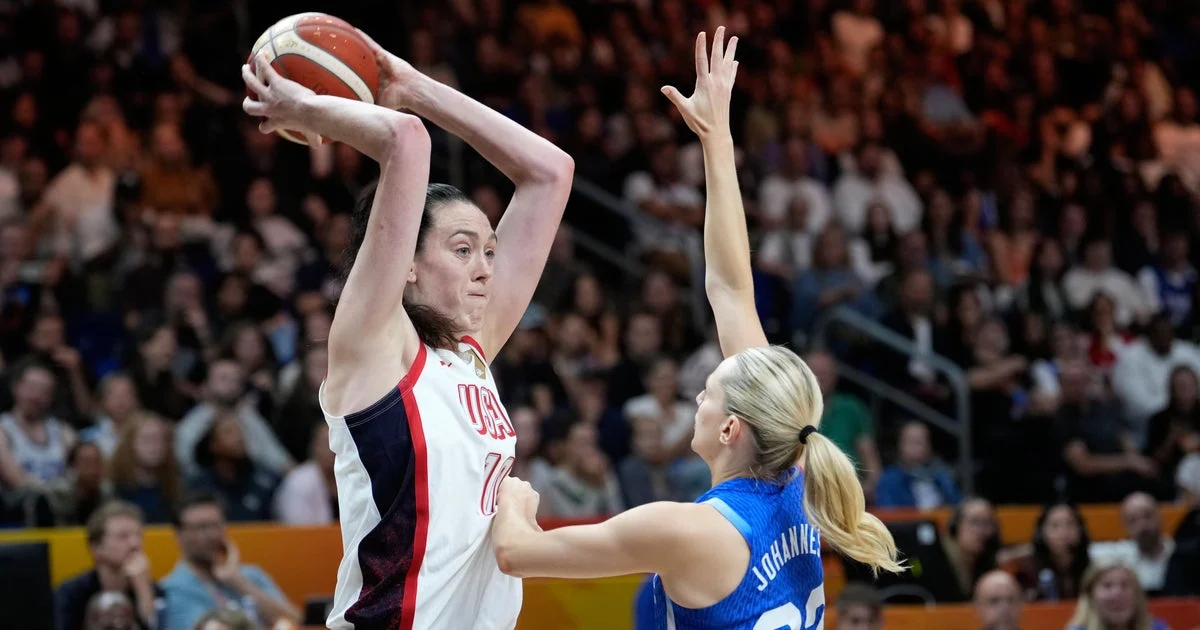
The United States women’s national basketball team cemented its status as the preeminent dynasty in international sports on Sunday, September 13, 2026, by defeating France 97-79 to claim the FIBA World Cup title in Berlin. This victory marks the fifth consecutive World Cup gold medal for the American squad and extends their staggering unbeaten streak in the tournament to 36 games, a run that stretches back to the 2006 semifinals. Despite an early scare that saw the U.S. trailing by double digits, the Americans’ superior depth and tactical adjustment in the second half ensured their continued dominance on the global stage.
A Match of Two Halves: The Chronology of the Final
The gold-medal game began as a testament to the narrowing gap between the U.S. and the rest of the world. France, motivated by their narrow one-point loss to the U.S. during the 2024 Paris Olympic Games, entered the arena in Berlin with clear intent. The French side dictated the tempo early, utilizing a high-intensity defensive scheme that forced the Americans into uncharacteristic turnovers.
At the conclusion of the first quarter, France held a 20-17 advantage. The tension escalated rapidly in the second quarter when France orchestrated an 11-0 run, fueled by back-to-back perimeter shots from Gabby Williams. With the U.S. facing a 14-point deficit—a rare sight for a program accustomed to comfortable leads—the team’s veteran leadership began to stabilize the rhythm. Breanna Stewart, the tournament MVP, acted as the primary catalyst, facilitating the offense and finding gaps in the French interior defense. A crucial three-pointer by Caitlin Clark in the final seconds of the second quarter cut the French lead to 45-43, providing the U.S. with the momentum necessary for their second-half surge.
The third quarter served as the turning point. The U.S. opened the frame with an 11-2 run, reclaiming the lead at 54-47. Stewart, who finished the game with 22 points, dominated the interior, while Jackie Young, who contributed 18 points, provided necessary perimeter relief. A pivotal sequence occurred when France was whistled for two consecutive unsportsmanlike fouls, allowing the U.S. to extend their lead to 73-57 heading into the final frame. France, despite valiant efforts from Dominique Malonga (21 points) and Gabby Williams (20 points), was unable to recover, as the American defense tightened to effectively neutralize the French transition game.
Historical Context and Statistical Dominance
The 2026 FIBA World Cup victory is more than a mere trophy for the U.S. program; it is a reaffirmation of a historical mandate. Since suffering their last loss in the 2006 semifinals against Russia, the American team has maintained a record of 9-0 in gold-medal games. This stretch of excellence is bolstered by an unprecedented 36-game win streak, an anomaly in modern professional basketball where parity is increasingly common.
Data from the tournament underscores the team’s evolution. While the U.S. has historically won by an average of 26 points in medal-round games, this year’s tournament presented significant challenges. The group stage win over Italy, decided by just three points, and the 10-point margin in the semifinals against Spain, represented the closest margins the program has faced in five decades. These statistics highlight a shifting landscape in international basketball, where scouting and tactical sophistication among European and Asian nations have reached an all-time high.
A Transition Period: The Youth Movement
The 2026 roster was noted for being the second-youngest in the history of the American World Cup program. The integration of high-profile newcomers—including Caitlin Clark, Angel Reese, and Paige Bueckers—signaled a transition from the legacy era to a new generation of superstars. While these players were making their debut on the national stage, their ability to adapt to FIBA’s unique rules and physical intensity was critical to the team’s success.
Analysts have noted that the success of this specific roster rests on the balance between veteran composure and youthful athleticism. The presence of established stars like Stewart provided a steadying force when the team faced early deficits, while the new class brought a pace and shooting ability that kept opponents from collapsing their defense entirely on the paint. This blend of experience and emerging talent ensures that the U.S. will remain a heavy favorite heading into the next Olympic cycle.
Implications for International Basketball
The loss for France, while disappointing, represents the nation’s best-ever finish in the World Cup, a milestone that underscores their position as the primary challenger to American hegemony. The ongoing rivalry between the U.S. and France has become the marquee fixture of the women’s game, with the two nations consistently meeting in high-stakes elimination matches.
For the international community, the competitive nature of this year’s final suggests that the "American gap" is indeed closing. The reliance on referees for critical calls and the increased frequency of high-scoring, back-and-forth quarters indicate that the tactical divide is narrowing. However, the U.S. team’s ability to remain calm under pressure—as evidenced by their second-half comeback—remains the hallmark of their program.
Future Outlook and Official Reflections
Following the conclusion of the match, the focus shifted to the broader implications for the growth of women’s basketball globally. With Spain taking the bronze medal after defeating host nation Germany, the top tier of international basketball remains heavily concentrated in the West, though the performances of teams like Italy and Germany indicate that the depth of the field is expanding.
While the U.S. federation has not yet issued a formal statement on the 2026 campaign, the consensus among observers is that this win serves as a blueprint for future tournaments. By successfully integrating a new core while maintaining the tactical discipline required to secure gold, the U.S. has effectively navigated the most difficult phase of a generational transition. As the team looks toward the next major competition, the message to the international community remains clear: the U.S. women’s basketball team continues to set the standard by which all other international sports programs are measured. The 2026 World Cup, marked by early vulnerability and eventual triumph, will likely be remembered as the moment the U.S. proved its dynasty is not merely based on past performance, but on the ability to evolve in the face of mounting competition.

