
The modern educational landscape has undergone a profound digital transformation, shifting traditional pen-and-paper instruction toward dynamic, device-agnostic platforms. Educators, parents, and self-directed learners increasingly rely on mobile and browser-based applications to supplement classroom curricula, master specialized skills, and engage with interactive academic content. Selecting the ideal learning platform requires careful consideration of instructional goals, learner age demographics, platform compatibility, and pricing models, as the market features a vast spectrum of tools ranging from gamified early childhood literacy apps to university-level professional certificate programs.
Background Context and the Evolution of EdTech
The proliferation of educational technology has accelerated dramatically over the past decade, driven by widespread smartphone adoption, improved high-speed internet infrastructure, and the global shift toward remote and hybrid learning environments. Historically, educational software was confined to static CD-ROMs or rigid school computer labs. Today’s applications leverage cloud computing, adaptive algorithms, and gamification to create personalized learning pathways that respond to a student’s individual pacing and performance.
According to industry market analyses, global investments in educational technology have surged, reflecting a permanent integration of digital tools into formal and informal schooling. Policymakers and curriculum developers now view applications not merely as recreational distractions, but as core components of modern pedagogy. However, this rapid growth has created an overwhelming marketplace, leaving educators and parents to navigate thousands of competing options with varying degrees of pedagogical rigor.
Comprehensive Overview of Top Learning Categories
To evaluate the expansive ecosystem of digital learning tools effectively, software can be categorized by academic discipline, target age group, and functional utility—spanning foundational academics, STEM enrichment, scientific exploration, literacy, language acquisition, and citizen science.
Foundational Academics and Adaptive Practice
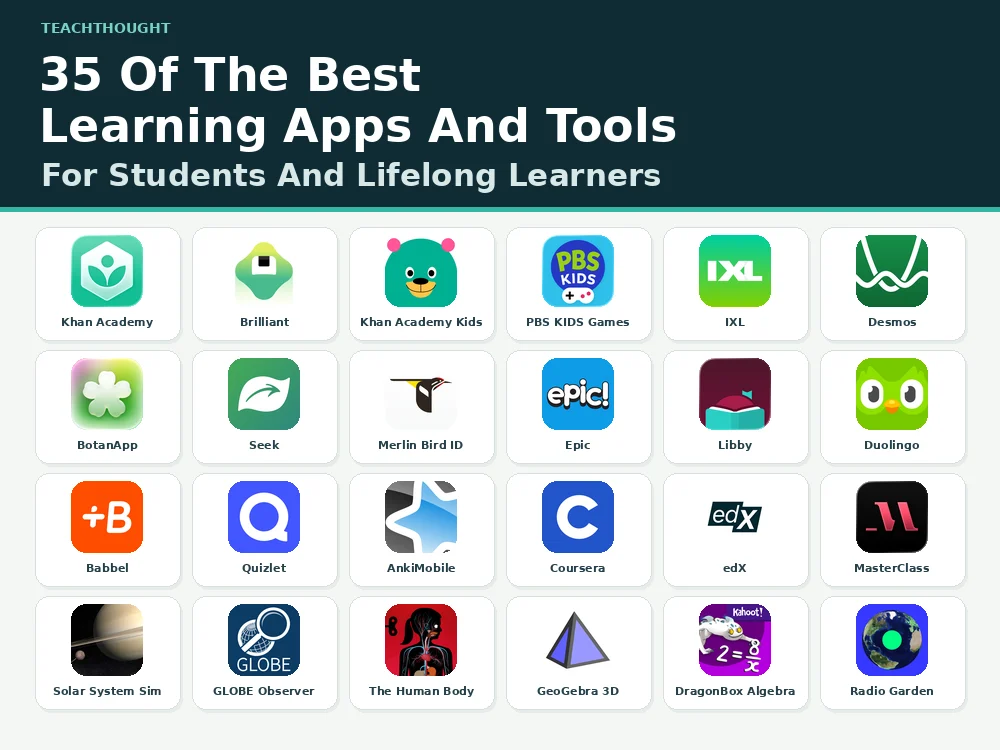
Platforms offering comprehensive, multi-subject curricula serve as the backbone for many modern classrooms and homeschooling environments. Khan Academy remains a cornerstone of free, open-access education, providing structured video lessons and practice problems across mathematics, the humanities, and the sciences for learners of all ages. Complementing this approach is Brilliant, which departs from traditional lecture-based formats by emphasizing interactive, problem-solving sequences designed to cultivate critical thinking in mathematics, logic, coding, and data science.
For targeted practice and skill reinforcement, IXL provides diagnostic-driven exercises in mathematics, language arts, and social studies, allowing teachers to pinpoint and address specific knowledge gaps. Meanwhile, Quizlet and Anki harness the science of spaced repetition through digital flashcard systems, helping students optimize long-term memory retention for vocabulary, terminology, and factual recall.
Early Childhood and Elementary Development
Early childhood education relies heavily on engagement, sensory interaction, and gamified reinforcement. Khan Academy Kids and PBS KIDS Games deliver structured, age-appropriate activities centered around foundational reading and numeracy skills, utilizing familiar television and media characters to maintain young children’s attention. For primary and middle school students (grades three through eight), BrainPOP pairs short, highly produced animated films with formative quizzes and creative activities, transforming complex historical, scientific, and cultural concepts into digestible multimedia modules.
STEM, Visualization, and Interactive Simulation
Abstract concepts in science and mathematics often require visual modeling to achieve true comprehension. The Desmos Graphing Calculator and GeoGebra 3D Calculator offer powerful, intuitive environments for students to manipulate equations, geometric shapes, and three-dimensional surfaces dynamically.
Physics and chemistry education are similarly revolutionized by PhET Interactive Simulations, developed by the University of Colorado Boulder, which allows students to run virtual experiments with variables like voltage, friction, and molecular motion safely and repeatedly. In computer science, Scratch provides a foundational, block-based programming environment where children and novices can construct interactive animations, stories, and games, fostering logical reasoning without the immediate barrier of complex syntax.
Natural Sciences and Environmental Exploration
Digital tools have increasingly turned consumer mobile devices into portable laboratories for field biology and astronomy. For botany and outdoor exploration, Botan App, Seek by iNaturalist, and the Cornell Lab of Ornithology’s Merlin Bird ID utilize advanced image and audio recognition algorithms to identify plant species, fungi, wildlife, and bird songs instantly in the field.
Space exploration and earth sciences are brought to life through platforms like NASA’s Eyes, Solar System Sim, and the GLOBE Observer citizen-science application. These tools allow users to examine spacecraft trajectories, observe planetary motion in three dimensions, and contribute real-world environmental data directly to ongoing scientific research initiatives. Furthermore, platforms like OneZoom visualize the complex evolutionary relationships of the tree of life, turning phylogenetic data into an interactive, zoomable map.
Literacy, Language Acquisition, and the Humanities
Reading comprehension and language learning represent two of the most heavily populated sectors in the educational app market. Epic provides young readers with a vast digital library containing thousands of illustrated ebooks, read-aloud titles, and audiobooks. For older students and adults, Libby connects users to local public library systems, facilitating the digital borrowing of bestsellers, audiobooks, and periodicals using a standard library card.
In language acquisition, Duolingo and Babbel occupy distinct yet complementary spaces. Duolingo employs short, gamified daily lessons focused on vocabulary acquisition and sentence structure, ideal for casual learners and habit-building. Babbel offers a more structured, conversational curriculum geared toward practical dialogue and grammatical nuance. For civics and social studies, iCivics utilizes immersive games and simulations to educate students on the mechanics of democratic governance, legal systems, and civic participation.
Higher Education, Professional Development, and Creative Arts
Adult learners and advanced students seeking specialized knowledge turn to massive open online course (MOOC) providers such as Coursera and edX, which partner with premier global universities and industry leaders to offer accredited courses, professional certificates, and full degree pathways. For creative and vocational enrichment, MasterClass provides cinematic video masterclasses taught by world-renowned practitioners in fields ranging from culinary arts and literature to filmmaking and music composition.
Implications, Access Challenges, and Future Outlook
The integration of digital learning applications into daily routines carries profound implications for educational equity and pedagogical effectiveness. On one hand, free, web-accessible platforms democratize high-quality instruction, enabling students in remote or underfunded districts to access advanced calculus, coding tutorials, and interactive science laboratories that would otherwise be unavailable.
Conversely, the proliferation of subscription-based models, in-app purchases, and hardware requirements risks widening the digital divide. Schools and districts must carefully evaluate data privacy compliance, device compatibility, and equitable access before mandating specific digital tools for student cohorts.
Ultimately, education experts emphasize that applications should be viewed as pedagogical instruments rather than standalone solutions. The most successful implementations align specific software capabilities—whether it is an adaptive math algorithm, a citizen-science observation log, or a spaced-repetition flashcard deck—with clear instructional objectives, student developmental stages, and robust educator guidance. As artificial intelligence and adaptive learning algorithms continue to mature, the next generation of educational applications will likely offer even more personalized feedback loops, further redefining the boundaries of traditional classrooms.

