
The arrest of Artur Danielyan, the leader of the Armenian opposition party Adekvad, in early October marks a significant escalation in the ongoing friction between the administration of Prime Minister Nikol Pashinyan and his political detractors. Danielyan’s detention, triggered by inflammatory social media posts criticizing the government, is far from an isolated incident. Instead, it serves as a prominent indicator of a systemic trend wherein Armenian authorities increasingly utilize criminal charges—often predicated on digital speech—to neutralize political opposition. This development has sparked alarm among civil society groups, who argue that the judiciary is being weaponized to stifle dissent, thereby undermining the democratic foundations the current government once championed.
A Chronology of Escalating Tensions
The legal pressures facing opposition figures are deeply rooted in the polarized environment following the 2020 Nagorno-Karabakh war and the subsequent events of 2023. The timeline of these tensions reveals a pattern of reactive litigation:
- April 2020: The introduction of Article 226.2 into the Armenian Criminal Code, aimed at criminalizing public incitement to violence, provides the legislative bedrock for many of the current prosecutions.
- September 2023: Azerbaijan’s military offensive leads to the collapse of the de facto Nagorno-Karabakh administration and the exodus of over 100,000 ethnic Armenians to Armenia. The issue of political prisoners held in Baku becomes a central point of contention.
- June 2026 (Pre-Election Period): Tensions peak during the parliamentary election cycle. Activist Artur Osipyan, a displaced person from Nagorno-Karabakh, is arrested following a public confrontation with the Prime Minister, leading to charges of obstructing the electoral process and inciting violence via social media.
- October 2026: Artur Danielyan is taken into custody following a Facebook post in which he labeled Prime Minister Pashinyan a "scumbag" over the government’s refusal to prioritize a prisoner exchange for detained Armenian soldiers.
Danielyan’s arrest specifically highlights the raw nerves surrounding the fate of the 19 Armenians currently detained in Azerbaijan. His critique targeted Pashinyan’s public refusal to swap an Azerbaijani soldier—who had been convicted of violent crimes within Armenian territory—for these detainees. By framing the Prime Minister’s policy as a betrayal of national duty, Danielyan invited immediate state scrutiny, resulting in charges that his critics claim are politically motivated rather than legally sound.
Selective Justice: The Data Behind the Dissent
The concern over "selective justice" is supported by data and observations from independent watchdogs. According to a 2025 Freedom House assessment, nearly 95% of criminal cases prosecuted under Article 226.2 since its inception involved allegations of threats against Prime Minister Pashinyan or his political inner circle. Crucially, the report notes a glaring disparity: while opposition rhetoric is frequently prosecuted as "incitement to violence," similar, and often more vitriolic, language used by government supporters or pro-government bloggers against refugees and opposition figures rarely results in criminal investigation.
Further evidence of this imbalance was documented by the Regional Center for Democracy and Security (RCDS) during the 2026 pre-election period. The RCDS found that pro-government influencers utilized social media to disparage displaced Karabakh Armenians, employing derogatory slurs. Despite the clear visibility of these posts, law enforcement agencies remained largely inactive. This discrepancy fuels the argument that the legal system is functioning as an instrument of the ruling party to sanitize the digital public sphere of anti-government sentiment while ignoring hostility directed toward vulnerable groups by state-aligned voices.
The Civil Society Response
The backlash from civil society has been swift and organized. More than a dozen major NGOs and human rights organizations have issued a joint statement condemning the prosecution of figures like Danielyan and Osipyan. The statement explicitly labels the state’s actions as "patently illegal, disproportionate, and politically motivated."

"It is punitive in nature and sends a direct signal to the broader public aimed at silencing dissent, critical views, and undesirable speech," the collective stated. For these organizations, the issue is not whether the speech was inflammatory or insulting—often cited as the basis for the charges—but rather that the state is applying the law in a manner that creates a "chilling effect" on political discourse. By targeting high-profile opposition leaders, the government effectively communicates that any critique of its security or foreign policy could lead to incarceration.
Geopolitical Realignment and the "EU Trap"
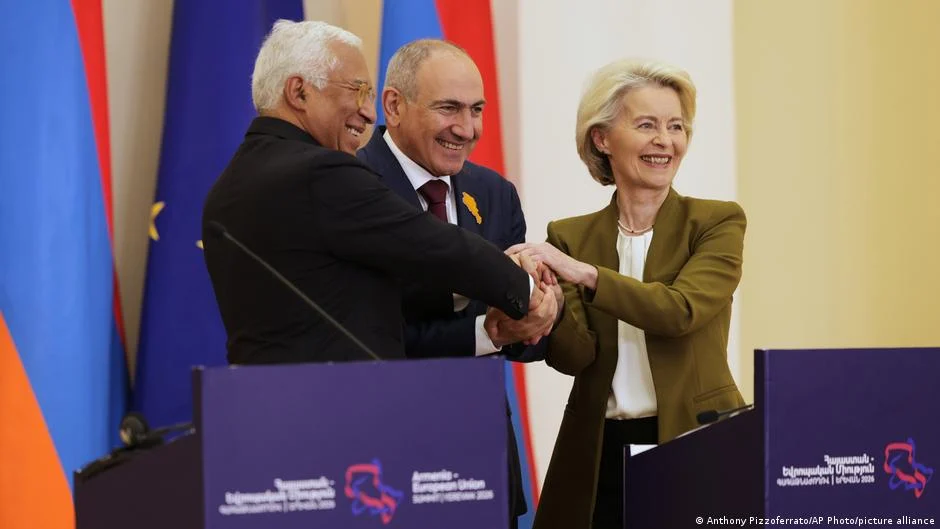
The lack of a robust response from the European Union is a point of intense discussion among political analysts in Yerevan. As Armenia pivots away from its traditional security guarantor, Russia, and seeks deeper integration with Brussels, the Pashinyan administration has effectively positioned itself as the sole pro-Western alternative in a volatile neighborhood.
Tigran Grigoryan, a prominent political analyst, suggests that the EU’s silence is a calculated, pragmatic choice. "The EU has adopted a very pragmatic and geopolitically driven approach," Grigoryan explains. "Armenia has become the EU’s primary partner in the region, particularly given the democratic backsliding seen in neighboring Georgia. Because the alternative to Pashinyan is often painted as a pro-Russian opposition, the EU is reluctant to exert meaningful pressure on human rights issues for fear of destabilizing the current government."
This creates a complex dilemma. Stefan Meister of the German Council on Foreign Relations (DGAP) argues that the EU is falling into a strategic trap. By prioritizing the removal of Russian influence as the primary metric for success, the EU inadvertently provides the Pashinyan administration with a "geopolitical pass." When Pashinyan labels all internal dissent as Russian-backed subversion, he effectively shields his administration from the standard democratic oversight that the EU would normally demand from a candidate or partner nation. Meister emphasizes that "not everyone who criticizes Pashinyan is a pro-Russian proxy," and by failing to distinguish between legitimate political opposition and foreign interference, the EU risks undermining its own core values of human rights and the rule of law.
Official EU Stance and Future Implications
In response to inquiries regarding the deterioration of democratic norms, an EU spokesperson reiterated that fundamental rights, the rule of law, and democratic governance remain at the core of the EU-Armenia Comprehensive and Enhanced Partnership Agreement (CEPA). The official statement noted that the EU is "closely following developments," and insisted that "investigations should be carried out in an independent and impartial manner, free from political considerations."
However, observers argue that such boilerplate rhetoric is insufficient to curb the current trend. For the Armenian government, the immediate goal appears to be the consolidation of power through the strategic management of public opinion and the silencing of vocal critics. The broader implications are dire: if the current path continues, Armenia risks losing the hard-won democratic progress that defined the post-2018 era. The erosion of free speech, coupled with the judicial targeting of political rivals, threatens to leave the country with a hollowed-out democratic system, where the veneer of EU alignment masks an increasingly authoritarian domestic governance model.
As the government moves forward with its current strategy, the question remains whether the EU will eventually move beyond diplomatic statements to demand accountability, or whether the geopolitical necessity of countering Russian influence will continue to override the necessity of defending the democratic rights of the Armenian people. For now, activists, journalists, and opposition leaders in Yerevan remain in a precarious position, waiting to see if their voices will be protected or silenced by the state apparatus.

