
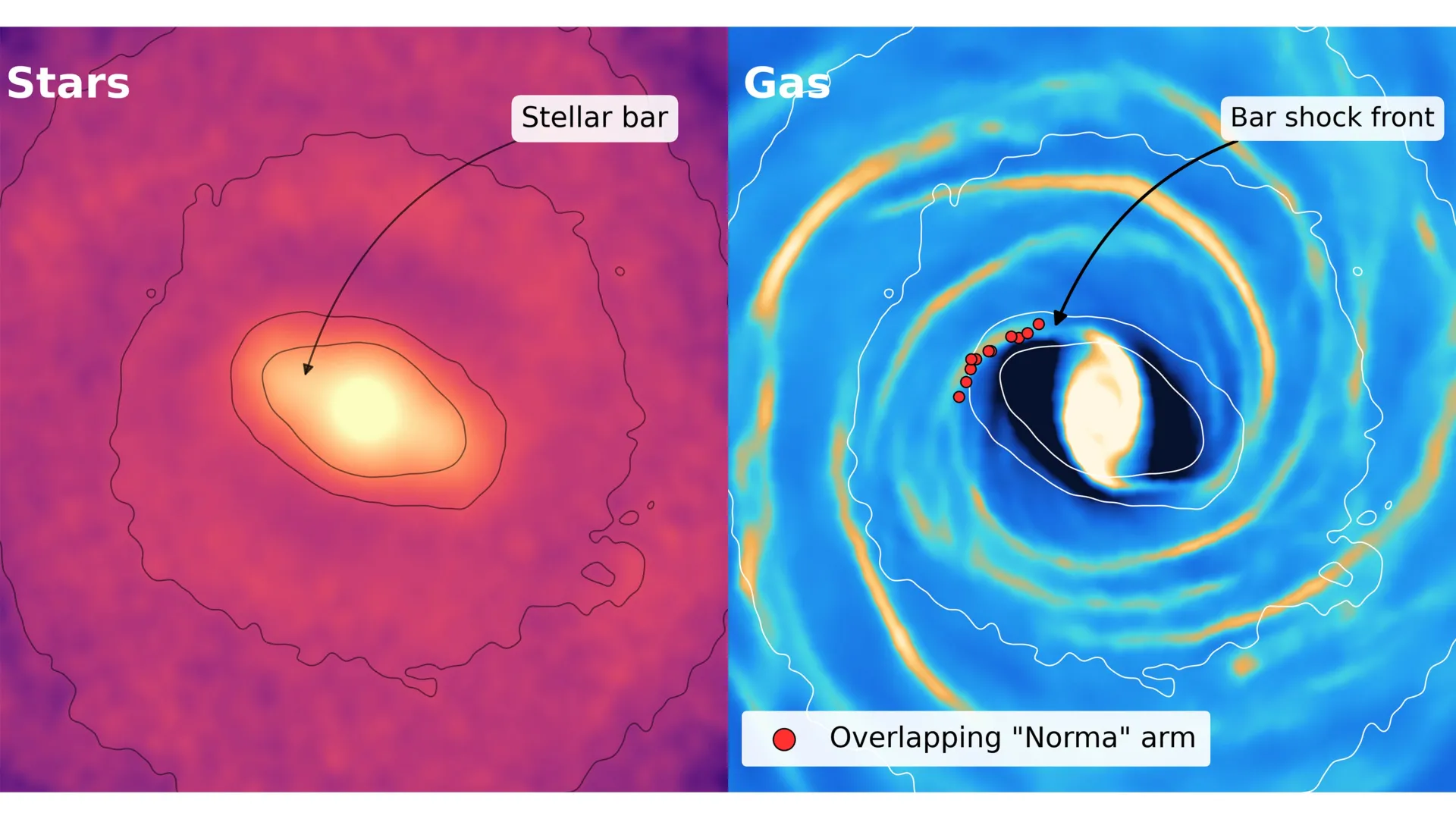
New research suggests the Milky Way produces stars in an unexpected location, revealing a surprising difference between our galaxy and most of its neighbors, while simultaneously challenging long-held assumptions about the fundamental architecture of our home galaxy. The study, led by researchers at the University of Sydney, indicates that a massive, rotating structure of stars near the galactic center is generating powerful shock waves that compress surrounding gas, triggering star formation in a region previously thought to be too turbulent for such processes.
This discovery, recently published in the journal Nature Astronomy, does more than just highlight an unconventional stellar nursery; it also casts doubt on the classification of the Norma arm, a feature long considered a primary spiral arm of the Milky Way. By reconciling sophisticated computer simulations with observational data from microwave-emitting masers, the research team has provided a new, potentially revolutionary perspective on the Milky Way’s internal geography.
The Dynamics of the Galactic Bar
The Milky Way is classified as a barred spiral galaxy, a designation it shares with approximately two-thirds of all spiral galaxies in the observable universe. These systems are defined by a prominent, elongated structure of stars—the "bar"—that rotates at the center of the galactic disk. Unlike the more symmetric structures of non-barred spirals, these bars act as cosmic gravitational engines, funneling gas toward the galactic center and fundamentally altering the evolution of the galaxy.
Dr. Hillary Davis, lead author of the study and a recent graduate of the University of Sydney’s School of Physics and the Sydney Institute for Astronomy, explains that the star formation process is driven by the bar’s rotational energy. "At its heart, star formation is a process we understand from everyday physics. Forces set matter in motion. In this case, gas is compressed, and that compression can create the conditions for new stars to be born on a massive scale," Dr. Davis stated.
In most observed barred galaxies, the extreme turbulence and shock waves generated by the rotating bar typically act as a deterrent to star formation. The intense gravitational sheer and kinetic energy usually tear apart nascent gas clouds before they can collapse under their own gravity. The Milky Way, however, appears to be an outlier. The research indicates that our galaxy belongs to a select group where substantial star formation occurs directly along the shock fronts of the central bar, a phenomenon rarely observed in our immediate galactic neighborhood.
Chronology of the Investigation
The process of mapping the inner Milky Way has been a centuries-long endeavor fraught with difficulty. Because our solar system is situated within the galactic disk, we are effectively trying to map a forest while standing behind a thick curtain of trees. Vast clouds of interstellar dust obscure the galactic center from optical telescopes, making direct observation of the bar’s exact dimensions and dynamics a matter of intense scientific debate.
For years, astronomers relied on infrared surveys and stellar kinematic models to estimate the bar’s properties. However, these methods often yielded conflicting results regarding the bar’s orientation, length, and rotation speed. The current study represents a culmination of a multi-year effort to resolve these discrepancies by bridging the gap between theoretical modeling and empirical data.
The team utilized a new generation of high-resolution, large-scale computer simulations that model galactic evolution over billions of years. By comparing these simulations against real-world observations of "masers"—naturally occurring microwave-emitting sources associated with the birth of massive stars—the team identified a high degree of correlation between the predicted shock fronts of the bar and the actual locations of these star-forming regions.
Reevaluating the Norma Arm
Perhaps the most significant implication of the research concerns the Norma arm. Traditionally, the Norma arm has been mapped as a distinct spiral feature wrapping around the inner galaxy. However, the alignment of observed masers with the predicted shock fronts of the Galactic bar suggests that a significant portion of this arm may be misidentified.
"We found that masers previously associated with the Norma arm closely align with the shock front predicted by our simulations," Dr. Davis noted. "This suggests that at least part of the so-called Norma arm may not be a spiral arm at all, but a region of star formation along the leading edge of the Galactic bar."
If confirmed, this discovery would necessitate a redrawing of the Milky Way’s internal map. It implies that some of the structural complexity previously attributed to the spiral arms is actually a byproduct of the bar’s rotation and its influence on the surrounding interstellar medium. This shift in understanding would change how astronomers interpret the distribution of gas and stars in the inner galaxy, providing a more coherent model of how the Milky Way has evolved into its current configuration.
Supporting Data and Structural Constraints
The study provides specific constraints that may finally settle long-standing debates regarding the physical dimensions of the Milky Way’s bar. Based on their analysis, the research team estimates the bar extends approximately 4.3 kiloparsecs—roughly 14,000 light-years—outward from the galactic center along its long axis.
This finding supports a structural model of a relatively long, slowly rotating bar. The use of masers as tracers was vital in this calculation. Masers, which function similarly to lasers but operate at microwave frequencies, provide highly precise markers for where massive stars are currently forming. Because these massive stars have short lifespans, they remain close to their birthplaces, making them excellent "beacons" for mapping the active regions of the galaxy.
The project relied on extensive computing power to process the complex simulations. Data and computational resources were provided by the National Computing Infrastructure (NCI) Australia and the LUNARC center in Sweden, underscoring the international and collaborative nature of modern astrophysics.
Broader Scientific Implications
The implications of this research extend far beyond the Milky Way. By understanding why our galaxy facilitates star formation along its bar—a trait that distinguishes it from most of its barred counterparts—astronomers can refine their broader theories of galaxy evolution.
"In most similar galaxies, star formation very commonly occurs along spiral arms. What’s extraordinary is seeing this happen in a different region of our Galaxy, where shocks are usually so strong that star formation is often suppressed," Dr. Davis said.
This study highlights the limitations of current astronomical paradigms. For decades, the "spiral arm" model served as a convenient framework for understanding the Milky Way, but as observational technology and computational power improve, the nuance of our galactic structure becomes increasingly apparent. The realization that our galaxy is an outlier in its star-forming activity suggests that the specific conditions of the Milky Way—the interplay between the bar’s mass, rotation speed, and the density of the surrounding gas—create a unique environment that defies simple categorization.
Future Research Directions
While the current findings provide a robust model for the inner galaxy, the researchers emphasize that this is only the beginning. The classification of the Norma arm as a potential extension of the bar remains a hypothesis that requires further validation through additional observations. Future surveys, particularly those utilizing the next generation of radio telescopes and high-resolution infrared instruments, will be required to confirm the full extent of the star-forming regions identified in this study.
Furthermore, the research team’s methodology—comparing massive, multi-billion-year simulations with localized observational data—serves as a blueprint for future studies of other barred spiral galaxies. As astronomers look toward the centers of more distant galaxies, they may find that the "Milky Way model" is more common than previously thought, or conversely, that our galaxy is even more unique than this study suggests.
By systematically narrowing down the possible structural configurations of the Milky Way, this research marks a significant step toward a comprehensive, high-fidelity map of our galaxy. It serves as a reminder that even in our own cosmic backyard, the most fundamental features remain subjects of discovery, debate, and ongoing refinement. The work, funded by organizations including the Australian Research Council and the Swedish Research Council, demonstrates the necessity of cross-disciplinary collaboration in deciphering the complex mechanics of the universe.

