
Between 11 million and 16 million years ago, during the mid-Miocene period, the ancestral precursors of the Indus River dolphin (Platanista minor) migrated into the murky, sediment-rich waters of what is now the Indus Basin. Over the course of subsequent geological epochs, these cetaceans underwent a remarkable evolutionary transformation, shedding their vestigial eyesight in favor of a highly sophisticated biological sonar system. Today, these "blind" mammals, known locally as the bhulan, navigate the shallow, treacherous waters of the Indus River by swimming on their sides, using echolocation to traverse a habitat that has been fundamentally altered by human intervention.
For centuries, the bhulan thrived in the expansive network of the Indus River system. However, the 20th and 21st centuries saw their habitat carved into fragmented segments by a labyrinth of dams, barrages, and irrigation canals. This physical isolation, coupled with anthropogenic pressures, pushed the species to the brink of extinction. Recent data, however, suggests a burgeoning, if fragile, recovery, prompted by a landmark conservation initiative in June 2026: the official establishment of the Punjnad Indus River Dolphin Sanctuary.

A Legacy of Decline and Resilience
The historical decline of the Indus River dolphin is a stark case study in the impact of water infrastructure on biodiversity. In the late 19th century, researchers estimated the population at approximately 10,000 individuals, distributed throughout the Indus River system from the foothills of the Himalayas to the Arabian Sea. By 2001, that number had plummeted to a precarious 617, a result of habitat loss, hunting, and accidental entanglement in fishing gear.
The species’ range has been slashed by an estimated 80% over the last century. Despite these losses, the 21st century has seen a concerted effort by the Pakistani government, NGOs, and local communities to reverse the tide. A landmark 2025 study published in the journal Endangered Species Research (ESR) confirmed that the metapopulation had rebounded to nearly 2,000 individuals, representing a 19.4% increase between 2011 and 2017.
This recovery is largely attributed to the ban on hunting implemented in the 1970s and the ongoing efforts of organizations like WWF-Pakistan to rescue stranded dolphins from irrigation canals. Currently, 99% of the remaining global population is confined to a 690-kilometer stretch of the river between the Chashma barrage in Punjab and the Sukkur barrage in Sindh.

The Punjnad Sanctuary: Bridging the Conservation Gap
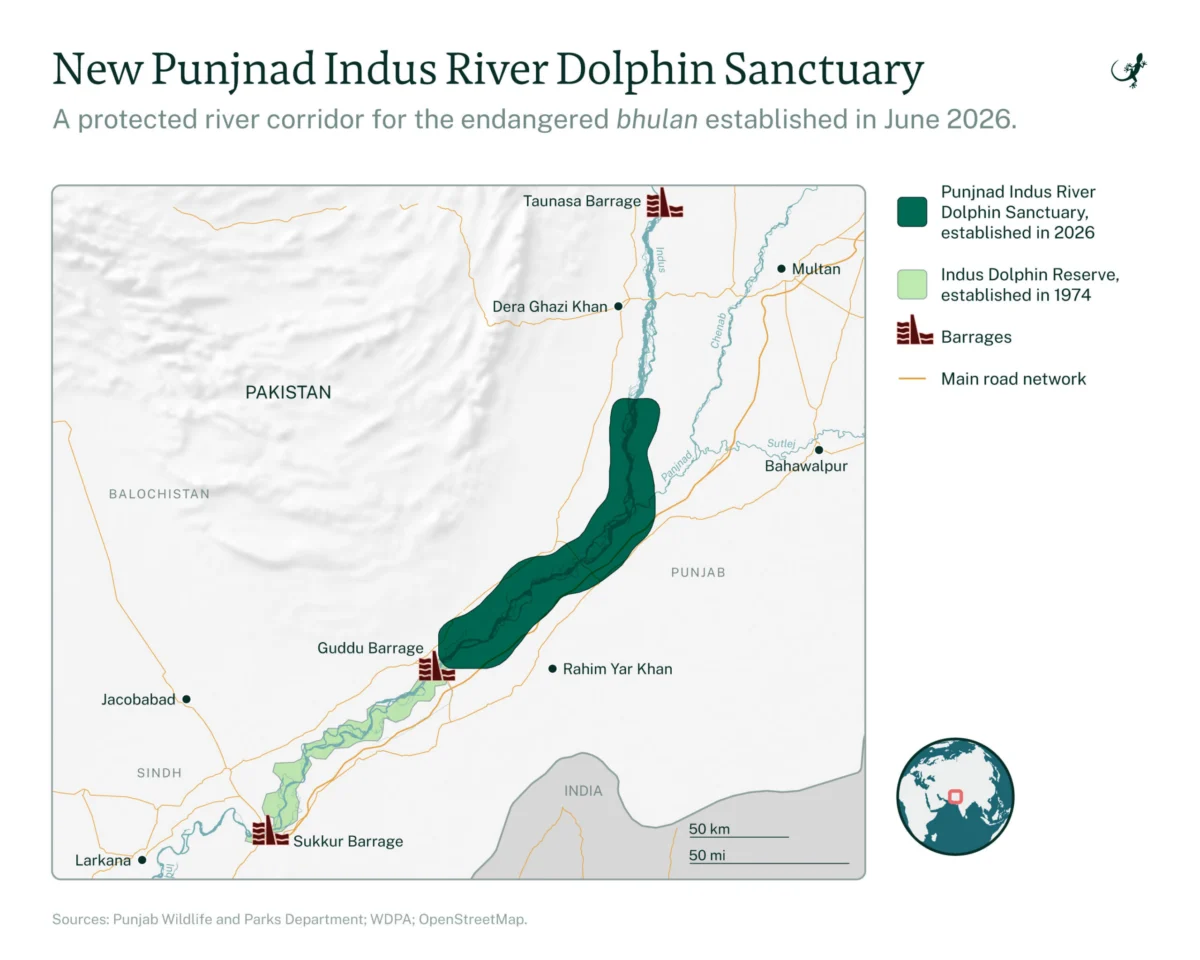
The June 2026 designation of the Punjnad Indus River Dolphin Sanctuary represents a critical turning point for the species. The sanctuary encompasses nearly 200 kilometers of the river in Punjab, effectively linking with the existing protected habitat in Sindh province. This creates a continuous 400-kilometer corridor of legally protected water, providing a vital lifeline for a species that is now almost entirely endemic to Pakistan, with only a vestigial population remaining in India’s Beas River.
Hamera Aisha, lead author of the 2025 ESR study, emphasizes the global significance of this move. "The Indus River dolphin is endemic to the Indus River system," Aisha noted. "If these populations were lost from the Indus, there is no comparable population elsewhere that could secure the future of the species. This gives Pakistan a unique, heavy responsibility for the survival of the bhulan."
The sanctuary’s creation is not merely symbolic; it provides a legal framework to manage human activity in the river, specifically regarding commercial fishing. According to Uzma Khan, a biologist with WWF-Pakistan and co-author of the recent study, commercial fishing contracts in Punjab have historically prioritized volume, leading to high rates of dolphin mortality through gillnet entanglement. Between 2008 and 2023, entanglement was identified as the cause of 52% of all documented dolphin deaths in the basin. The new sanctuary empowers authorities to regulate these practices, monitor threats, and enforce stricter compliance with conservation standards.

The Ongoing Battle Against Fragmentation
While the legal protection of the 400-kilometer corridor is a significant milestone, conservationists caution that "lines on a map" do not automatically solve the physical challenges of the river. The barrages, which are essential for the irrigation of Pakistan’s agricultural sector, remain the primary obstacle to the dolphin’s long-term survival.
These structures isolate sub-populations, preventing the genetic mixing necessary for a healthy, resilient species. Furthermore, they frequently draw dolphins into irrigation channels, where they become trapped. For over two decades, WWF-Pakistan has operated specialized rescue teams that physically transport stressed, stranded dolphins back to the main river channel—a high-risk, labor-intensive process.
Javed Mahar, conservator of the Sindh Wildlife Department, believes the new sanctuary is a necessary expansion of the legacy started in the 1970s. "The declaration of a protected area in Punjab is an encouraging step in the right direction," Mahar stated. "With the presence of an experienced organization like WWF-Pakistan, we expect to see concrete steps for future procreation and habitat management."

However, experts like Aisha note a vital distinction between "continuity of protection" and "ecological connectivity." The sanctuary does not dismantle the barrages, but it does allow for a more integrated management approach. Future initiatives may focus on adjusting the operation of these barrages to include ecological considerations, such as managing water flow levels during the dry season to ensure that dolphins are not inadvertently pulled into canal networks.
Broader Environmental Threats: Mining and Climate Change
The survival of the bhulan is inextricably linked to the health of the entire Indus River ecosystem. Beyond the immediate threats of nets and concrete, the river faces insidious dangers from industrial and environmental degradation.
Gold mining operations located along the riverbanks have been identified as a major source of water contamination, utilizing toxic chemicals such as mercury and cyanide. These pollutants enter the aquatic food web, bioaccumulating in the fish that serve as the dolphins’ primary food source. Additionally, climate change is fundamentally altering the hydrology of the region. Accelerated glacial melt in the Himalayas, combined with unpredictable precipitation patterns, threatens the natural flow regimes that the dolphins rely on to maintain their habitat of deep pools and connected channels.

Aisha stresses that the future of the species requires a multi-pronged approach. "Dolphins depend on adequate water depth, connected channels, and healthy fish populations," she explained. "Pollution from agricultural, municipal, and industrial sources—and increasingly, plastic pollution—needs greater attention because it affects both the dolphins and their prey."
The Role of Local Communities and Future Stewardship
The success of the Punjnad sanctuary will ultimately depend on the participation of the communities that live along the river. Historically, the transition from subsistence fishing to commercial exploitation has marginalized local fishers and increased pressure on the river’s biodiversity.
The new sanctuary framework aims to reverse this by promoting community-based sustainable fishing practices. The goal is to move toward the "Conservation Assured | River Dolphin Standards" (CA|RDS), an international benchmark for managing river dolphin habitats. This framework emphasizes that conservation cannot succeed in a vacuum; it must provide livelihood support to the people who depend on the river for their survival.

"Communities are pivotal to the success of any conservation initiative," says Khan. "By involving them in the management of the sanctuary, we can ensure that local livelihoods are aligned with the protection of the species."
As Pakistan looks toward the future of the Indus River dolphin, the establishment of the Punjnad sanctuary serves as a beacon of what is possible through scientific research, inter-provincial cooperation, and a commitment to preserving natural heritage. Yet, as experts remind us, this is not a finish line. The recovery of the bhulan is a work in progress, requiring constant vigilance, sustained funding, and a willingness to balance the demands of a growing human population with the needs of one of the world’s most unique freshwater mammals.
The responsibility now lies with both the state and the public to ensure that the "Queen of the Indus" continues to navigate these ancient waters for generations to come. The progress documented since the turn of the century proves that the species is capable of rebounding when given the space to thrive; the challenge now is to provide that space in a rapidly changing world.

