
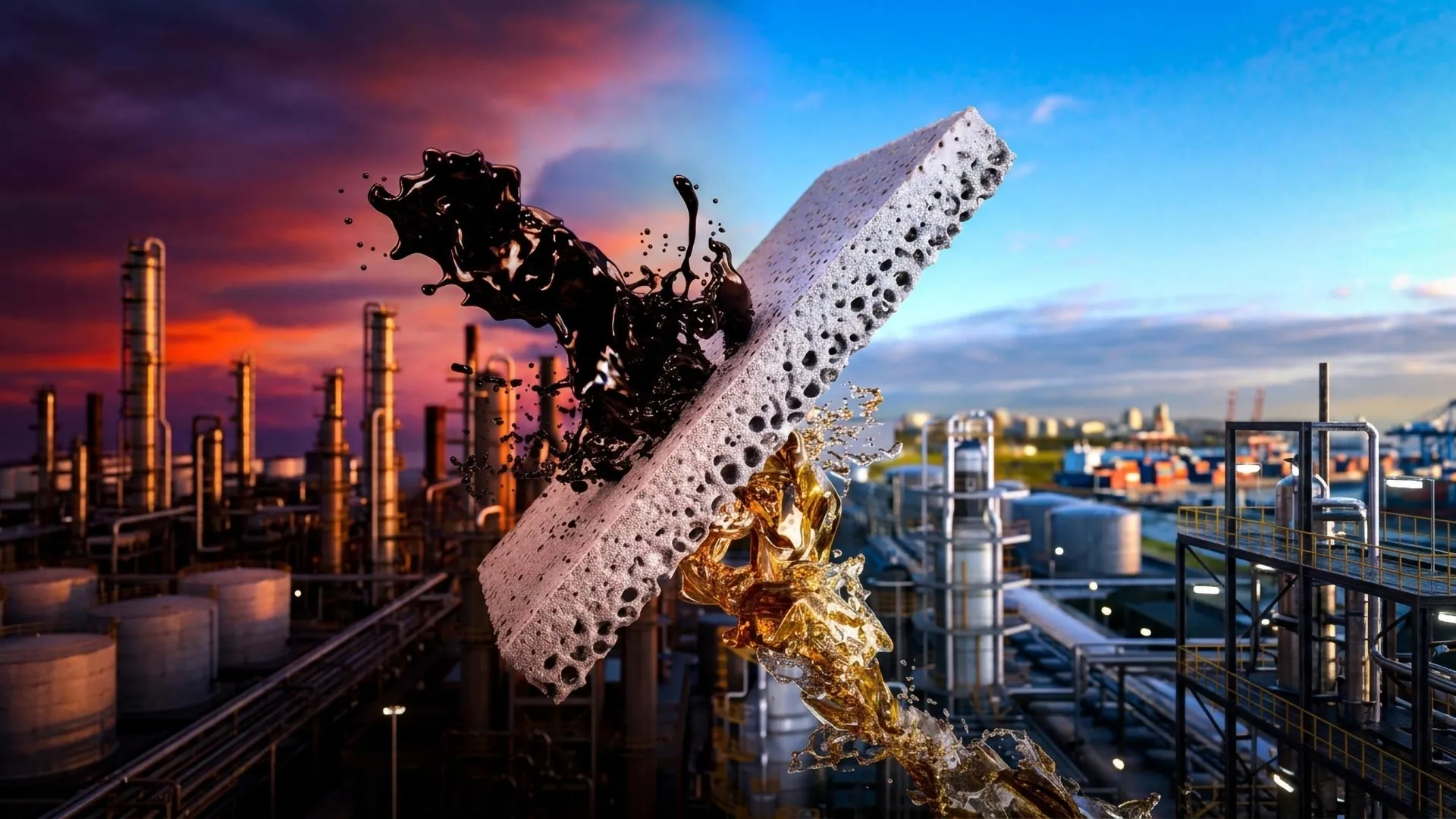
In a landmark achievement for chemical engineering and industrial sustainability, a joint research team from the Korea Advanced Institute of Science and Technology (KAIST) and the Georgia Institute of Technology has unveiled a transformative method for separating crude oil components without the use of traditional, energy-intensive heat distillation. The breakthrough, detailed in the latest edition of the journal Nature, centers on the development of a membrane system that leverages the fluid dynamics of the crude oil itself to facilitate separation at room temperature. By utilizing an inexpensive, porous polyacrylonitrile (PAN) material, researchers have demonstrated a mechanism that could fundamentally reshape the economics and environmental footprint of the global petrochemical industry.
The Century-Long Challenge of Thermal Distillation
For over a century, the global refining sector has operated on a foundational, albeit inefficient, principle: thermal distillation. To break down crude oil into usable hydrocarbons—such as gasoline, naphtha, kerosene, and diesel—refineries must subject the feedstock to temperatures exceeding 350°C. This process involves boiling the oil into vapor and subsequently cooling it to capture distinct fractions.
The thermodynamic cost of this operation is staggering. Global crude oil distillation is estimated to consume approximately 1,100 terawatt-hours (TWh) of energy annually. To put this figure into perspective, it is equivalent to the total annual electricity generation of roughly 130 one-gigawatt nuclear power plants. This massive consumption of thermal energy not only drives up the operating costs for refineries—and, by extension, the price of everything from gasoline to plastic packaging—but also serves as a primary driver of the sector’s carbon emissions.
As international regulations tighten and the pressure to meet carbon neutrality targets intensifies, the energy-intensive nature of distillation has become a significant liability for the petrochemical industry. Until now, the quest for an alternative has been stymied by the high costs and mechanical fragility of specialized synthetic membranes.
A Paradigm Shift: From Fouling to Functionality
Historically, the scientific community operated under the assumption that for a membrane to effectively separate hydrocarbons, it required a sophisticated, high-precision surface coating. These coatings, while capable of molecular-level separation, are notoriously expensive to produce and prone to microscopic defects when scaled for industrial use. Furthermore, traditional membrane research has viewed "fouling"—the accumulation of material within the pores of a filter—as a catastrophic failure that necessitates frequent, costly cleaning or membrane replacement.
The KAIST and Georgia Tech collaboration, led by Professor Dong-Yeun Koh and Professor Ryan Lively, inverted this logic entirely. By utilizing a bare, uncoated PAN membrane—a material already widely used as an industrial support substrate—the team observed an extraordinary phenomenon. As crude oil flowed through the porous polymer, heavy hydrocarbon molecules naturally accumulated on the inner walls of the membrane’s pores.
Rather than clogging the system in a way that hindered performance, this buildup functioned as a self-assembling architectural tool. The deposited molecules gradually constricted the pores, narrowing them to channels of less than 2 nanometers. This spontaneous, "self-correcting" process created a highly selective barrier that allowed lighter, valuable oil fractions to pass through with remarkable speed while effectively blocking heavier components.
The empirical results were unprecedented. The uncoated PAN membrane exhibited crude oil permeation rates 23 times higher than those documented in previous high-performance separation membranes. Furthermore, the system demonstrated remarkable resilience, maintaining stable performance throughout a 28-day continuous trial.
Chronology of the Discovery and Validation
The project represents a multi-year collaborative effort between the two institutions. The initial conceptualization phase focused on identifying materials that could withstand the chemically aggressive environment of raw crude oil. The choice of PAN was strategic, given its chemical stability and low cost.
Following initial lab-scale successes, the team moved to validate the membrane using real-world crude oil samples provided by HD Hyundai Oilbank. This was a critical step in the research timeline; unlike synthetic test fluids, real crude oil is a complex, unpredictable mixture of thousands of different hydrocarbon compounds. The successful performance of the membrane under these "industrial-relevant" conditions provided the necessary proof-of-concept to move toward potential commercialization.
The formal publication in Nature marks the transition of this technology from a theoretical laboratory curiosity to a validated scientific principle. The research team is now shifting its focus toward "modularization"—the process of scaling the membrane technology for integration into existing refinery infrastructure.
Strategic Implications for the Refining Sector
One of the most compelling aspects of this innovation is its potential for "brownfield" integration. Refineries do not necessarily need to scrap their existing distillation towers to benefit from this technology. Instead, the membrane modules could be installed as a pre-processing stage. By filtering the crude oil before it enters the heat-intensive distillation column, the membrane would remove a significant portion of the workload from the heating system.
The projected impact, based on extensive computer simulations, is profound. Estimates suggest that the integration of this membrane system could reduce energy consumption in the refining process by 31.6%. The environmental benefits are equally significant, with projected carbon dioxide emission reductions of 37.6% and a 20.7% decrease in the use of cooling water.
From an economic standpoint, the simulations indicate a potential 36% reduction in operational costs. For the South Korean market alone, which maintains a robust refining infrastructure, the researchers estimate that widespread adoption could mitigate approximately 10 million tonnes of greenhouse gas emissions annually. To visualize the scale of this reduction, it is equivalent to removing four million internal combustion engine vehicles from the road each year.
Broader Applications and Future Outlook
While the primary focus of the research was the refinement of crude oil, the underlying principle—the use of complex liquid mixtures to spontaneously form selective filtration channels—has implications that extend far beyond the petroleum sector.
The researchers identified several high-growth industries where this technology could be applied:
- Circular Plastic Economy: The membranes could be used to purify pyrolysis oil, which is the product of breaking down waste plastics. Efficient purification is a significant bottleneck in current chemical recycling efforts.
- Energy Storage: The technology could be adapted to recover high-value solvents used in the manufacturing of lithium-ion batteries.
- Pharmaceuticals and Biofuels: The precision of the 2-nanometer channels could be fine-tuned for the purification of complex pharmaceutical compounds or the processing of bio-derived fuels, both of which require high levels of purity.
Professor Ryan Lively of Georgia Tech noted that the low productivity of previous membrane systems was the primary barrier to industry adoption. "The PAN membranes, with their surprising separation mechanism, dramatically increase the productivity of the membrane unit, to the point where industry should seriously consider adopting the technology," Lively stated.
Challenges to Commercial Adoption
Despite the promising findings, the researchers acknowledge that significant hurdles remain. The current success is based on controlled testing environments and process simulations. Transitioning to full-scale industrial operations requires solving the engineering challenges of "large-area membrane modularization."
Dr. Jihoon Choi and Dr. Hyeokjun Seo, the study’s co-first authors, emphasized that the next phase of the research involves "precisely controlling this spontaneous pore-constriction phenomenon." Their goal is to develop a robust, plug-and-play platform that can handle the variable pressures and temperatures of a functioning refinery. Furthermore, long-term reliability in a harsh industrial environment—where contaminants other than hydrocarbons might be present—remains a key area for further study.
Conclusion
The development of this spontaneous, self-assembling membrane represents a rare intersection of "low-tech" materials and "high-tech" chemical engineering. By abandoning the search for expensive, synthetic surface coatings and instead embracing the inherent properties of the crude oil itself, the KAIST-Georgia Tech team has provided a potential roadmap for one of the most difficult challenges in industrial decarbonization. As the global economy seeks to bridge the gap between necessary chemical production and the imperative of climate action, innovations that enhance efficiency through fundamental scientific insight will likely play a decisive role in the energy transition. The coming years will be critical as the research moves from the controlled, validated environment of the laboratory to the demanding, high-throughput reality of the global refinery floor.

