
A routine aerial photography assignment off the coast of Miami, Florida, turned deadly on Wednesday morning when a small helicopter crashed into the waters of Biscayne Bay. The accident, which occurred shortly after 11 a.m. near Nixon Beach and Bill Baggs Cape Florida State Park on Key Biscayne, resulted in one fatality and left two other occupants with critical, life-threatening injuries. Local emergency responders, federal aviation authorities, and maritime rescue units swiftly mobilized to manage the crisis, launching a multi-agency response that dominated local waterways for hours.
Main Facts and Incident Overview
The aircraft involved in the Wednesday morning tragedy has been identified by preliminary National Transportation Safety Board (NTSB) data as a Robinson R44 II helicopter. According to federal and local investigators, the aircraft was carrying a total of three individuals at the time of the mishap and was reportedly engaged in a commercial or private photography flight over the scenic coastal waters of South Florida.
Shortly after the distress call was logged, emergency personnel from the Miami-Dade Fire Rescue (MDFR), the City of Miami Fire Rescue, Key Biscayne Fire Rescue, and the U.S. Coast Guard converged on the crash site. The impact occurred in relatively shallow waters just off the 1200 block of Crandon Boulevard, near the southern tip of Key Biscayne.
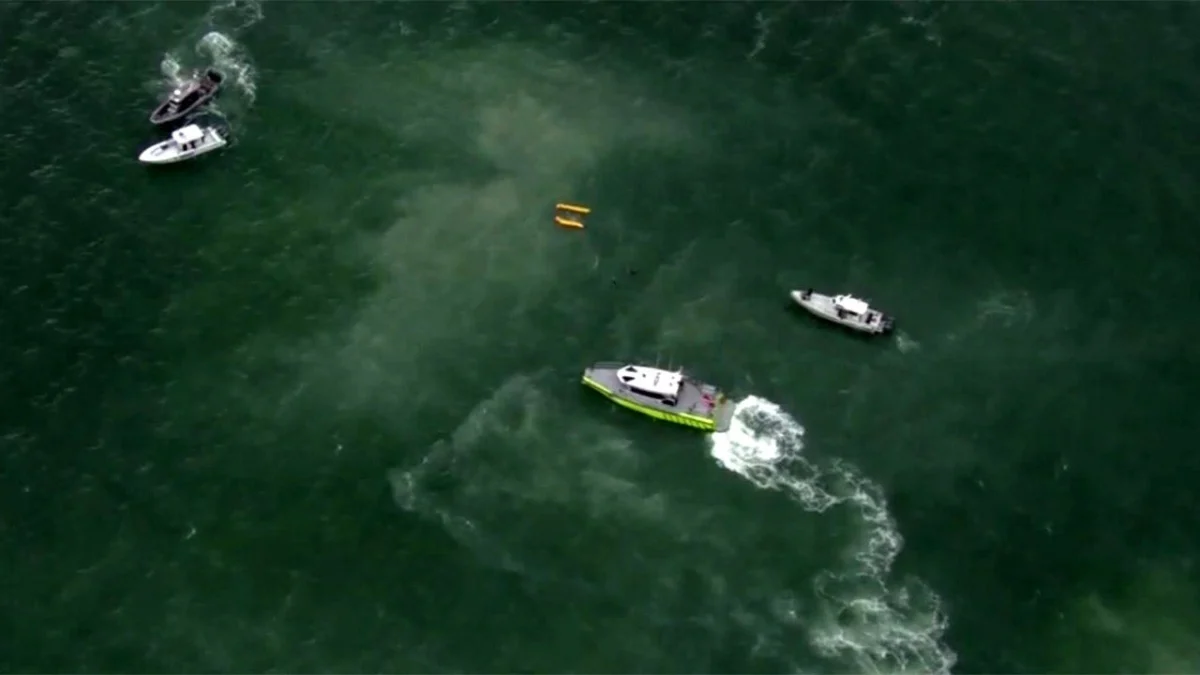
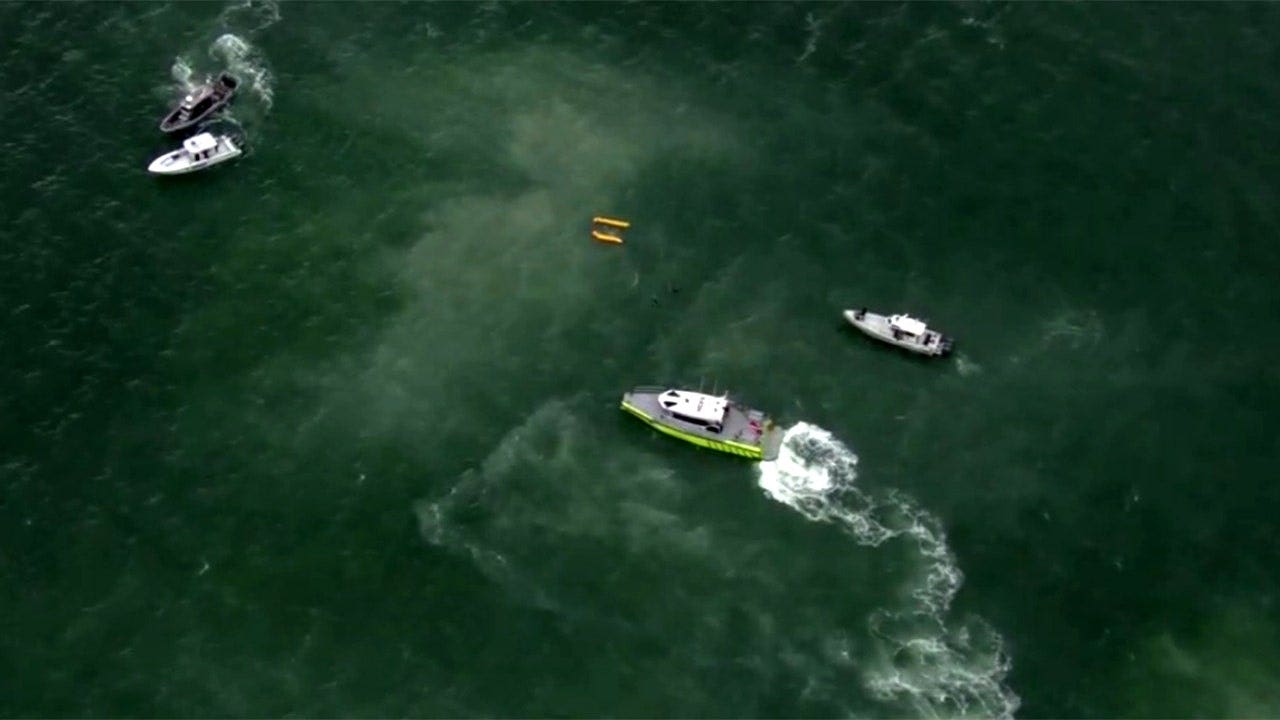
Aerial footage captured by local news helicopters shortly after the incident revealed the grim scene: the wreckage of the Robinson R44 II submerged near its deployed yellow emergency floats, surrounded by rescue boats, marine patrol vessels, and specialized public safety dive teams. Despite the rapid deployment of first responders, authorities confirmed that one of the three occupants succumbed to their injuries at the scene. The remaining two survivors were pulled from the water by rescue crews and immediately transferred to local trauma centers for urgent medical intervention.
Detailed Chronology of Events
The unfolding emergency sequence began late Wednesday morning, leaving investigators to piece together the final moments of the flight path.
- 11:00 a.m. – 11:15 a.m. EST: The Robinson R44 II helicopter takes off for what preliminary reports indicate was an aerial photography mission in the greater Miami airspace.
- Shortly after 11:15 a.m. EST: Witnesses in the vicinity of Nixon Beach and Bill Baggs Cape Florida State Park report seeing the small aircraft experience distress before going down in the waters of Biscayne Bay, just off the coast of Key Biscayne.
- 11:20 a.m. EST: Emergency dispatch centers receive multiple 911 calls regarding a downed aircraft in the water. First responders from Miami-Dade Fire Rescue, City of Miami Fire Rescue, and the U.S. Coast Guard are immediately dispatched to the scene.
- 11:35 a.m. EST: Marine units and dive teams arrive at the coordinates near Nixon Beach. Rescuers locate the wreckage and begin pulling victims from the water. Two adult patients showing severe trauma indicators are recovered.
- 11:50 a.m. EST: Ground rescue units transport the two surviving trauma patients from local waterfront staging areas to a designated landing zone. A Miami-Dade Fire Rescue Air Rescue helicopter subsequently lifts off to transport the critically injured individuals to a primary regional trauma center.
- 1:00 p.m. – Onward: Federal investigators from the National Transportation Safety Board (NTSB) and the Federal Aviation Administration (FAA) are notified. Coordination begins for the recovery of the aircraft wreckage and the launch of a formal, multi-faceted accident investigation.
Official Responses and Medical Status
Emergency management agencies coordinated rapidly to handle the medical logistics of the catastrophe. In statements provided to regional outlets like NBC Miami, public safety officials outlined the precise transfer of the injured parties.
"Two adult trauma alert patients were transported by ground rescue units from the City of Miami Fire Rescue and Key Biscayne Fire Rescue to a designated landing zone, where MDFR Air Rescue transported them to the main trauma center," public safety representatives stated.
The U.S. Coast Guard and the Miami-Dade Sheriff’s Office confirmed the casualty figures, noting that one individual perished despite life-saving efforts administered at the scene and during transit. As of Wednesday evening, the identities of the deceased individual and the two survivors have been withheld by authorities, pending formal notification of next of kin and ongoing family consultations. Medical updates regarding the two hospitalized survivors indicate they remain in critical condition under the care of specialized trauma physicians.
Background Context: The Robinson R44 and Aviation Safety
The aircraft involved in Wednesday’s tragedy, the Robinson R44, is one of the most widely utilized light utility and training helicopters in the world. Manufactured by Robinson Helicopter Company, the four-seat, single-engine aircraft is frequently employed for commercial endeavors such as aerial photography, flight instruction, traffic reporting, and recreational touring due to its cost-effectiveness and versatility.
However, aviation safety statistics regarding light helicopters—and specifically certain models produced by Robinson—have historically drawn scrutiny from safety advocates and federal regulators. The NTSB and the FAA maintain rigorous oversight frameworks for rotorcraft operations, particularly those operating in congested coastal environments or low-altitude flight regimes like photography and sightseeing tours.
Operating at low altitudes over water introduces inherent risks, including limited reaction time in the event of a sudden mechanical failure, engine stoppage, or loss of tail rotor effectiveness. While the R44 II model often features optional safety enhancements such as inflatable emergency floats—visible in the wreckage imagery recovered from Biscayne Bay—the margin for error during specialized visual missions remains exceedingly narrow.

Broader Impact, Economic Implications, and the Investigation Ahead
The crash off Key Biscayne highlights the unique safety challenges faced by aviation operators in South Florida. The region’s dense urban sprawl, juxtaposed with extensive coastal waterways, bridges, and bustling recreational boating zones, creates a complex operating environment for low-flying aircraft.
Commercial operators and independent aerial photographers relying on light helicopters must navigate stringent airspace rules governed by Miami International Airport and local executive airfields. Accidents of this nature invariably prompt renewed calls from aviation safety experts regarding the frequency of low-altitude commercial flights over populated or semi-populated marine recreational areas.
The NTSB, alongside the FAA, has assumed primary jurisdiction over the investigation. Investigators will focus on a myriad of potential contributing factors, including:
- Mechanical integrity and maintenance logs of the Robinson R44 II engine and rotor systems.
- Environmental variables, including localized wind patterns, visibility, and atmospheric conditions over Biscayne Bay at the time of the flight.
- Pilot qualifications, flight hours, and the specific parameters of the photography assignment.
- Air traffic control communications and radar track data to reconstruct the aircraft’s final moments in the air.
As the wreckage is recovered from the shallow waters of Biscayne Bay and transferred to a secure facility for forensic examination, federal investigators have emphasized that a comprehensive final report could take several months to complete. In the interim, local authorities continue to offer support to the families affected by the tragedy, while the South Florida aviation community mourns yet another sobering reminder of the hazards inherent in flight operations.

