
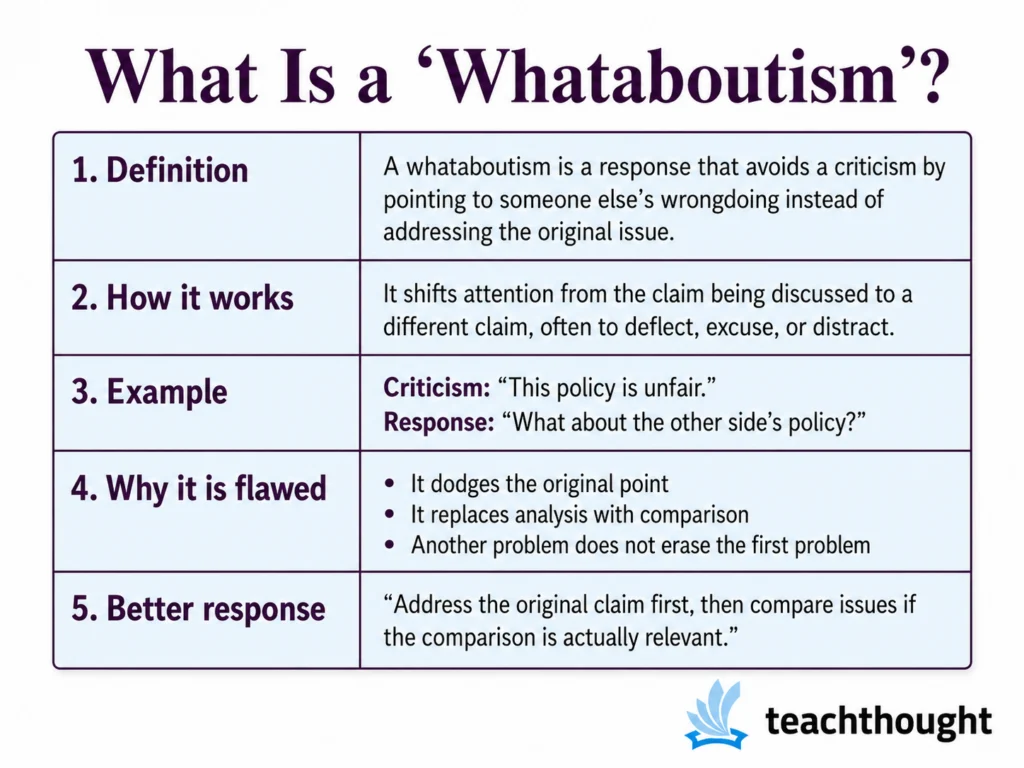
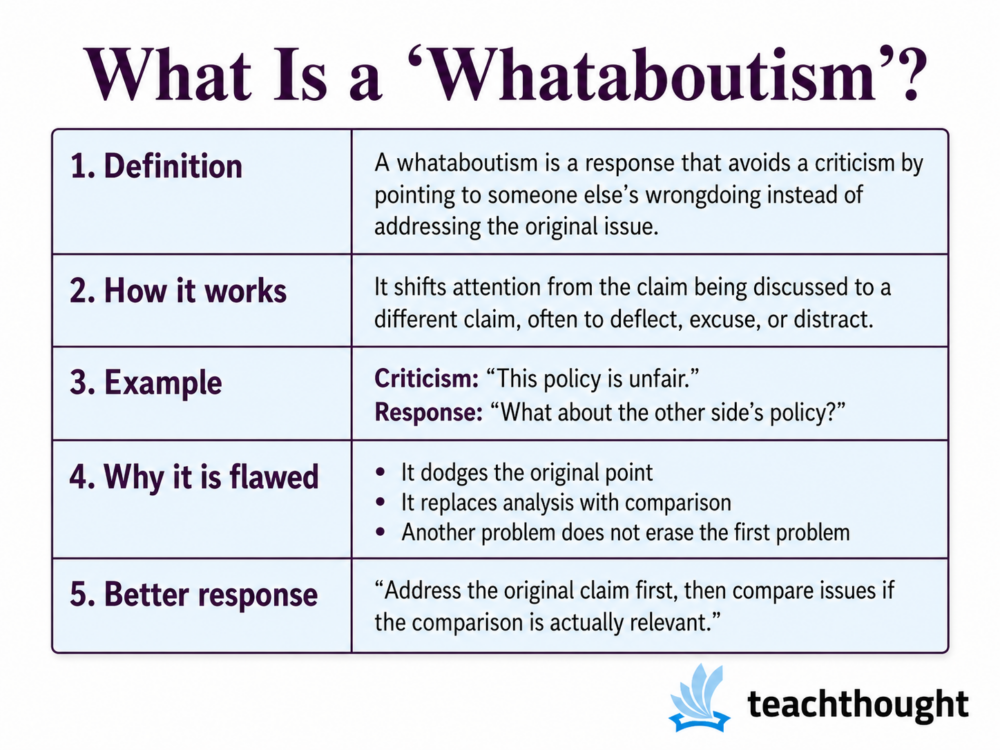
Whataboutism is a specific rhetorical strategy and logical fallacy designed to deflect criticism by shifting the focus onto the perceived failings of an opponent or an unrelated third party. At its core, the maneuver avoids direct engagement with a claim, question, or accusation by posing a counter-accusation, typically beginning with the phrase "What about…?" While it often mimics the appearance of a quest for fairness or consistency, linguistic experts and communication scholars identify it as a form of avoidance that stalls productive dialogue. By redirecting attention away from the original issue, whataboutism functions as a defensive shield, preventing accountability and clouding the merits of the primary argument.
The Mechanics of Deflection and Logical Foundations
The effectiveness of whataboutism lies in its ability to exploit the human desire for equity. When an individual is confronted with a mistake or a moral failing, pointing out a similar failing in someone else can create a temporary illusion of parity. However, in the realm of logic, whataboutism is a variant of the tu quoque fallacy (Latin for "you also"). This fallacy attempts to discredit an opponent’s position by asserting the opponent’s failure to act consistently in accordance with that position.
Whataboutism is also closely related to other logical disruptions, such as the "red herring" and "false equivalence." A red herring is a peripheral topic introduced to distract from the main subject, while false equivalence occurs when two disproportionate situations are presented as being of equal weight. In a debate, whataboutism often combines these elements: it introduces a distracting topic (the red herring) while implying that the two wrongs cancel each other out (false equivalence).
The distinction between a legitimate comparison and whataboutism is found in the intent and the outcome of the statement. A useful comparison clarifies the original issue by providing context or highlighting a pattern. For example, comparing two legal cases to ensure consistent sentencing is a valid use of comparative logic. In contrast, whataboutism replaces the original question entirely. If a student is criticized for not contributing to a group project and responds by pointing out another student’s absence from a meeting, they have not addressed their own lack of contribution; they have merely attempted to change the subject of the investigation.
A Chronology of Whataboutism: From Cold War Tactics to Digital Age Dominance
The history of whataboutism is deeply rooted in international diplomacy and state-level propaganda. Understanding its evolution provides essential context for its current prevalence in social media and domestic politics.
1940s – 1950s: The Roots of Soviet Deflection
During the early years of the Cold War, the Soviet Union developed a consistent pattern of responding to Western criticism of its human rights record by pointing to racial segregation and lynchings in the United States. This "And you are lynching Negroes" trope became the foundational template for what would later be named whataboutism.
1970s: Coining the Term
While the tactic was decades old, the specific term "whataboutism" began to appear in the late 1970s. Writer Michael West is often credited with popularizing the term in a 1978 letter to The Guardian, where he criticized the repetitive nature of pro-Soviet rhetoric that sought to justify Eastern Bloc failings by highlighting Western flaws.
2008 – 2014: The Resurgence
The term saw a significant revival during the Russo-Georgian War in 2008 and the annexation of Crimea in 2014. Journalists and political analysts noted that Kremlin officials frequently responded to international condemnation by citing the 2003 invasion of Iraq or the NATO intervention in Kosovo, arguing that Western powers had no moral standing to criticize others.
2016 – Present: Mainstream Integration
In the mid-2010s, whataboutism moved from the realm of foreign policy into the center of domestic political discourse in the United States and Europe. The rise of social media platforms like X (formerly Twitter) and Facebook provided the perfect environment for rapid-fire deflections. Political figures across the spectrum began using the tactic to navigate scandals, using the "what about" framework to pivot to their opponents’ controversies during live interviews and debates.
Supporting Data and the Psychology of Persuasion
Data suggests that whataboutism is not just a rhetorical annoyance but a psychologically potent tool. According to research on cognitive dissonance, when individuals are presented with information that challenges their worldview or the integrity of their "team" (political, social, or professional), they experience mental discomfort. Whataboutism provides an immediate "escape hatch" from this discomfort.
A study by the Reuters Institute for the Study of Journalism highlighted that polarized audiences are more likely to accept and share content that employs whataboutism because it validates their existing biases. By focusing on the "hypocrisy" of the other side, the audience can ignore the valid criticisms directed at their own side.
Furthermore, digital discourse analysis indicates that whataboutism thrives in "high-velocity" information environments. In a 24-hour news cycle, the goal of a rhetorician using whataboutism is often not to win the argument on its merits, but to "flood the zone." By introducing multiple counter-accusations, the speaker ensures that the original claim is buried under a mountain of secondary debates, a tactic often referred to by communications experts as the "Gish Gallop."
Examples in Practice: Weakening the Fabric of Discussion
To better understand how whataboutism undermines communication, consider the following common scenarios and their structural impact on dialogue:
-
Professional Accountability:
- Claim: "The marketing department missed the deadline for the quarterly report."
- Whataboutism Response: "What about the sales team? They didn’t even submit their lead generation data from last month."
- Analysis: The sales team’s failure may be a legitimate issue, but it does not change the fact that the marketing report is late. By shifting the focus, the speaker avoids explaining the delay or proposing a solution.
-
Source Credibility in Academia:
- Claim: "The statistics in this essay are from a biased source with no peer review."
- Whataboutism Response: "What about the sources used by the other group? Their references were even older than mine."
- Analysis: This response attempts to lower the standard of the entire class rather than meeting the specific requirements of the assignment. It treats the pursuit of truth as a relative competition rather than an objective standard.
-
Social and Ethical Criticism:
- Claim: "That specific comment regarding the minority group was insensitive and unfair."
- Whataboutism Response: "What about all the unfair things people say about my community every day?"
- Analysis: While the speaker may indeed be a victim of unfairness elsewhere, this does not resolve the specific instance of insensitivity being discussed. It creates a circular loop of grievance where no single issue can be addressed until all issues are addressed simultaneously.
The Impact on Education and Critical Thinking
For educators and students, whataboutism represents a significant hurdle to developing robust critical thinking skills. The core of academic inquiry involves staying with a question long enough to examine its evidence, implications, and nuances. Whataboutism encourages the opposite: a shallow, reactionary leap from one topic to another.
Pedagogical experts suggest that the prevalence of whataboutism in popular culture can bleed into the classroom, making Socratic Seminars and evidence-based debates difficult to manage. When students use whataboutism, they are often signaling that they feel singled out or defensive. Recognizing this allows educators to redirect the conversation. Instead of allowing the "What about…?" to derail the lesson, teachers can ask: "That is an interesting point regarding Jordan’s absence, but how does that change the evidence regarding your own contribution to the project?"
By separating relevant comparisons from simple deflections, students learn to maintain the integrity of an argument. They begin to understand that two things can be true at once: an opponent can be a hypocrite, and the original criticism can still be valid.
Broader Implications: The Erosion of Accountability
The long-term impact of widespread whataboutism is the erosion of public accountability. When every accusation is met with a counter-accusation, the public eventually suffers from "outrage fatigue." If every leader is portrayed as equally flawed through a series of "what abouts," the concept of objective wrongdoing begins to vanish.
This creates a "post-truth" environment where evidence is secondary to tribal loyalty. In such a climate, the goal of communication is no longer to reach a consensus or solve a problem, but to survive the news cycle by ensuring the "other side" looks just as bad. This cynicism can lead to civic disengagement, as voters and citizens conclude that all parties are equally untrustworthy, regardless of the specific evidence presented against them.
Conclusion and Strategies for Response
Whataboutism is a powerful rhetorical tool because it weaponizes the truth of one situation to hide the truth of another. To combat it, observers and participants in debate must insist on the "order of operations" in logic. One must answer the primary claim before earning the right to introduce a secondary comparison.
The goal is not to eliminate the question "What about?" from the English language, but to use it with precision. A productive "what about" seeks to expand the context of a solution, whereas a fallacious "what about" seeks to escape the consequences of a problem. In an era of unprecedented information flow, the ability to identify and neutralize whataboutism is perhaps one of the most vital components of modern literacy. By holding fast to the original question, we ensure that discussion remains a tool for progress rather than a mechanism for evasion.

