
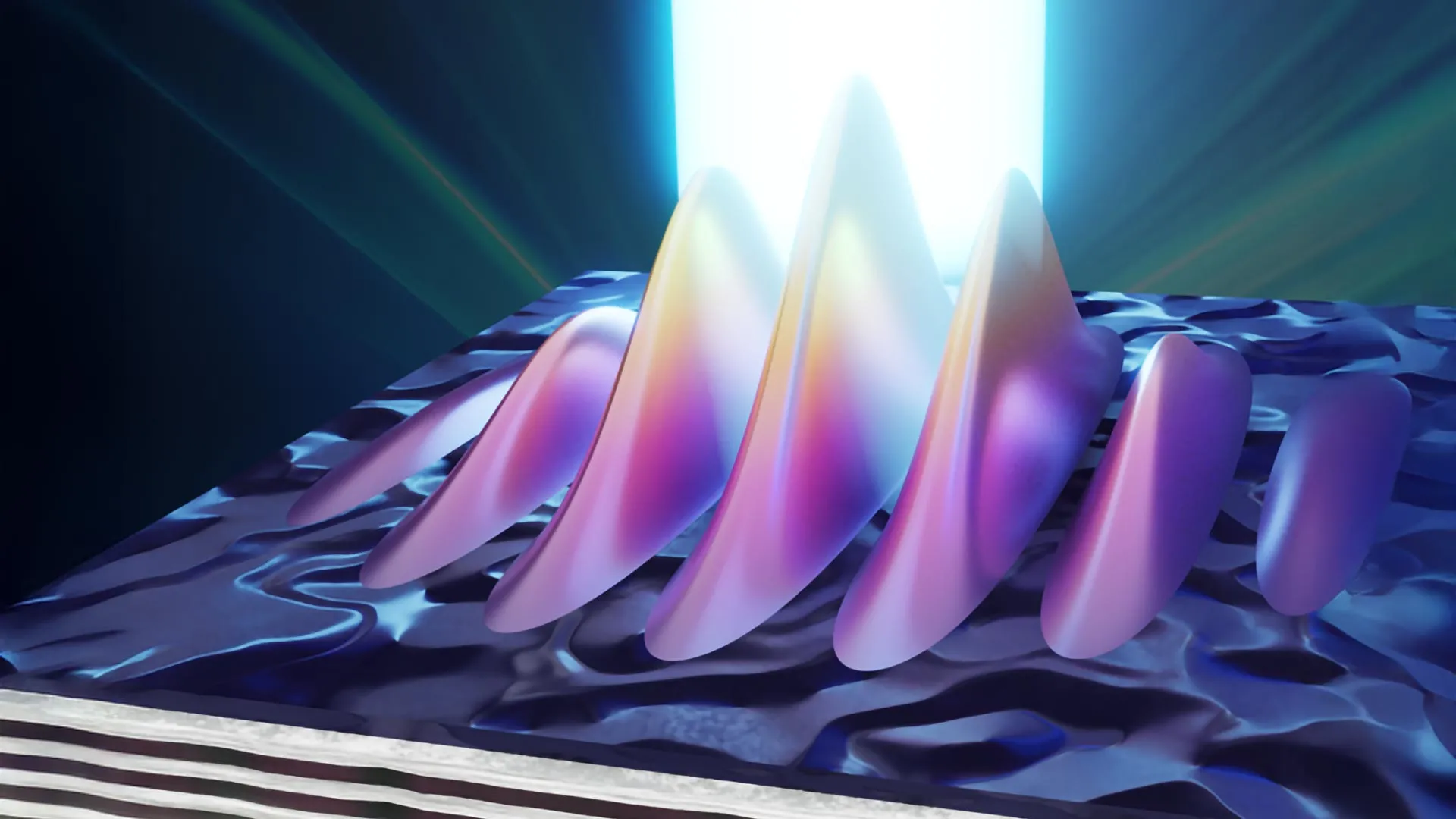
In a milestone for condensed matter physics, an international research consortium has successfully demonstrated a "supersolid"—a paradoxical state of matter that simultaneously exhibits the rigid, repeating structure of a crystal and the frictionless, superfluid flow of a liquid—at room temperature. This breakthrough, published in the journal Science Advances, marks a departure from decades of quantum research that previously required extreme, near-absolute-zero temperatures. By utilizing hybrid light-matter particles known as exciton polaritons within an innovative liquid-crystal microcavity, the team has effectively bypassed the need for expensive and cumbersome cryogenic infrastructure.
The collaboration, involving the University of Warsaw, the Military University of Technology in Poland, IBM Research Zurich, and the French National Centre for Scientific Research (CNRS), has established a new experimental paradigm. This development not only confirms a long-standing theoretical prediction under accessible conditions but also opens a viable pathway toward the integration of quantum phenomena into practical, room-temperature photonic technologies.
A Historical Quest: From Theory to Laboratory
The concept of a supersolid was first proposed in the 1960s, challenging the classical binary classification of matter. In the macroscopic world, solids are defined by their ordered, lattice-like atomic arrangements, while liquids are characterized by their ability to flow and conform to their containers. Quantum mechanics, however, introduces the phenomenon of superfluidity, where a fluid flows with zero viscosity, moving through narrow channels without resistance until a critical velocity is reached.
For decades, the existence of a state that could simultaneously maintain crystalline order and superfluidity remained purely mathematical. The scientific community reached a turning point in 2017 when researchers finally observed supersolidity in ultracold atomic Bose-Einstein condensates (BECs). These early experiments relied on cooling systems to reach temperatures within micro-kelvins of absolute zero, effectively "freezing" the atomic motion to allow collective quantum effects to dominate. While successful, the extreme cooling requirements acted as a major barrier to the scalability and practical application of these states.
The Mechanism: Exciton Polaritons and Microcavities
The recent breakthrough hinges on a fundamental shift in materials science: moving from cold atoms to quasiparticles. The TopoLight consortium focused on exciton polaritons, which are formed when photons (light) and excitons (electron-hole pairs) couple within a restricted optical environment. These quasiparticles are intrinsically hybrid; they possess the low mass of photons, which facilitates high-speed movement, and the interaction strength of matter, which allows them to condense into a single quantum state.
To sustain this state at room temperature—specifically around 60°C (140°F)—the team engineered a unique optical microcavity. This device consisted of a specially synthesized liquid crystal layer integrated with an organic semiconductor, methyl-substituted ladder-type poly(paraphenylene), or MeLPPP. By confining light between highly reflective mirrors, the researchers forced the light and matter to interact with such intensity that the resulting polaritons could form a condensate even in warm, ambient conditions.
Spontaneous Symmetry Breaking and Spatial Order
Evidence of the supersolid phase was derived from the light emitted by the sample. As the polariton system entered the supersolid state, researchers observed a series of regularly spaced bright fringes, which served as a visual manifestation of density modulation—the defining structural hallmark of a crystal.
However, the team observed a more profound phenomenon: spontaneous symmetry breaking. Upon repeated laser excitation, the fringe patterns did not appear in a fixed, permanent location. Instead, the system randomly selected one of several equivalent configurations. This behavior confirms the theoretical prediction that a supersolid, as a quantum system, would settle into an optimal energy state from a range of degenerate possibilities.
Furthermore, the team detected a "persistent spin helix," a spatial variation in the polarization of the emitted light. This dual observation—periodic intensity patterns (density order) and periodic polarization patterns (spin order)—demonstrated that the system possessed multiple layers of simultaneous, spontaneous order, a hallmark of the complex, exotic nature of the supersolid state.
Logistical Hurdles and the "Hours-to-Success" Protocol
The path to these results was fraught with practical difficulties. The organic semiconductor used in the microcavity was chemically reactive with the liquid crystal, leading to a degradation of the sample over time. This forced the researchers to adopt a high-pressure, rapid-execution experimental schedule.
"We had to plan the entire sequence of experiments in advance," explained Dr. Marcin Muszyński, the study’s lead author. "Repeating a measurement meant fabricating an entirely new sample." Because each device had a useful lifespan of only a few hours after assembly, the team had to calibrate their photonic measurements with extreme precision before the material properties began to shift. The collaborative effort saw the photonic structures fabricated at the Military University of Technology in Poland, while the delicate integration and testing were performed at the high-precision laboratories of IBM Research Zurich.
Implications for Future Quantum Technologies
The move toward room-temperature quantum matter carries significant weight for the future of information technology. Currently, the requirement for cryogenics limits quantum-based systems to highly specialized, large-scale laboratory settings. By demonstrating that supersolid states can be manipulated via electrical voltage—thanks to the tuneable nature of the liquid-crystal microcavity—the research team has provided a blueprint for the next generation of photonic computing.
- Neuromorphic Computing: By imitating the way the human brain processes information through collective, low-power interactions, these light-based systems could provide a platform for high-efficiency, non-von Neumann computing architectures.
- Optical Sensing: The supersolid’s extreme sensitivity to polarization and light intensity makes it an ideal candidate for high-precision sensors, capable of detecting subtle environmental changes that standard sensors would overlook.
- Quantum Photonic Devices: The ability to electrically tune the state of the supersolid allows for dynamic control of light, which is essential for creating logic gates and switching mechanisms in future optical data networks.
Broader Scientific Context and Institutional Significance
The University of Warsaw, which played a pivotal role in this study, has a long-standing history in the physical sciences dating back to its founding in the early 19th century. The involvement of the Faculty of Physics—consistently ranked among the top global institutions—underscores the rigor applied to this experiment. The successful collaboration between the university and industry leaders like IBM signals a shift toward the "industrialization" of quantum research, where exotic theoretical states are increasingly integrated into the development of commercially viable technologies.
The findings also provide a robust experimental playground for future physicists. Because the device is electrically tunable, researchers can now study the phase transitions of quantum matter in real-time, adjusting the voltage to observe how the supersolid forms, stabilizes, and interacts with external noise. This flexibility is a radical improvement over previous methods, where changing the experimental parameters would have required cooling the entire system down again from scratch.
Conclusion
The successful observation of a room-temperature supersolid represents a fundamental change in our ability to control matter at the quantum level. By replacing extreme cold with high-intensity light-matter coupling, the international research team has removed the "cryogenic barrier" to quantum research. While the path to practical quantum photonic processors and neuromorphic computers remains long, the realization of such an exotic state in a portable, electrically controlled format is a definitive step toward bringing quantum advantages out of the laboratory and into the mainstream technological landscape. As researchers continue to refine these liquid-crystal microcavities, the prospect of ubiquitous, high-speed, and energy-efficient optical computing becomes significantly more attainable.

