
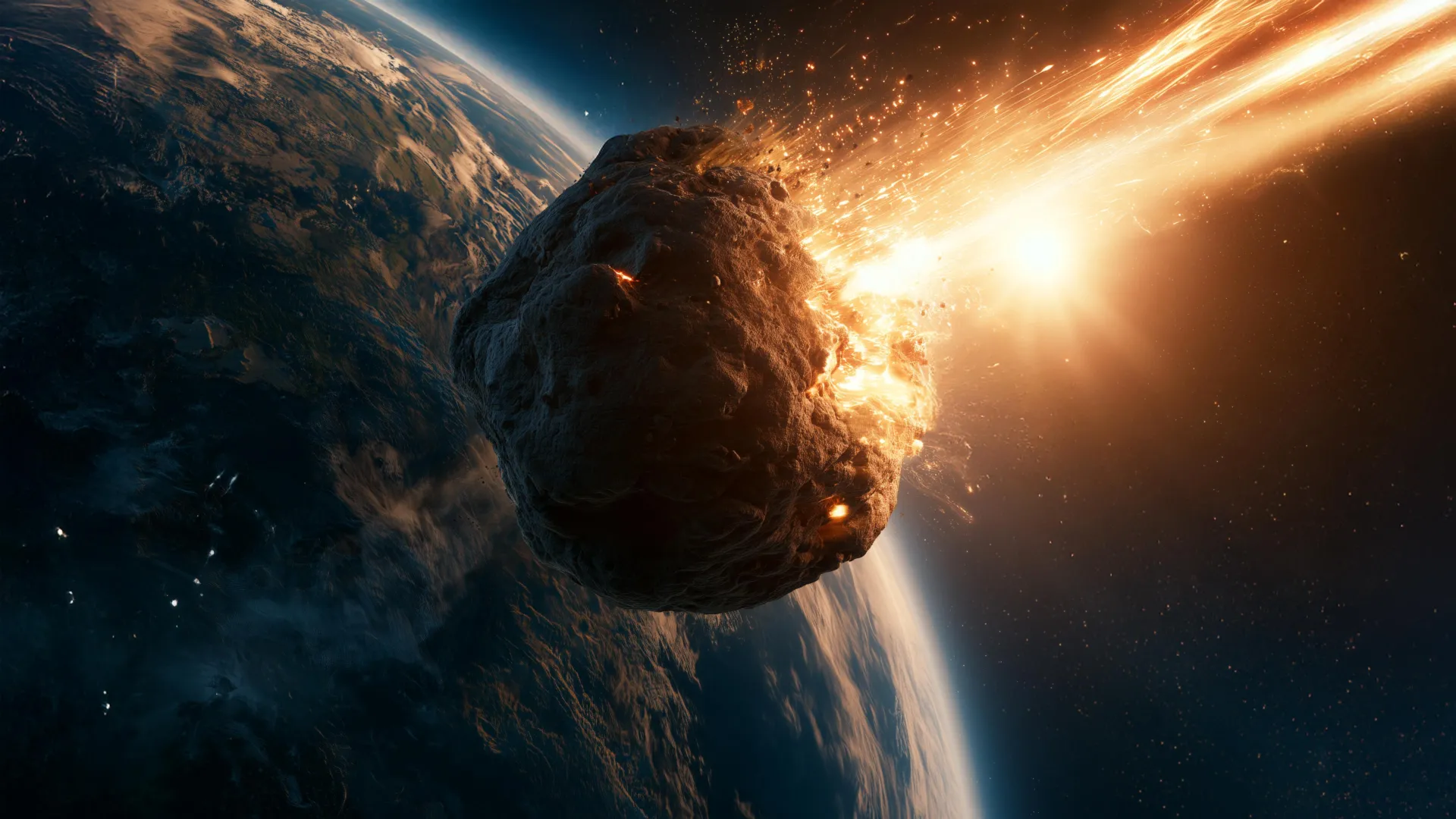
The threat of a Near-Earth Object (NEO) collision remains one of the few natural disasters capable of causing global-scale destruction, and researchers at Sandia National Laboratories have recently unlocked a critical variable in the effort to prevent such a catastrophe. A new study, published in the journal Icarus, reveals that the effectiveness of a nuclear-based asteroid deflection mission is not merely dependent on explosive yield, but is fundamentally tethered to the geometry of the target and the precise orientation of the blast. By utilizing a revolutionary computational modeling system, scientists have determined that hitting the "wrong" side of an irregular asteroid could result in a drastically less effective deflection, potentially leaving the planet vulnerable.
The Physics of the Nuclear Stand-off
The concept of nuclear planetary defense relies on the "stand-off" method. Rather than a direct impact—which risks shattering a potentially fragile asteroid into multiple, still-dangerous fragments—a nuclear device would be detonated at a calculated distance from the object. The resulting X-ray burst would vaporize the thin surface layer of the asteroid, causing the material to expand rapidly into space. According to Newton’s third law of motion, this rapid outward expansion acts like a rocket engine, providing a reactive "push" that alters the asteroid’s velocity and trajectory.
For years, researchers have utilized simplified spherical models to simulate these interactions. However, real-world asteroids—such as Bennu, Ryugu, or Dimorphos—are rarely uniform. They are often "rubble piles" characterized by ridges, massive craters, and highly irregular, lumpy surfaces. Nathan Moore, a physicist at Sandia National Laboratories and lead author of the study, noted that these irregularities create complex interactions that previous models failed to capture.
Breaking the Computational Barrier
Historically, planetary defense researchers were forced into a technical compromise: they could either model the intricate 3D shape of an asteroid or perform high-fidelity physics calculations, but rarely both. The computational load required to marry fluid dynamics with surface material vaporization was simply too high for existing systems.
The Sandia team overcame this by developing an innovative algorithm that integrates two disparate simulation frameworks: ALEGRA and SPARTA. ALEGRA is a high-energy code typically used for extreme conditions, such as magnetically imploding wires in the Z machine, while SPARTA is a Direct Simulation Monte Carlo (DSMC) code used to model rarefied gas dynamics, such as the solar wind’s effect on satellites. By bridging these two platforms, the researchers created a simulation environment that is 1,600 times faster than its predecessors. This leap in processing speed allowed the team to treat the asteroid not as a geometric abstraction, but as a complex, three-dimensional body with varying topography.
The Disparity of Aim
The findings generated by this new model are startling. In one simulation involving a non-spherical asteroid, the researchers observed that striking the object from one specific angle yielded a deflection velocity of 3.9 millimeters per second. When the simulated blast point was shifted to a different orientation—maintaining the same explosive yield—the deflection velocity dropped to a mere 0.8 millimeters per second.
This represents a nearly fivefold difference in efficacy based solely on the target point. Furthermore, the implications for the asteroid’s rotational state were even more volatile. Depending on the blast angle, the change in the asteroid’s spin rate fluctuated by a factor of 17. In a real-world scenario, an unexpected change in rotation could complicate follow-up mitigation efforts or alter the asteroid’s path in ways that are difficult to predict, underscoring why "aiming" is as important as the payload itself.
Chronology of Asteroid Mitigation Research
The path to this discovery has been marked by a series of experimental milestones in high-energy physics:
- 2010s: Sandia National Laboratories utilizes the Z machine—the world’s most powerful pulsed-power facility—to conduct fundamental experiments on the effects of intense X-ray bursts on materials, successfully demonstrating the basic mechanics of surface vaporization.
- 2022: NASA’s Double Asteroid Redirection Test (DART) mission successfully strikes the moonlet Dimorphos with a kinetic impactor, proving that humanity can alter an asteroid’s orbit. This served as a catalyst for refining nuclear stand-off models, which are viewed as a more robust solution for larger or more distant threats.
- 2023–2024: The Sandia team develops the dual-code ALEGRA-SPARTA simulation, moving beyond spherical approximations to analyze the "lumpy" nature of real-world asteroids using data from spacecraft flybys.
- 2025: Publication of the findings in Icarus confirms that directional precision is a primary factor in successful planetary defense.
Technical Challenges and Future Implications
While the new model is a significant advancement, the researchers are careful to emphasize that it is not yet a complete solution. The current simulations focus primarily on surface ablation—the vaporization of rock—and cannot yet fully predict the structural failure of an entire asteroid body. If an asteroid is a porous, gravitationally bound collection of rocks, a nuclear blast could potentially cause the entire object to fragment or reform, adding a layer of unpredictability that scientists are not yet prepared to model with high certainty.
Moreover, the operational logistics of such a mission remain daunting. To execute a precise nuclear deflection, mission planners would need high-resolution, 360-degree mapping of the asteroid well in advance of the mission. If a hazardous object were identified with only a few months or years of warning, the ability to perform such reconnaissance would be severely limited. Furthermore, delivering a nuclear device to a specific coordinate in space with the precision required to hit a specific "side" of a spinning, tumbling, and potentially high-velocity asteroid represents a monumental engineering challenge.
The Global Perspective on Planetary Defense
The research carries significant weight for international space agencies. Agencies like NASA and the European Space Agency (ESA) have long prioritized the "Planetary Defense Coordination Office" to track and mitigate NEO risks. The consensus among the scientific community is that a "toolbox" approach is required: kinetic impactors for smaller, more manageable threats, and nuclear stand-off devices as a "heavy lifter" for larger objects or those discovered too late for a kinetic mission.
The integration of the Sandia model into the global planetary defense strategy could shift the focus from "how much energy do we need?" to "where should we apply that energy?" By identifying the ideal blast location—the "sweet spot"—mission planners might be able to achieve the desired deflection with smaller explosive yields, reducing the risk of unintended consequences.
Conclusion: Toward a Proactive Defense
The Sandia research acts as a sobering reminder that space is not a vacuum of simple, predictable shapes, but a chaotic environment of irregular, often unpredictable bodies. The transition from simplistic spherical simulations to high-fidelity, shape-aware modeling marks the maturity of the field of planetary defense.
As Nathan Moore noted, "Pick the right side and you win. Guess wrong and it could be a bad day." This statement encapsulates the stakes: humanity now possesses the theoretical and computational framework to turn the tide against a potential extinction-level event. The next phase of this work will involve refining these models to account for the internal composition of asteroids, moving toward a future where we can simulate not just the nudge of an asteroid, but the precise physics of its structural integrity under the most extreme conditions imaginable. For now, the development of these tools provides a crucial, evidence-based roadmap for safeguarding Earth, ensuring that if the time comes to deflect a world-threatening projectile, we do so with the precision required to ensure our survival.

